

Knowledge to Action Model in Nursing
Introduction
Key Concept: Evidence–practice gap in healthcare
- Research shows it can take 10–17 years for evidence to become routine clinical practice, meaning patients may not benefit from the latest best practice immediately.
- The knowledge to action model in nursing helps close this gap by guiding nurses on how to translate knowledge into daily patient care.
- Many healthcare organizations struggle with implementing findings from a systematic review, which is why structured implementation strategies are essential.
The Problem: Why knowledge translation matters
- The knowledge to action model in nursing emphasizes that generating research alone does not improve outcomes unless nurses actively apply it.
- Without effective knowledge translation, valuable research remains unused, limiting improvements in safety, quality, and efficiency.
- The knowledge to action model in nursing supports evidence-based practice by helping nurses identify barriers and facilitators that affectknowledge use in real healthcare environments.
- For example, time constraints, lack of training, and limited resources often prevent nurses from applying new evidence.
Introducing the framework
- The knowledge to action model in nursing is a widely used framework designed to move research into action.
- Often called theKTA framework or knowledge-to-action framework, the KTA model explains how knowledge is created, refined, and implemented in healthcare systems.
- The model consists of two key components: knowledge creation and the action cycle, which together guide healthcare professionals to translate knowledge effectively.
- Through the knowledge to action model in nursing, clinicians develop knowledge tools, adopt best practice, and improve patient outcomes.
- This article explores how the knowledge to action model in nursing supports clinical practice, strengthens evidence-based practice, and provides structured implementation strategies for sustainable healthcare improvements.
What is the Knowledge to Action Model?
Origin and Developers
- The knowledge to action model in nursing was developed by Ian D. Graham and colleagues in 2006 to address the persistent gap between research discoveries and real-world clinical practice.
- The knowledge to action model in nursing is widely recognized as a practical framework that supports effective knowledge translation in healthcare.
- Often called the KTA framework, the KTA model, or the knowledge-to-action framework, it provides a structured process that helps nurses translate knowledge from research into everyday patient care.
- The model highlights two major components: knowledge creation and the action cycle, both of which are essential for improving knowledge use in healthcare settings.
- Within the knowledge to action model in nursing, research evidence such as a systematic review is refined into usable formats like guidelines, protocols, and knowledge tools that support best practice.
Purpose of the Model
- The primary goal of the knowledge to action model in nursing is to bridge the gap between scientific evidence and routine clinical practice.
- The knowledge to action model in nursing helps nurses and healthcare organizations implement evidence-based practice more consistently and effectively.
- Through the action cycle, the kta model identifies barriers and facilitators that influence whether research findings are successfully applied.
- The knowledge to action model in nursing also supports healthcare teams in developing targeted implementation strategies that ensure research findings are translated into real improvements in care.
- By emphasizing knowledge use, the knowledge-to-action framework ensures that healthcare professionals move beyond simply generating research to actively applying it.
How the KTA Model Differs from Other Frameworks
- The knowledge to action model in nursing stands out from other implementation models because it integrates both knowledge creation and practical application.
- Unlike models such as PARIHS or RE-AIM, the knowledge to action model in nursing provides a clear, cyclical process that guides clinicians step-by-step through knowledge translation.
- The KTA framework focuses heavily on adapting evidence to local contexts, identifying barriers and facilitators, and promoting sustainable best practice.
- As a result, the knowledge to action model in nursing remains one of the most widely used approaches for advancing evidence-based practice and improving healthcare outcomes.
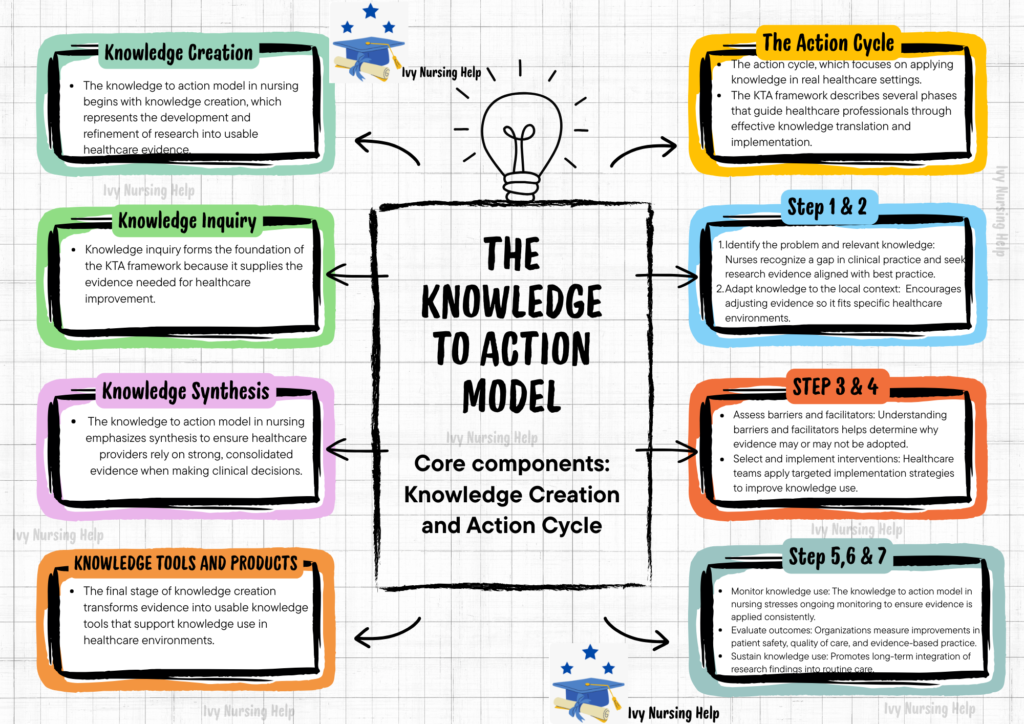
Core components: Knowledge Creation and Action Cycle
Knowledge Creation (The Knowledge Funnel)
- The knowledge to action model in nursing begins with knowledge creation, which represents the development and refinement of research into usable healthcare evidence.
- Within the knowledge-to-action framework, knowledge moves through a funnel that makes research increasingly practical for clinical practice.
Knowledge Inquiry
- This stage includes primary research studies that generate new insights related to patient care and evidence-based practice.
- In the knowledge to action model in nursing, knowledge inquiry forms the foundation of the KTA framework because it supplies the evidence needed for healthcare improvement.
Knowledge synthesis
- Evidence is combined through a systematic review or other synthesis methods.
- The knowledge to action model in nursing emphasizes synthesis to ensure healthcare providers rely on strong, consolidated evidence when making clinical decisions.
Knowledge tools and products
- The final stage of knowledge creation transforms evidence into usable knowledge tools that support knowledge use in healthcare environments.
- Examples include clinical guidelines, decision-support algorithms, care pathways, and protocols that promote best practice.
- In the KTA model, these tools help nurses translate knowledge into real-world care improvements.
The Action Cycle
- The second major component of the knowledge to action model in nursing is the action cycle, which focuses on applying knowledge in real healthcare settings.
- The KTA framework describes several phases that guide healthcare professionals through effective knowledge translation and implementation.
Key steps in the action cycle:
Identify the problem and relevant knowledge
- Nurses recognize a gap in clinical practice and seek research evidence aligned with best practice.
Adapt knowledge to the local context
- The knowledge to action model in nursing encourages adjusting evidence so it fits specific healthcare environments.
Assess barriers and facilitators
- Understanding barriers and facilitators helps determine why evidence may or may not be adopted.
Select and implement interventions
- Healthcare teams apply targeted implementation strategies to improve knowledge use.
Monitor knowledge use
- The knowledge to action model in nursing stresses ongoing monitoring to ensure evidence is applied consistently.
Evaluate outcomes
- Organizations measure improvements in patient safety, quality of care, and evidence-based practice.
Sustain knowledge use
- The knowledge to action model in nursing promotes long-term integration of research findings into routine care.
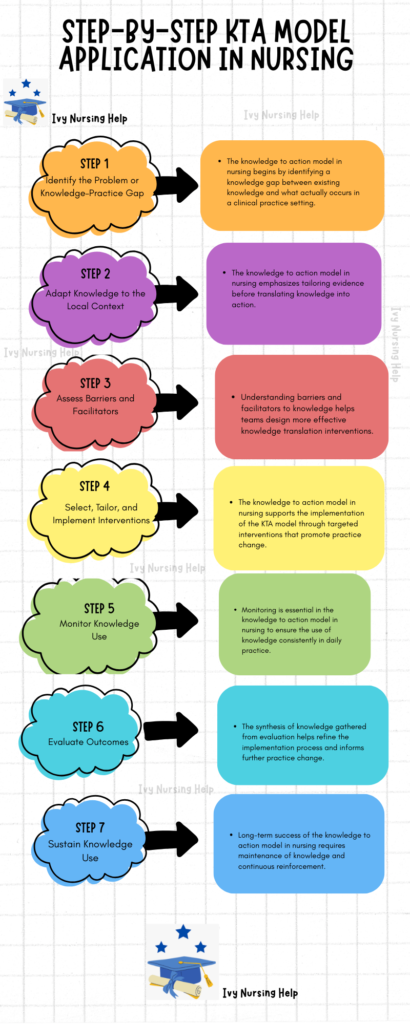
Step-by-Step Application in Nursing — Practical Guide
Step 1: Identify the Problem or Knowledge–Practice Gap
- The knowledge to action model in nursing begins by identifying a knowledge gap between existing knowledge and what actually occurs in a clinical practice setting.
- In the knowledge-to-action framework for the implementation, nurses analyze the state of evidence-based practice to determine where improvements are needed.
- Strategies to identify gaps in knowledge include:
- Reviewing nursing research and knowledge synthesis, such as a systematic review.
- Auditing patient outcomes in the practice setting.
- Examining the current nursing care processes used in units such as nursing in child and family services.
- The knowledge to action model in nursing, originally developed in 2006 by Dr. Ian Graham and colleagues, provides a structured practice guide for recognizing barriers to evidence-based practice, including lack of knowledge, limited resources, or workflow challenges.
- This stage of the knowledge to action process ensures that new knowledge from research is relevant to real patient needs and can support better nursing care provided to children, adults, and families.
Step 2: Adapt Knowledge to the Local Context
- The knowledge to action model in nursing emphasizes tailoring evidence before translating knowledge into action.
- Within the KTA framework, teams review a practice guideline or best practice guideline and adapt it to the local clinical practice setting.
- For example, evidence-based nursing in child and family care may require different protocols than adult units.
- Stakeholder engagement is essential when using the KTA framework:
- Nurse leaders
- Clinical educators
- Frontline nurses
- Interprofessional teams
- These professionals help ensure the application of knowledge fits the workflow, culture, and patient populations.
- This stage of the implementation process supports facilitators in knowledge use and strengthens the implementation of evidence-based nursing.
Step 3: Assess Barriers and Facilitators
- A core element of the knowledge to action model in nursing is identifying barriers and facilitators to knowledge use.
- The KTA action cycle recommends structured assessment methods such as:
- Staff surveys
- Focus groups
- Workflow mapping
- Observations in the clinical practice setting
- Common barriers to evidence-based practice include time constraints, staffing shortages, and limited continuing education in the health professions.
- Understanding barriers and facilitators to knowledge helps teams design more effective knowledge translation interventions.
- Many organizations combine the knowledge to action framework with the Consolidated Framework for Implementation Research to strengthen the implementation of evidence in healthcare systems.
Step 4: Select, Tailor, and Implement Interventions
- The knowledge to action model in nursing supports the implementation of the KTA model through targeted interventions that promote practice change.
- During the implementation of evidence-based practice, teams choose strategies such as:
- Educational workshops and education in the health professions
- Clinical reminders and decision-support tools
- Audit and feedback reports
- Workflow redesign
- Policy updates and leadership support
- These implementation strategies help move knowledge into practice and strengthen evidence-based nursing practice.
- The knowledge creation process ensures that knowledge tools and products—such as protocols, algorithms, and clinical pathways—are applied in practice.
- The knowledge to action model in nursing, therefore, ensures that the implementation of the KTA model transforms research into improved patient care.
Step 5: Monitor Knowledge Use
- Monitoring is essential in the knowledge to action model in nursing to ensure the use of knowledge consistently in daily practice.
- Healthcare organizations monitor knowledge use through:
- Chart audits
- Process indicators
- Compliance reviews
- Staff competency assessments
- The KTA framework included ongoing feedback loops within the creation and the action cycle to verify that interventions are functioning as intended.
- This stage of the knowledge to action process ensures that knowledge products continue supporting the practice of high-quality care.
Step 6: Evaluate Outcomes
- The evaluation of the model implementation is a critical step in the knowledge to action model in nursing.
- Outcomes measured during the implementation of KTA model may include:
- Patient outcomes and safety indicators
- Cost-effectiveness
- Staff satisfaction
- Improvements in evidence-based nursing in the care delivered to patients
- The synthesis of knowledge gathered from evaluation helps refine the implementation process and informs further practice change.
- Articles in journals such as the Journal of Continuing Education highlight how the knowledge to action framework strives to incorporate mechanisms promoting evidence-based practice.
Step 7: Sustain Knowledge Use
- Long-term success of the knowledge to action model in nursing requires maintenance of knowledge and continuous reinforcement.
- Strategies for model implementation and sustaining knowledge include:
- Appointing nurse champions
- Embedding protocols into electronic medical records
- Offering ongoing continuing education in the health professions
- Updating knowledge tools and products regularly
- Sustaining improvements ensures sustainable use of knowledge and supports consistent nursing care across healthcare systems.
- The knowledge to action model in nursing demonstrates how translating knowledge into action improves outcomes in areas such as the KTA model in a pediatric unit or broader hospital systems.
Practical Tips for Implementation
- When using the KTA framework to guide practice improvements, consider:
- Clear timelines for the implementation process
- Defined roles for nurse leaders, educators, and quality teams
- Budget and staffing resources
- Documentation templates for tracking the application of the KTA model
- The knowledge to action model in nursing remains one of the most practical approaches for implementing evidence-based practice because the framework has two major parts—knowledge creation and the action cycle.
- By applying the knowledge to action model in nursing, healthcare professionals can facilitate knowledge transfer, improve evidence-based nursing practice, and ensure that new knowledge is successfully translated into better patient outcomes.
Case Study / Examples of the Knowledge to Action Model in Nursing
Example 1: Pressure Injury Prevention Bundle Using the KTA Model
- The knowledge to action model in nursing provides a structured practice guide for improving patient safety through the implementation of evidence-based nursing. This example shows how the knowledge to action framework can move existing knowledge from nursing research into real clinical practice settings.
Step 1: Identify the knowledge gap
- A hospital unit discovered rising pressure injury rates in a pediatric and adult practice setting. Through data review and knowledge synthesis, nurses used the knowledge to action model in nursing to identify gaps in knowledge and determine the state of evidence-based practice in the US.
Step 2: Adapt knowledge to the local context
- The team reviewed a best practice guideline and a practice guideline related to pressure injury prevention. Using the knowledge to action model in nursing, they adapted interventions to improve nursing care and nursing in the care provided to patients, including nursing care provided to children in child and family care units.
Step 3: Assess barriers and facilitators
- The implementation of the KTA model revealed barriers to evidence-based practice, such as workload, lack of knowledge, and inconsistent training. However, facilitators to knowledge use included leadership support and staff interest in continuing education in the health professions.
Step 4: Implement interventions
- Using the knowledge to action model in nursing, the team introduced repositioning schedules, skin assessments, and staff education. These knowledge translation interventions helped move knowledge into practice and support the implementation of evidence-based practice.
Step 5: Monitor knowledge use
- During the KTA action cycle, leaders used audits to monitor knowledge use and ensure that the knowledge tools and products were being applied in practice.
Step 6: Evaluate outcomes
- The evaluation of the model implementation showed reduced pressure injuries and improved evidence-based nursing practice. Results were shared through the Journal of Continuing Education and hospital reports promoting practice change.
Step 7: Sustain knowledge use
- The knowledge to action model in nursing supported maintenance of knowledge through policy updates, refresher training, and integration into electronic documentation systems, ensuring the sustainable use of knowledge.
Example 2: Antimicrobial Stewardship in a Pediatric Unit
- Another example of the knowledge to action model in nursing involved improving antibiotic prescribing in a KTA model in a pediatric hospital unit.
- Through the knowledge-to-action framework for the implementation, nurses used new knowledge from nursing research and knowledge synthesis to support an evidence-based nursing approach to infection control.
- The knowledge creation process produced a knowledge product, including prescribing protocols and decision-support tools that were applied in practice.
- Using the stages of the KTA framework, staff worked on translating knowledge into action, strengthening evidence-based nursing in child and family environments and improving nursing in child and family care.
Key Lessons and Measurable Results
- The knowledge to action model in nursing demonstrates how knowledge creation and the action cycle move research into care improvements.
- Key lessons include:
- Successful implementation of evidence-based nursing requires strong leadership and structured implementation processes.
- Identifying barriers and facilitators to knowledge improves the application of the KTA model.
- Ongoing education in the health professions helps facilitate knowledge transfer and promote evidence-based practice.
- The knowledge-to-action model in nursing makes important contributions to the practice of healthcare by ensuring that knowledge is put into action to improve patient outcomes and strengthen the implementation of evidence-based practice across healthcare systems.
Common Barriers And Facilitators
Common Barriers in Implementing the Knowledge to Action Model
- The knowledge to action model in nursing highlights several barriers to evidence-based practice that can slow the implementation of evidence-based nursing in a clinical practice setting. The knowledge to action framework was designed to address these gaps between existing knowledge and knowledge into practice.
Staff resistance and culture challenges
- Nurses may be hesitant to change routines during the implementation process, especially when new protocols affect daily nursing care or nursing in child and family care environments.
Limited time and resources
- Heavy workloads reduce opportunities for continuing education in the health professions, making it harder to stay updated with nursing research and knowledge synthesis.
Lack of leadership support
- Without management involvement, the implementation of the KTA model and the implementation of evidence-based practice may stall before reaching full practice change.
Data and knowledge gaps
- Organizations may struggle to identify gaps in knowledge, evaluate the state of evidence-based practice, or translate new knowledge into knowledge tools and products.
Facilitators that Support Implementation
- The knowledge to action model in nursing identifies key facilitators to knowledge use that help teams move research into action through the knowledge-to-action framework for implementation.
Leadership buy-in and policy support
- Leaders help support the practice, allocate resources, and guide the application of the KTA model.
Clinical champions and educators
- Champions encourage implementing evidence-based practice and promote evidence-based nursing practice in the practice setting, including nursing care provided to children and broader child and family care programs.
Accessible knowledge tools
- Practical knowledge products, protocols, and best practice guidelines help translate research findings into daily care.
Education and feedback loops
- Ongoing education in the health professions and performance feedback help teams monitor knowledge use, strengthen the knowledge creation process, and maintain momentum in the KTA action cycle.
Mitigation Strategies and Quick Wins
- The knowledge to action model in nursing encourages practical solutions to overcome barriers and facilitators to knowledge within the stages of the KTA framework.
- Quick strategies include:
- Using the KTA framework to guide the implementation of evidence and ensure knowledge translation interventions are applied in practice.
- Conducting small pilot projects to test practice guidelines and refine the implementation of KTA model.
- Integrating findings from the Journal of Continuing Education and other research sources to strengthen the promotion of evidence-based practice.
- By addressing these challenges, the knowledge to action model in nursing helps healthcare teams facilitate knowledge transfer, improve evidence-based nursing in the care delivered to patients, and ensure sustainable use of knowledge across healthcare systems.
Boost Your Nursing Grades
Struggling with a nursing assignment? Ivy Nursing Help provides expert writers, evidence-based research, and APA-perfect papers to help you submit confidently and score higher.
Evaluation, sustainability, and measuring impact
Measuring Outcomes and Key Metrics
- The knowledge to action model in nursing emphasizes strong evaluation to ensure the implementation of evidence-based nursing improves patient care and organizational performance.
- Within the knowledge to action framework, healthcare teams measure progress using three primary metric categories:
- Process measures: Track whether new practices are implemented correctly, such as compliance with protocols in a model in a pediatric SANE program or other specialty units.
- Outcome measures: Evaluate patient results, safety indicators, and improvements in evidence-based practice in US healthcare systems.
- Balancing measures: Identify unintended effects such as workload changes or workflow disruptions.
- The knowledge to action model in nursing ensures that these metrics reflect the concepts of knowledge generated during the knowledge creation part of the model.
Data Collection and Monitoring
- The knowledge to action model in nursing recommends structured data collection within the knowledge to action framework.
- Common approaches include:
- Chart audits and electronic health record reports
- Staff surveys and competency assessments
- Patient outcome tracking and quality dashboards
- Data may be collected weekly, monthly, or quarterly depending on the project scope. The framework was developed to support continuous learning and improvement in thought in nursing and health systems.
Sustaining Improvements Over Time
- Long-term success of the knowledge to action model in nursing requires sustainability strategies.
- These include:
- Updating policies and protocols
- Continuous quality improvement cycles
- Maintaining knowledge repositories and training resources
- The KTA model included mechanisms to reinforce change, reflecting the influence of Michel Maffesoli’s thought on nursing and broader implementation science principles.
- By maintaining evaluation and reinforcement strategies, healthcare organizations ensure lasting improvements in patient care.
Conclusion
Why the Model Matters
- The knowledge to action model in nursing provides a structured way to improve patient outcomes through the implementation of evidence-based nursing and stronger evidence-based practice in US healthcare systems.
- The knowledge to action framework connects the knowledge creation part with real clinical change, translating the concepts of knowledge and thought to nursing and health into better care delivery.
- The framework was developed to help nurses move research into practice in settings such as child and family care, evidence-based nursing in child, and nursing in child and family environments.
Take Action in Your Practice
- The knowledge to action model in nursing encourages teams to start small by piloting a project using a practice guideline or quality initiative, even in areas like a model in a pediatric SANE program.
- Explore training resources, research articles, and implementation guides inspired by Michel Maffesoli’s thought to nursing, and begin applying the steps where the KTA model includes practical strategies for change.
FAQS: Knowledge To Action Model In Nursing
What are the two main components of the KTA model?
- The knowledge to action model in nursing is a well-known framework that helps nurses move research into clinical practice through effective knowledge translation.
- The KTA framework, originally explained by Ian Graham and colleagues, shows that the knowledge to action model in nursing has two major parts:
- Knowledge creation: The knowledge creation part includes nursing research, knowledge synthesis, and development of knowledge tools and products, such as a practice guideline or best practice guideline, to support evidence-based nursing practice.
- Action cycle: The KTA action cycle focuses on knowledge use, identifying barriers and facilitators to knowledge, selecting implementation strategies, and ensuring implementation of evidence-based practice in a clinical practice setting.
What are the four models of nursing care?
- Common models used in healthcare and child and family care settings include:
- Functional nursing
- Team nursing
- Primary nursing
- Patient-centered care
- These models guide nursing care, help support the practice, and can be improved through the knowledge to action model in nursing and the knowledge-to-action framework for the implementation.
What are the four types of knowledge in nursing?
- The concepts of knowledge commonly referenced in nursing include:
- Empirical knowledge
- Ethical knowledge
- Personal knowledge
- Aesthetic knowledge
- These knowledge types help nurses translate knowledge, strengthen evidence-based practice in US healthcare systems, and contribute to the knowledge creation process described in the knowledge to action model in nursing.
What are the five concepts of Evidence-Based Practice (EBP)?
- Core principles that support the implementation of evidence-based nursing include:
- Best research evidence (often from a systematic review)
- Clinical expertise
- Patient preferences and values
- Available resources
- Outcome evaluation and monitoring knowledge use.
- Using the knowledge to action model in nursing, these elements help move knowledge into practice, encourage practice change, and improve patient outcomes through implementing evidence-based practice.

