

PARIHS Framework: 3 Key Elements
1. Introduction
Importance of Effective Implementation in Healthcare
- In modern healthcare and public health, translating research findings into real improvements in clinical practice remains a major challenge. Many healthcare organizations produce strong research evidence, yet gaps still exist between research and practice. This gap highlights the need for strong implementation science approaches that support the implementation of evidence into practice and improve patient outcomes.
Introducing the PARIHS framework
- The PARIHS framework (Promoting Action on Research Implementation in Health Services) is a widely recognized conceptual framework used in implementation research to guide the implementation of evidence-based practice.
- Developed by Kitson, Harvey, and McCormack in 1998, the PARIHS framework explains that successful implementation of research evidence occurs through the interaction of three elements: evidence, context, and facilitation.
- The PARIHS framework for implementation emphasizes that effective research utilization requires organizations to carefully evaluate research evidence, the healthcare context, and the process of facilitation.
Role of the PARIHS Framework in Implementation Science
- The PARIHS framework is widely used in health services research and evidence-based nursing to support the implementation of evidence-based interventions and improve research use in healthcare systems.
- It serves as an implementation framework and framework for implementation that helps professionals design implementation strategies for implementing evidence-based practice and strengthening the implementation of evidence based practice across settings.
- Scholars often compare the PARIHS framework with other models, such as the consolidated framework for implementation research, demonstrating its importance in implementation research and research utilization.
Evolution and Updates of The Framework
- Over time, researchers revisited the model through PARIHS revisited, which led to the revised version of the PARIHS known as i-PARIHS.
- This version of the PARIHS framework expanded ideas about context and facilitation, strengthening the framework for implementation and supporting the successful implementation of evidence across healthcare organizations.
Purpose and Roadmap of This Article
- This article explains how to use the framework as a guide for the implementation project process.
- Readers will learn how promoting action on research implementation, implementing research, and translating research into practice can be achieved using the PARIHS framework, supported by real-world case studies and insights from institutes of health and the broader literature on promoting action on research implementation in health services.
2. Background and Origins
History and Development of the PARIHS Framework
- Early development in health services research
- The PARIHS framework (Promoting Action on Research Implementation in Health Services) emerged in the late 1990s through the work of Kitson and colleagues studying research implementation in health services.
- Their goal was to understand why research evidence often failed to translate into clinical practice despite strong health services research and evidence-based nursing knowledge.
- Foundation in implementation science
- The PARIHS framework became an important conceptual framework within implementation science and implementation research because it focused on the interaction between context and facilitation, evidence, and the environment required for successful implementation of evidence.
- Through literature on the promoting action of research use, the model highlighted how research findings could move from research and practice gaps toward research into practice.
Evolution of the framework
- Researchers later expanded the model through PARIHS revisited, which led to the revised version of the PARIHS known as i-PARIHS.
- This version of the PARIHS framework strengthened the role of facilitation, leadership, and stakeholder engagement when applying the PARIHS framework for implementation.
Rationale for Creating the Framework
Bridging the research-practice gap
- The PARIHS framework was designed to improve research utilization and support the implementation of evidence-based practice in healthcare systems.
- The framework helps organizations implement evidence effectively by analyzing research evidence, the healthcare context, and the role of facilitation.
Improving evidence-based healthcare
- By focusing on implementing evidence-based practice, the PARIHS framework provides a framework for implementation that supports the implementation of evidence based practice across clinical practice and public health settings.
- This approach strengthens the implementation of evidence-based interventions and encourages successful implementation through structured implementation strategies.
Comparison with Other Implementation Frameworks
Relationship to other implementation models
- The PARIHS framework is often compared with the consolidated framework for implementation research and other implementation frameworks used in implementation research.
Unique contribution of the PARIHS framework
- Unlike some models, the PARIHS framework focuses heavily on context and facilitation as essential drivers for implementing research and improving research use.
- Healthcare teams frequently use the framework as a guide to guide an implementation project, supported by case studies, guidance from institutes of health, and evidence from health services research aimed at achieving the successful implementation of evidence and improving the implementation of evidence into practice.
3. Core Elements of the PARIHS Framework
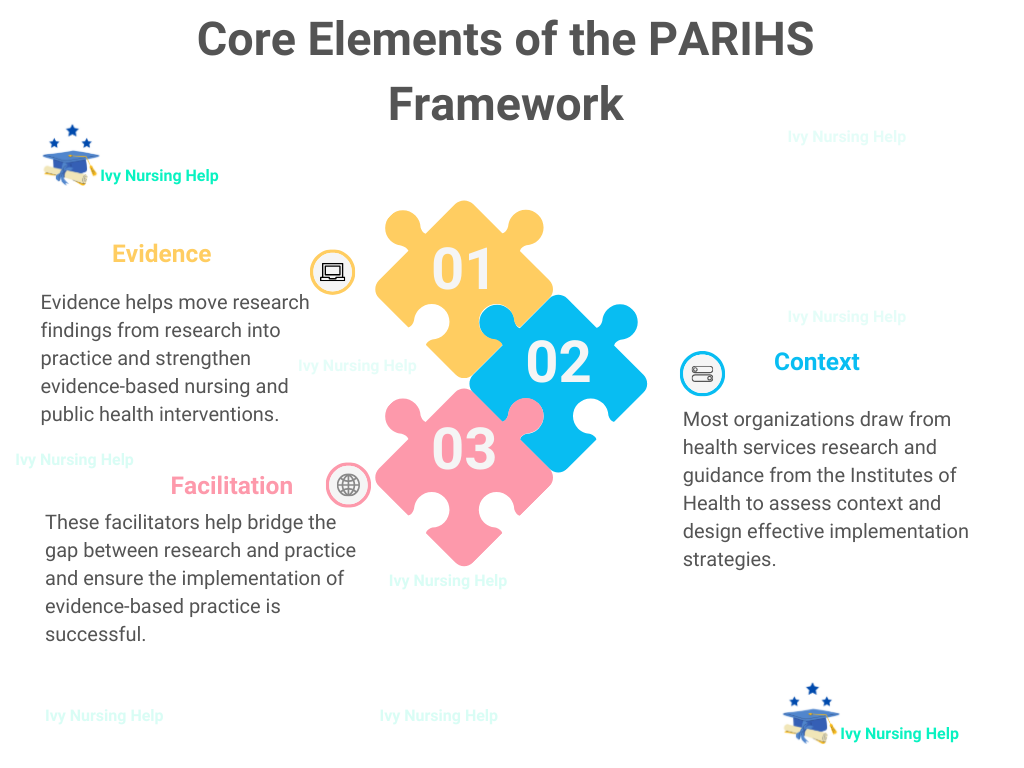
- The PARIHS framework is a widely recognized conceptual framework in implementation science designed to improve research implementation in health services and strengthen the implementation of evidence into practice. Developed by Kitson and colleagues, the PARIHS framework for implementation proposes that successful implementation depends on the interaction between three major elements: Evidence, Context, and Facilitation.
- Healthcare leaders often use the framework as a framework to guide for an implementation project aimed at improving clinical practice, public health, and evidence-based nursing. Understanding these three components helps organizations implement effective implementation strategies and improve research utilization.
Evidence
- Evidence is the first core element of the PARIHS framework and represents the knowledge used to guide implementing evidence-based practice.
Definition and types of evidence
- The PARIHS framework emphasizes that evidence is not limited to published research evidence. Instead, it includes multiple forms of knowledge used in health services research and clinical practice.
- Types of evidence considered in the PARIHS framework include:
- Research evidence: Findings from implementation research, clinical trials, and systematic reviews that inform the implementation of evidence-based practice.
- Clinical expertise: Insights from experienced practitioners that support research use and decision-making in healthcare.
- Patient preferences: Values and expectations of patients that influence implementing evidence-based practice.
- Local data: Organizational performance data and quality indicators used to improve research and practice integration.
- These evidence sources help move research findings from research into practice and strengthen evidence-based nursing and public health interventions.
How evidence quality influences implementation
- According to the PARIHS framework, the credibility, relevance, and clarity of research evidence strongly influence the successful implementation of evidence.
- Strong research findings improve acceptance among healthcare teams and increase research utilization.
- The PARIHS framework highlights that when evidence is clear and relevant to clinical practice, organizations are more likely to implement it effectively.
Assessing and synthesizing evidence
- The PARIHS framework encourages systematic evaluation of available evidence before launching an implementation project.
- Healthcare teams analyze research evidence, local outcomes data, and clinical expertise to support the implementation of evidence-based interventions.
- Through this process, organizations transform research findings into practical implementation strategies that support the implementation of evidence based practice.
Context
- Context refers to the environment in which implementing research and implementation of evidence-based practice occur. In the PARIHS framework, context significantly influences the successful implementation of healthcare interventions.
Components of Context
- The PARIHS framework identifies several key contextual elements:
- Culture: Organizational values and attitudes toward research use and innovation.
- Leadership: Leadership support that promotes implementing evidence-based practice and encourages staff engagement.
- Evaluation systems: Mechanisms that track outcomes and measure the implementation of evidence-based interventions.
- Resources: Staffing, funding, and infrastructure required to implement evidence-informed interventions.
- These factors collectively influence the implementation of evidence into practice across healthcare settings.
Contextual Assessment Tools and Strategies
- The PARIHS framework recommends assessing organizational readiness before starting an implementation project.
- Tools developed within implementation science help evaluate leadership, culture, and readiness for implementing research.
- Many organizations draw from health services research and guidance from the Institutes of Health to assess context and design effective implementation strategies.
Organizational Readiness and Climate
- Organizational readiness is essential for the successful implementation of evidence.
- In the PARIHS framework, supportive leadership and a positive climate help bridge the gap between research and practice.
- These contextual elements help transform research findings into improved clinical practice and public health outcomes.
Facilitation
- Facilitation is the third core element of the PARIHS framework and refers to the processes that enable teams to implement evidence successfully.
Definition and facilitator roles
- In the PARIHS framework, facilitation involves individuals or teams who support healthcare organizations in applying evidence.
- Facilitators may be:
- Internal facilitators: Staff members who understand local culture and guide implementing evidence-based practice.
- External facilitators: Experts who bring knowledge from implementation research and broader implementation science.
- These facilitators help bridge the gap between research and practice and ensure the implementation of evidence-based practice is successful.
Skills and attributes of facilitators
- Effective facilitation requires multiple competencies:
- Leadership and communication skills.
- Knowledge of implementation frameworks and implementation strategies.
- Ability to translate research findings into practical interventions.
- Skills in coaching, mentoring, and problem-solving during implementation projects.
- These attributes help teams move research into practice and strengthen evidence-based nursing.
Facilitation strategies
- Facilitators use multiple strategies during an implementation project, including:
- Training healthcare staff on new clinical practice guidelines.
- Supporting teams in implementing research findings.
- Monitoring progress to ensure successful implementation.
- Applying lessons learned from case studies and the literature on promoting the action of research utilization.
Interaction Among Evidence, Context, and Facilitation
- The PARIHS framework proposes that successful implementation of evidence occurs when evidence, context, and facilitation interact effectively.
- Strong research evidence provides the foundation for the implementation of evidence-based practice.
- A supportive context enables organizations to adopt new knowledge in clinical practice and public health.
- Skilled facilitation helps healthcare teams overcome barriers and apply implementation strategies.
- Together, these elements form the core of the PARIHS framework for implementation, guiding the implementation of evidence-based interventions.
- Later developments, such as PARIHS revisited and the revised version of the PARIHS, known as i-PARIHS, expanded this version of the PARIHS framework to further strengthen context and facilitation.
- Today, the PARIHS framework continues to be used alongside other models such as the consolidated framework for implementation research, providing a powerful framework for implementation that supports research implementation in health services, promotes action on research implementation, and advances the promoting action on research implementation in health services agenda across healthcare systems.
4. Operationalizing PARIHS: Practical Steps and Tools
- The PARIHS framework provides a structured framework for implementation that helps healthcare organizations translate research evidence into improved clinical practice and public health outcomes.
- Developed through health services research by Kitson and colleagues, the PARIHS framework is widely used in implementation science to support the implementation of evidence-based practice and guide research implementation in health services.
- Healthcare leaders can use the framework as a framework to guide an implementation project, ensuring successful implementation of evidence through careful assessment of evidence, context, and facilitation.
Assessing Evidence: Methods and Checklists
- In the PARIHS framework, evaluating research evidence is the first step toward the implementation of evidence-based practice.
- Healthcare teams review research findings from implementation research, systematic reviews, and health services research to determine relevance for clinical practice and evidence-based nursing.
- Evidence assessment methods include:
- Critical appraisal checklists used to evaluate the quality of research evidence.
- Evidence synthesis tools that combine multiple research findings to guide implementing evidence-based practice.
- Practice guidelines developed by institutes of health and professional organizations.
- This step strengthens research utilization and supports the implementation of evidence-based interventions that move research into practice.
Context Assessment: Surveys, Interviews, and Observational Methods
- The PARIHS framework highlights that context strongly influences successful implementation.
- Assessing context and facilitation allows organizations to identify strengths and barriers within the healthcare environment.
- Common context assessment methods include:
- Staff surveys to evaluate organizational culture and readiness for implementing research.
- Interviews and focus groups with clinicians to explore barriers to research use.
- Observational methods that examine workflows and leadership engagement in clinical practice.
- These strategies are widely used in implementation science and complement other models such as the consolidated framework for implementation research.
Designing a Facilitation Plan
- Facilitation is a central component of the PARIHS framework for implementation and helps healthcare teams implement evidence effectively.
- A facilitation plan typically includes:
- Selecting facilitators (internal leaders or external experts) with expertise in implementation strategies.
- Training teams on implementing evidence-based practice and translating research findings into daily practice.
- Developing timelines and milestones for the implementation project.
- The version of the PARIHS framework expanded through PARIHS revisited, and the revised version of the PARIHS, known as i-PARIHS, places even greater emphasis on strong facilitation.
Implementation Planning: Pilot Testing, Adaptation, Monitoring, and Evaluation
- In the PARIHS framework, implementation planning ensures the successful implementation of evidence through structured implementation strategies.
- Key steps include:
- Pilot testing interventions before full-scale implementation of evidence-based practices.
- Adapting interventions to fit local clinical practice and public health environments.
- Monitoring progress through evaluation tools and performance indicators.
- Analyzing outcomes using case studies and evidence from the literature on the promoting action of promoting action on research implementation.
- These activities support research and practice integration and strengthen the implementation of evidence into practice across healthcare systems.
- The PARIHS framework serves as a powerful implementation framework that guides action on research implementation, improves research use, and ensures the successful implementation of evidence-informed interventions in healthcare.
5. Case Studies and Examples
- The PARIHS framework has been widely applied in health research, research in nursing, and healthcare organization and implementation research to support the implementation of evidence-based interventions.
- Many studies using the PARIHS framework demonstrate how the model helps teams implement research into practice and improve outcomes in healthcare settings. Below are examples illustrating the use of the PARIHS framework in real-world implementation efforts.
Clinical Practice Change: Improving Chronic Disease Management
- One well-known example involved the collaborative chronic care model used to improve long-term disease management in a large healthcare system.
- A research team used the original PARIHS framework as an implementation in the health services framework to translate health research into better patient care.
- The framework was applied to identify barriers and facilitators to implementation, including leadership support, staff engagement, and organizational readiness.
How PARIHS elements were applied
- The three PARIHS elements—evidence, context, and implementation facilitation—were analyzed using structured tools such as an interview guide and staff assessments.
- The elements of PARIHS and sub-elements of the framework helped identify factors that influence the implementation of new clinical protocols.
- The research team worked closely with clinicians to support implementing evidence into practice through training and coaching.
Outcomes and lessons learned
- Results showed improved quality of care and stronger adoption of the use of evidence-based clinical protocols.
- The framework has been used to demonstrate that strong leadership and implementation facilitation are critical to successful change.
Policy and Quality Improvement: Veterans Health System Example
- Another example comes from the Quality Enhancement Research Initiative, a program supported by the Office of Research and Development and the National Institutes of Health.
- In this project, the PARIHS framework served as a framework for guiding the implementation of new clinical guidelines within a large healthcare system.
Application of the framework
- The research team applied the use of a theoretical framework approach and used the framework to develop strategies for improving guideline adoption.
- Through qualitative research, investigators explored barriers and facilitators to implementation and examined how the elements of the framework influenced results.
- Several studies using the PARIHS framework in this initiative showed that the use of PARIHS improved communication between leaders and frontline staff.
Lessons learned
- Researchers concluded that the PARIHS framework may help healthcare systems strengthen research and development efforts and identify effective ways to implement research in real settings.
Boost Your Nursing Grades
Struggling with a nursing assignment? Ivy Nursing Help delivers expert, plagiarism-free, APA-compliant papers fast. Get top-quality support from professional nurse writers today.
Implementation Science Example: i-PARIHS in Nursing Research
- More recent healthcare organization and implementation research has used the i-PARIHS framework to guide the implementation of nursing interventions.
- In several studies using the PARIHS framework, investigators used the i-PARIHS framework to adapt the integrated-promoting action on research implementation model for complex care environments.
Framework adaptation and insights
- The framework was used to examine the framework elements, elements of PARIHS, and contextual factors affecting implementation.
- Researchers reported in the Canadian Journal of Nursing Research that the PARIHS framework supports a systematic way to implement research while identifying what may be missing from the framework in certain contexts.
Implications for future research
- Experts note that future research should continue refining the model, drawing on guidance from the Medical Research Council and additional implementation research.
- Continued investigation will help determine how the PARIHS framework can further improve implementing evidence-based interventions and strengthen the implementation of evidence into practice across healthcare systems.
6. Strengths and Limitations
- The PARIHS framework is widely recognized in health research and research in nursing as an important implementation in health services framework that helps healthcare organizations implement research into practice.
- Developed by Kitson et al, the original PARIHS framework emphasizes the interaction between evidence, context, and implementation facilitation. However, like many models in healthcare organization and implementation research, the PARIHS framework has both strengths and limitations.
Strengths of the PARIHS Framework
- Holistic view of implementation
- The PARIHS framework offers a comprehensive way to understand the factors that influence the implementation of healthcare innovations.
- The three PARIHS elements—evidence, context, and facilitation—help organizations identify barriers and facilitators to implementation when implementing evidence-based interventions.
- Strong emphasis on facilitation
- One key strength of the PARIHS framework is its focus on implementation facilitation, which supports teams in implementing evidence into practice.
- Many studies using the PARIHS framework show that facilitation improves adoption of innovations such as the collaborative chronic care model.
- Practical utility in research and healthcare
- The use of the PARIHS framework is common in qualitative research, research and development, and programs like the Quality Enhancement Research Initiative supported by the Office of Research and Development and the National Institutes of Health.
- In many projects, the framework was applied using tools such as an interview guide to evaluate framework elements and sub-elements of the framework.
Limitations and Critiques
- Complexity of framework elements
- Critics argue that some elements of PARIHS and framework elements are difficult to measure in practice.
- The PARIHS framework may require adaptation across healthcare settings to account for diverse organizational contexts.
- Challenges in operationalization
- Some researchers note that aspects may be missing from the framework, especially when addressing large-scale policy implementation.
- Studies published in the Canadian Journal of Nursing Research highlight that research is needed to refine measurement tools for elements of the framework.
Responses and Updates in the Literature
- To address limitations, researchers used the i-PARIHS framework and developed the i-PARIHS framework to guide complex implementation projects.
- This update expanded the integrated-promoting action on the research implementation model and strengthened the framework for guiding the implementation of innovations.
- Organizations comparing models such as the replicating effective programs framework have found that the PARIHS framework still offers a valuable way to implement research, though future research guided by the Medical Research Council is recommended to improve the use of theoretical frameworks and strengthen the use of evidence-based interventions in healthcare.
7. Recent Developments and Integrations
- The PARIHS framework continues to evolve as researchers expand its application in health research, research in nursing, and broader healthcare organization and implementation research.
- Since the original PARIHS framework was proposed by Kitson et al. (Kitson, Harvey, and McCormack in 1998), new developments have strengthened how organizations implement research into practice and improve the use of evidence-based healthcare interventions.
Revised PARIHS and Integrated Frameworks (i-PARIHS)
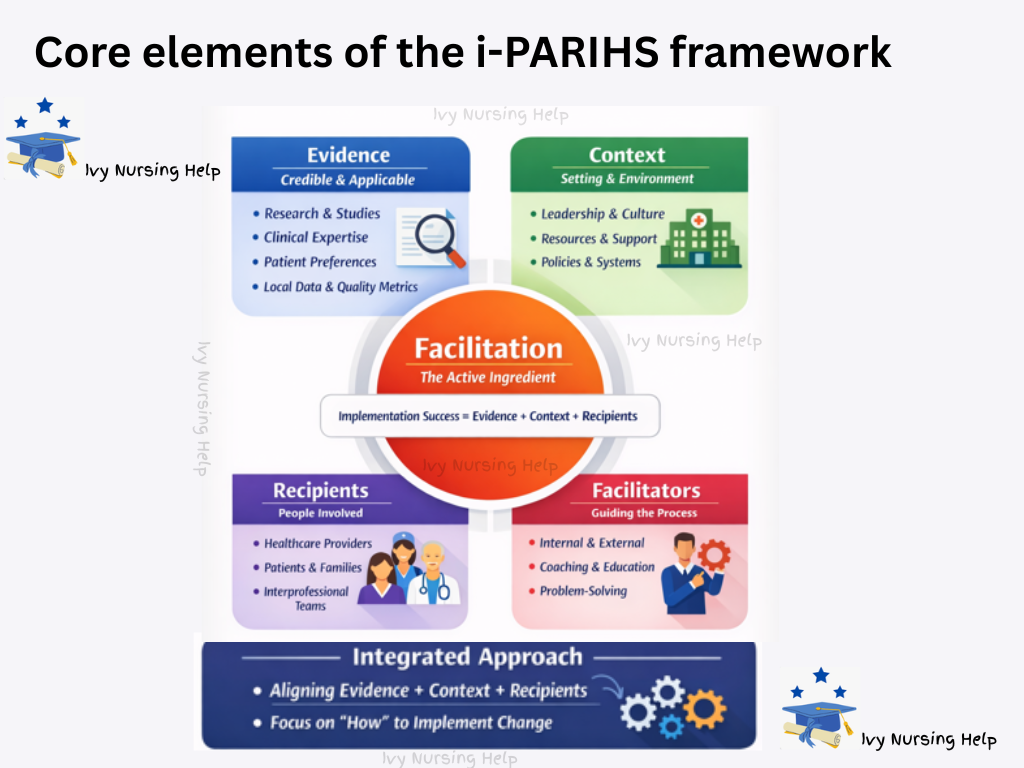
- Researchers recognized that some elements were missing from the framework, leading to the development of the integrated model known as i-PARIHS.
- The updated model builds on the original PARIHS framework and expands the three PARIHS elements by clarifying framework elements and sub-elements of the framework involved in implementation.
- Many studies using the PARIHS framework have used the i-PARIHS framework or the i-PARIHS framework to guide complex implementation facilitation strategies.
- The updated model is often described in the PARIHS literature as part of the integrated-promoting action on research implementation approach for implementing evidence-based interventions.
- In many cases, the framework was applied by a research team conducting qualitative research, using tools such as an interview guide to identify barriers and facilitators to implementation.
Integration with Implementation Science and Evaluation
- In modern implementation science, the use of the PARIHS framework is frequently combined with other models, such as the replicating effective programs framework.
- The PARIHS framework has been widely used in initiatives such as the Quality Enhancement Research Initiative, supported by the Office of Research and Development and the National Institutes of Health.
- Researchers emphasize the use of theoretical frameworks when evaluating factors that influence the implementation of innovations in healthcare.
- In many projects, the framework has been used as a framework for guiding the implementation of innovations such as the collaborative chronic care model, helping teams translate health research findings into practice.
Emerging Applications: Digital Health and Global Health
- The PARIHS framework is increasingly used to support research and development in digital health systems and global healthcare initiatives.
- Researchers note that the PARIHS framework may help identify a structured way to implement research in technology-driven healthcare environments.
- Programs guided by the Medical Research Council and published in journals such as the Canadian Journal of Nursing Research highlight the growing use of PARIHS in digital care delivery.
- Continued future research is recommended to explore how the elements of PARIHS can support implementing evidence into practice across global health systems.
8. Implications for Practitioners and Researchers
- The PARIHS framework offers important insights for healthcare practitioners and researchers seeking a structured way to implement research and improve implementing evidence-based interventions.
- The PARIHS framework and the original PARIHS framework developed by Kitson et al remain influential as an implementation in the health services framework that bridges health research and practice.
How Practitioners Can Use the PARIHS Framework
- The use of the framework allows healthcare teams to plan and evaluate the implementation facilitation process when introducing new clinical interventions.
- Practitioners applying the use of the PARIHS framework can identify factors that influence the implementation, including leadership support, organizational readiness, and resource availability.
- By assessing framework elements and elements of the framework, clinicians can address barriers and facilitators to implementation when implementing evidence-based interventions.
- In many studies using the PARIHS framework, teams implement research into practice by using tools such as an interview guide to evaluate readiness and support decision-making.
Research Opportunities for Implementation Science
- The PARIHS framework continues to offer opportunities for research and development in health research and implementation science.
- Researchers often explore the use of theoretical frameworks and compare the use of PARIHS with other models, such as the replicating effective programs framework.
- Several studies using the PARIHS framework and initiatives like the Quality Enhancement Research Initiative demonstrate how a research team can analyze the factors that influence the implementation of innovations.
Practical Tips for Training Facilitators and Assessing Context
- Effective implementation facilitation requires training healthcare leaders to interpret framework elements and adapt them to real clinical environments.
- Many projects used the i-PARIHS framework to strengthen facilitator roles and improve the collaborative chronic care model and other evidence-based initiatives.
- Practitioners applying the PARIHS framework can use structured interview guides and contextual assessments to better understand barriers and facilitators to implementation.
9. Conclusion
Recap of Key Messages
- The PARIHS framework remains a valuable implementation in the health services framework developed by Kitson et al to help healthcare teams implement research into practice.
- The original PARIHS framework highlights the three PARIHS elements—evidence, context, and implementation facilitation—which influence the factors that influence the implementation of healthcare innovations.
- Many studies using the PARIHS framework in healthcare organization and implementation research and health research demonstrate how the use of the PARIHS framework improves the use of theoretical frameworks and strengthens implementing evidence-based interventions.
Final Recommendations for Practice
- Practitioners should prioritize the use of the framework to evaluate framework elements, identify barriers and facilitators to implementation, and guide research and development initiatives.
- Implementation teams can apply tools such as an interview guide and insights from qualitative research to adapt the PARIHS framework and support programs like the collaborative chronic care model.
Call for Further Research
- Future research team efforts should continue exploring the use of PARIHS, including comparisons with models like the replicating effective programs framework.
- Initiatives such as the Quality Enhancement Research Initiative and projects that used the i-PARIHS framework show how the PARIHS framework can develop new strategies for implementing evidence-based interventions.
10. FAQs: PARIHS Framework
What are the three key elements of the PARIHS framework?
- The PARIHS framework (Promoting Action on Research Implementation in Health Services) is a conceptual framework used in implementation science and health services research to support the implementation of evidence-based practice.
- The PARIHS framework identifies three core elements that influence the successful implementation of innovations in clinical practice and public health:
- Evidence: Includes research evidence, research findings, clinical expertise, and patient preferences used to guide implementing evidence-based practice.
- Context: Organizational culture, leadership, and resources that affect research utilization and the implementation of evidence into practice.
- Facilitation: Processes that help teams implement research through training, leadership support, and implementation strategies.
- These three components—context and facilitation, evidence, and environment—form the foundation of the PARIHS framework for implementation and help translate research into practice.
What are the 4 principles of primary health care?
- The four principles guiding public health and clinical practice include:
- Equity: Ensuring fair access to healthcare services.
- Community participation: Engaging patients and communities in research and practice decisions.
- Intersectoral collaboration: Cooperation between health sectors and other industries.
- Appropriate technology: Using evidence-informed tools that support implementation of evidence-based practice and improve care delivery.
Who wrote the PARIHS framework?
- The PARIHS framework was developed by Kitson and colleagues through health services research exploring research implementation in health services.
- Their work introduced the framework for implementation known as promoting action on research implementation, which explains how research use leads to the successful implementation of evidence.
- The version of the PARIHS framework was later refined through PARIHS revisited, leading to the revised version of the PARIHS known as i-PARIHS.
What is the 5-step framework?
- Many implementation research models describe a five-step implementation framework used to use the framework to guide change:
- Identify a problem or implementation project in clinical practice.
- Review research evidence and case studies to support change.
- Develop implementation strategies for implementing research.
- Apply the PARIHS framework and other models, such as the consolidated framework for implementation research.
- Evaluate outcomes and strengthen research utilization using guidance from institutes of health and the literature on the promoting action of promoting action on research implementation.

