

Rogers Diffusion of Innovation Theory in Nursing
1. Introduction
Innovation drives modern nursing practice.
- In today’s rapidly evolving healthcare environment, innovation is essential for improving patient outcomes, safety, and efficiency.
- Rogers Diffusion of Innovation Theory in nursing explains how nurses and healthcare organizations adopt innovations within complex organizational systems.
- Understanding the diffusion process helps leaders implement evidence-based changes in diverse health services settings.
Overview of the theory and relevance to practice.
- Rogers Diffusion of Innovation Theory in nursing is rooted in the broader diffusion of innovation theory, developed by Everett Rogers.
- The theory describes how an innovation spreads through a social system over time.
- It outlines adopter categories: innovator, early adopters, early majority, late majority, and laggard.
- In Rogers Diffusion of Innovation Theory in nursing, adoption depends on perceived relative advantage, compatibility, trialability, and observability.
- Nurses function as both adopter and change agent within the implementation process.
- A systematic review of evidence-based interventions often supports decisions to adopt innovations in clinical settings.
Purpose and scope of this article.
- This article explores Rogers Diffusion of Innovation Theory in nursing and its practical applications.
- It explains key elements of the diffusion of innovation model and how nurses adopt innovations in clinical and leadership roles.
- It identifies barriers affecting the adoption process, especially within complex organizational cultures.
- It highlights strategies for nurse leaders to guide the implementation process effectively.
- By understanding Rogers Diffusion of Innovation Theory in nursing, professionals can strengthen innovation uptake, empower early adopters, and support the late majority while minimizing resistance from the laggard group.
2. Background and Historical Context
Origin of Rogers’ DOI Theory
- Rogers Diffusion of Innovation Theory in nursing originates from the broader diffusion of innovation theory developed by Everett M. Rogers.
- Rogers first introduced the diffusion of innovation framework in 1962, explaining how an innovation spreads through a social system over time.
- The theory describes the diffusion process, emphasizing communication channels, time, and social structures.
- In Rogers Diffusion of Innovation Theory in nursing, the focus is on how nurses and leaders support the adoption of evidence-based practices.
Core Concepts Applied Across Disciplines
- The theory identifies adopter categories: innovator, early adopters, early majority, late majority, and laggard.
- Adoption decisions depend on perceived relative advantage, compatibility, trialability, and observability.
- A change agent plays a key role in guiding others through the implementation process.
- Across education, business, agriculture, and health services, organizations use this model to adopt innovations systematically.
- A systematic review often supports evidence prior to large-scale organizational implementation.
Relevance to Nursing as a Discipline
- Rogers Diffusion of Innovation Theory in nursing provides a structured approach to implementing clinical guidelines.
- Nurses function as both adopter and leader in promoting innovation within complex systems.
- The framework helps healthcare teams adopt innovations efficiently while addressing resistance from the late majority and laggard groups.
- Ultimately, Rogers Diffusion of Innovation Theory in nursing strengthens patient outcomes by improving the structured adoption of best practices.
3. Core Elements of Rogers’ Diffusion of Innovation Theory
Definition of Innovation in Nursing
- In Rogers Diffusion of Innovation Theory in nursing, an innovation is any new idea, practice, technology, or guideline perceived as new by nurses or healthcare organizations.
- Examples include electronic health record upgrades, new wound care protocols, or telehealth models in health services.
- According to diffusion of innovation theory, innovation does not require invention—only newness to the adopter.
- In Rogers Diffusion of Innovation Theory in nursing, successful adoption depends on how the innovation fits within the organizational culture and clinical workflow.

Five Perceived Attributes Influencing Adoption
- Relative advantage
The degree to which the innovation is seen as better than the current practice.
Example: A new sepsis screening tool reduces mortality—clear relative advantage supports adoption.
- Compatibility
Alignment with existing values and practice standards.
Example: Evidence-based fall prevention aligning with nursing safety goals improves compatibility.
- Complexity
How difficult is the innovation to understand or use?
Simpler technologies increase adoption within nursing teams.
- Trialability
Ability to test on a small scale before the full implementation process.
Pilot programs allow units to adopt innovations gradually.
- Observability
Visibility of measurable outcomes.
When improved patient satisfaction is observable, diffusion of innovation accelerates.
In Rogers Diffusion of Innovation Theory in nursing, these attributes strongly shape the diffusion process.
Adopter Categories in Nursing Workforce
- Innovator – Risk-taking nurse leader testing new protocols first.
- Early adopters – Influential charge nurses acting as change agent champions.
- Early majority – Practical staff nurses waiting for proven results.
- Late majority – Skeptical nurses requiring peer validation.
- Laggard – Resistant individuals are slow to adopt innovations despite evidence.
Rogers Diffusion of Innovation Theory in nursing emphasizes tailoring strategies for each group to enhance adoption.
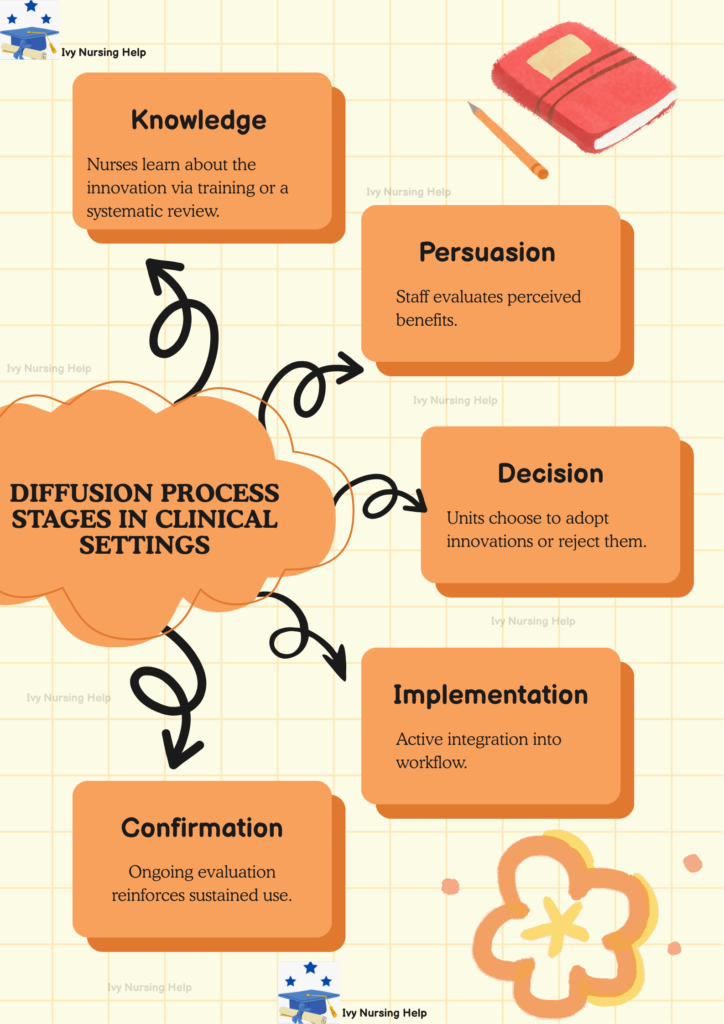
Diffusion Process Stages in Clinical Settings
- Knowledge – Nurses learn about the innovation via training or a systematic review.
- Persuasion – Staff evaluates perceived benefits.
- Decision – Units choose to adopt innovations or reject them.
- Implementation – Active integration into workflow.
- Confirmation – Ongoing evaluation reinforces sustained use.
Role of Communication, Social Systems, and Time
- Effective communication channels speed the implementation process.
- Strong organizational culture supports widespread adoption.
- Over time, Rogers Diffusion of Innovation Theory in nursing guides structured, evidence-based transformation in modern healthcare systems.
4. Applications of DOI in Nursing Practice
- Rogers Diffusion of Innovation Theory in nursing provides a practical roadmap for translating research into bedside care.
- In clinical practice, an innovation may include evidence-based interventions, new sepsis protocols, fall-prevention bundles, or technology adoption such as EHRs, telehealth, and bedside monitoring devices.
- Using principles from diffusion of innovation theory, nurse leaders evaluate the characteristics of the innovation, including relative advantage and compatibility with workflow.
- A systematic review often informs decisions before implementation across health service settings.
- During the diffusion process, an innovator or respected change agent introduces the practice to peers.
- Early adopters test the intervention, increasing credibility and supporting broader adoption among staff.
- Rogers Diffusion of Innovation Theory in nursing ensures structured integration rather than fragmented change.
Quality Improvement and Patient Safety Initiatives
- In quality improvement, Rogers Diffusion of Innovation Theory in nursing aligns closely with implementation science and innovation research.
- Safety initiatives—such as medication reconciliation improvements or infection-control bundles—rely on effective diffusion of innovation.
- Leaders analyze how the characteristics of the innovation affect uptake across units.
- Tracking adoption metrics supports organizational accountability.
- By applying Rogers Diffusion of Innovation Theory in nursing, teams enhance patient safety and reduce variability in practice.
- The framework bridges theory to action by guiding the systematic spread of best practices.
Nursing Leadership and Change Management
- Rogers Diffusion of Innovation Theory in nursing highlights the importance of influential adopters.
- A nurse leader acting as a change agent can accelerate adoption through mentorship and modeling.
- Identifying early adopters within departments supports smoother transitions.
- Leaders use communication strategies to influence each adopter group, ensuring sustained change.
- In complex organizational environments, Rogers Diffusion of Innovation Theory in nursing strengthens strategic planning for innovation rollout.
Interprofessional Collaboration and Cross-Department Diffusion
- Healthcare delivery requires teamwork across disciplines; thus, Rogers Diffusion of Innovation Theory in nursing supports interprofessional diffusion.
- Collaboration between nurses, physicians, pharmacists, and IT specialists enhances the implementation process.
- Shared governance models accelerate adoption across departments.
- Applying Rogers Diffusion of Innovation Theory in nursing ensures that innovation spreads consistently across teams, improving outcomes system-wide.
5. Case Studies and Examples
Case 1: Implementing a Sepsis Early-Detection Protocol
- In this example of Rogers Diffusion of Innovation Theory in nursing, a hospital introduced a sepsis early-detection innovation supported by a systematic review.
- During theknowledge stage of the diffusion process, nurse leaders educated staff on mortality data and the relative advantage of early screening.
- An experienced ICUinnovator and respected change agent championed the protocol.
- Early adopters piloted the tool, demonstrating observability through improved patient outcomes.
- The early majority joined once data confirmed compatibility with existing workflows.
- Barriers included organizational resistance and perceived complexity.
- Offering trialability through a limited-unit rollout improved adoption.
- The late majority and occasional laggard required peer reassurance.
- Ultimately, Rogers Diffusion of Innovation Theory in nursing guided the structured implementation process, leading to reduced sepsis mortality across health services.
Case 2: Adoption of Electronic Medication Administration Records (eMAR)
- This case highlights Rogers Diffusion of Innovation Theory in nursing during digital transformation.
- The eMAR system represented a major innovation in medication safety within health services.
- Nurse managers used clear communication channels to support the diffusion of innovation.
- An innovator nurse informatics specialist served as a change agent, training staff.
- Early adopters quickly recognized the relative advantage of barcode scanning in preventing errors.
- Concerns about workflow compatibility and usability slowed the late majority.
- Hands-on workshops enhanced trialability, easing the implementation process.
- The early majority adopted once positive results increased the observability of fewer medication errors.
- A small laggard group resisted, requiring mentorship and policy reinforcement.
- Through structured leadership,Rogers Diffusion of Innovation Theory in nursing supported sustainable adoption across the organization.
Case 3: Telehealth Integration During a Pandemic
- The rapid expansion of telehealth illustrates Rogers Diffusion of Innovation Theory in nursing in crisis response.
- Telehealth became an urgent innovation to maintain care delivery in overwhelmed health services systems.
- The accelerated diffusion process occurred due to the immediate need and visible relative advantage in reducing exposure risks.
- Strong organizational backing enabled rapid adoption.
- Early adopters and tech-savvy nurses led virtual visits as change agents.
- High observability—such as improved access and patient satisfaction—encouraged the early majority.
- Flexible platforms allowed trialability, increasing confidence.
- Even the late majority and some laggard staff adopted innovations as telehealth proved compatible with clinical standards.
- This case confirms how Rogers Diffusion of Innovation Theory in nursing and broader diffusion of innovation theory explain rapid healthcare transformation.
6. Barriers and Facilitators to Diffusion in Nursing
Common Barriers
In Rogers Diffusion of Innovation Theory in nursing, barriers often slow the diffusion process and delay adoption of a new innovation.
- Resistance to change
The late majority and laggard groups may hesitate to adopt innovations due to fear of workflow disruption.
- Perceived complexity
If an innovation appears difficult to use, nurses question its compatibility with daily practice.
- Lack of resources
Limited staffing, funding, or technology infrastructure within health services settings can hinder the implementation process.
- Organizational culture
Weak leadership or poor communication channels reduce trust in the diffusion of innovation.
- Regulatory and policy constraints
Compliance requirements may delay organizational approval, even when a systematic review supports the innovation’s relative advantage.
Key Facilitators
- Leadership support
Strong nurse leaders acting as change agents accelerate Rogers Diffusion of Innovation Theory in nursing in practice.
- Clinical champions
An innovator or respected adopter can influence early adopters and the early majority.
- Training and education
Clear communication improves understanding of the diffusion of innovation theory and reduces resistance.
- Pilot testing (trialability)
Small-scale testing increases trialability, allowing staff to evaluate effectiveness before full rollout.
- Positive outcomes and feedback loops
High observability of improved patient outcomes reinforces continued adoption.
Contextual Factors Influencing Diffusion
- Staffing levels and workload directly impact nurses’ willingness to adopt innovations.
- Workflow integration determines practical compatibility within clinical units.
- Technology infrastructure supports or limits successful implementation.
- Policy environment and reimbursement structures shape organizational readiness.
Rogers Diffusion of Innovation Theory in nursing provides a structured lens to identify barriers and leverage facilitators, ensuring sustainable innovation adoption across complex healthcare systems.
7. Strategies to Promote Adoption of Innovations in Nursing
Practical Leadership Steps
- Rogers Diffusion of Innovation Theory in nursing provides a structured roadmap for increasing adoption of any clinical innovation.
- Nurse leaders and each change agent should:
- Assess key attributes: relative advantage, compatibility, trialability, observability, and perceived complexity.
- Use findings from a systematic review to strengthen credibility within health services settings.
- Segment staff by adopter category: innovator, early adopters, early majority, late majority, and laggard.
- Tailor communication strategies based on readiness and influence within theorganizational culture.
- In Rogers Diffusion of Innovation Theory in nursing, understanding the diffusion process ensures that leaders address resistance proactively.
Pilot Projects and Demonstrations
- Pilot projects enhance trialability, allowing staff to test the innovation before the full-scale implementation process.
- Simulation labs and live demonstrations reduce perceived complexity and increase compatibility with workflow.
- Demonstrating measurable outcomes strengthens observability, accelerating the diffusion of innovation.
- Small-scale rollouts also allow teams to refine strategies before broader adoption across departments.
- These steps align directly with principles from diffusion of innovation theory and reinforce Rogers Diffusion of Innovation Theory in nursing.
Engaging Early Adopters and Opinion Leaders
- Early adopters and respected nurse leaders influence peers more effectively than formal mandates.
- Empowering an innovator or clinical champion to model the innovation supports faster adoption among the early majority.
- Peer modeling reduces skepticism from the late majority and minimizes resistance from the laggard group.
- In Rogers Diffusion of Innovation Theory in nursing, social influence is a powerful driver of change.
Education, Monitoring, and Reinforcement
- Provide structured training, competency-building sessions, and sustained coaching.
- Monitor outcomes to ensure continued observability of benefits.
- Use feedback loops to guide staff toward the confirmation stage of the diffusion process.
By applying Rogers Diffusion of Innovation Theory in nursing, leaders can systematically help teams adopt innovations and sustain meaningful clinical transformation.
8. Evaluation and Measurement of Diffusion Outcomes
Key Metrics for Measuring Diffusion Success
- Rogers Diffusion of Innovation Theory in nursing emphasizes measuring the rate of adoption and mapping it against the classic diffusion curve.
- Key metrics include:
- Adoption rate – Percentage of health care professionals who adopt an innovation within a defined timeframe.
- Time to adoption – Speed of the process by which an innovation is accepted across care settings, such as acute care hospitals or the intensive care unit.
- Fidelity – Extent and quality of implementation; whether staff uses the innovation as intended.
- Clinical outcomes – Improved quality of care and patient-centered care outcomes as a result.
- Patient satisfaction and cost-effectiveness – Critical in managed care and national health service systems.
- In Rogers Diffusion of Innovation Theory in nursing, the type of innovation and its characteristics directly influence adoption and implementation.
- According to Rogers, innovation is communicated through certain channels over time among members of a social system, shaping innovation diffusion in complex health care systems.
Designing Effective Evaluation Plans
- Rogers Diffusion of Innovation Theory in nursing supports structured development and evaluation strategies.
- Begin with a baseline assessment: measure knowledge about the innovation and knowledge of the innovation among health care practitioners.
- Use process and outcome indicators aligned with practice guideline standards and healthcare innovations.
- Apply a mixed methods study design—combining clinical research, health services research, and implementation research.
- Incorporate social network analysis to understand how the communication of innovations spreads through certain channels over time among staff.
- Because innovation theory is often regarded as a conceptual framework, theory-to-practice translation requires systematic evaluation.
Using Data for Scale-Up and Continuous Improvement
- In Rogers Diffusion of Innovation Theory in nursing, data guide whether to accept or reject the innovation.
- Senior management in care organizations should review research findings to determine readiness for broader implementation of innovations.
- Using diffusion principles, leaders analyze innovation characteristics, compatibility with care pathways, and outcomes as a result of adoption.
- Research in this area shows that the cumulative process and innovation-decision process are part of a complex process of organizational change.
- Ultimately, Rogers Diffusion of Innovation Theory in nursing helps improve care by ensuring the sustainable spread of innovations across systems where innovations must be communicated through certain channels over time among professionals.
9. Implications for Nursing Education, Policy, and Research
Nursing Education
- Rogers Diffusion of Innovation Theory in nursing should be intentionally integrated into undergraduate and graduate curricula.
- Faculty can teach core principles of diffusion theory, emphasizing that an innovation may succeed or fail depending on how it is introduced and supported.
- Courses should explain concepts identified by Rogers, including adopter categories and the innovation-decision process as a social process.
- Simulation, case studies, and continuing medical education programs can prepare nurses to lead change initiatives.
- By embedding Rogers Diffusion of Innovation Theory in nursing into coursework, students better understand how adopters of an innovation influence peers and outcomes.
- Linking theory to clinical leadership strengthens readiness for implementing the innovation in real-world settings.
Achieve Capstone Excellence
Need help crafting a high-quality nursing capstone paper? Ivy Nursing Help delivers expert research, evidence-based writing, and APA precision to ensure academic success. Let our professional nursing writers help you submit a powerful, top-grade capstone with confidence.
Policy Implications
- Rogers Diffusion of Innovation Theory in nursing highlights how policy shapes adoption behaviors.
- Incentives, accreditation standards, and reimbursement structures can encourage organizations to prioritize innovation.
- Regulations supporting the safe use of communication technologies enhance the spread of evidence-based practices.
- Policymakers should align standards with principles from Roger’s diffusion of innovations theory to accelerate equitable diffusion.
- When policy frameworks reward quality improvement, healthcare systems are more likely to sustain Rogers Diffusion of Innovation Theory in nursing in practice.
Research Implications
- Despite progress, research gaps remain in adapting Rogers Diffusion of Innovation Theory in nursing to complex adaptive healthcare systems.
- Scholars must examine equity in diffusion and barriers affecting marginalized populations.
- Long-term sustainability studies are needed to evaluate the state of the science and outcomes after implementing the innovation.
- Expanding research will strengthen the application of diffusion principles across evolving healthcare environments.
10. Conclusion
Recap of Key Insights
- Rogers Diffusion of Innovation Theory in nursing provides a powerful diffusion theory framework for understanding how change occurs in clinical environments.
- Conceptsidentified by Rogers, including adopter categories and the innovation-decision pathway, explain how a social process influences outcomes.
- In nursing practice, an innovation may succeed when adopters of an innovation understand its value and support implementing the innovation effectively.
- Rogers Diffusion of Innovation Theory in nursing bridges theory to practice, strengthening the overall state of the science in healthcare improvement.
- Nurse leaders, educators, and researchers should apply Roger’s diffusion of innovations theory to guide sustainable transformation.
- Invest in continuing medical education and leverage communication technologies to accelerate adoption.
- Commit to using diffusion principles to ensure safe, evidence-based innovation across healthcare systems.
11. FAQs: Rogers Diffusion of Innovation Theory in Nursing
What is Rogers diffusion of innovation in nursing?
- Rogers Diffusion of Innovation Theory in nursing explains how new practices, technologies, or clinical guidelines spread among nurses and healthcare teams.
- Rooted in diffusion theory and roger’s diffusion of innovations theory, it describes the social process through which innovation is communicated and adopted.
- In practice, Rogers Diffusion of Innovation Theory in nursing helps leaders understand how adopters of an innovation influence peers when implementing the innovation in clinical settings.
What are Roger’s five product factors of the innovation diffusion framework?
- The five attributes identified by Rogers include:
- Relative advantage
- Compatibility
- Complexity
- Trialability
- Observability
- These factors determine whether an innovation may be accepted or rejected.
- Within Rogers Diffusion of Innovation Theory in nursing, these attributes directly influence adoption speed.
What factors affect the diffusion of innovation?
- Organizational culture, leadership support, and access to communication technologies.
- Education levels and readiness of adopters of an innovation.
- Alignment with evidence and thestate of the science.
How can nurses bridge the innovation diffusion gap?
- Integrate Rogers Diffusion of Innovation Theory in nursing into continuing medical education.
- Promote mentorship and peer modeling.
- Strengthen evidence-based leadership to ensure effective and sustainable implementation.

