

Johns Hopkins Nursing Evidence Based Practice Model
1. Introduction
Importance of Evidence-Based Practice in Nursing
- Evidence-based practice (EBP) is the backbone of modern healthcare: It ensures that every nurse delivers care grounded in research, clinical expertise, and patient preferences rather than tradition alone.
- Improves safety and quality: The Johns Hopkins nursing evidence based practice model promotes the use of best evidence to reduce errors and enhance patient outcomes across settings.
- Supports clinical decision-making: By integrating research into daily workflows, the Johns Hopkins nursing evidence based practice model strengthens clinical decision-making for nurses and healthcare professionals.
- Promotes consistency in care: Using a structured model and guidelines, organizations can standardize treatment approaches within practice for nurses and healthcare environments.
Definition and Role of the Model
- What it is: The Johns Hopkins nursing evidence based practice model is a problem-solving framework created under Johns Hopkins Nursing to help translate research into actionable care strategies.
- Also known as: Often associated with Johns Hopkins evidence-based practice and Hopkins evidence-based practice for nurses, it provides a clear path from inquiry to implementation.
- Professional foundation: Influenced by scholarly collaboration and organizations such as Sigma Theta Tau International, the Johns Hopkins nursing evidence based practice model empowers teams to evaluate evidence systematically.
- Outcome-focused: The Johns Hopkins nursing evidence based practice model encourages measurable improvements in safety, efficiency, and patient satisfaction.
Purpose and Scope of the Article
- What readers will gain: This article explains the history, structure, and real-world application of the Johns Hopkins nursing evidence based practice model.
- Practical insights: Learn how EBP frameworks guide practice for nurses and healthcare, support leadership, and elevate care delivery.
- Balanced perspective: Explore benefits, limitations, and actionable implementation tips for the Johns Hopkins nursing evidence based practice model.
2. Background and Context
Brief History of Evidence-Based Practice in Healthcare and Nursing
- Origins of evidence-based practice: The movement toward evidence-based practice (EBP) began in medicine during the late 20th century, emphasizing the use of best evidence to guide patient care instead of relying solely on tradition.
- Adoption in nursing: As the role of the nurse evolved, leaders recognized that structured EBP improves safety, quality, and outcomes within practice for nurses and healthcare systems.
- Growing professional expectations: Today, nurses and healthcare professionals are expected to integrate research into clinical decision-making, making frameworks like the Johns Hopkins nursing evidence based practice model essential.
- Standardization of care: The Johns Hopkins nursing evidence based practice model supports consistent application of research through proven model and guidelines, strengthening accountability across healthcare settings.
Origins and Development of the Johns Hopkins Nursing EBP Model
- Institutional foundation: The Johns Hopkins nursing evidence based practice model was developed at Johns Hopkins Nursing to provide a practical, user-friendly approach to translating research into action.
- Scholarly collaboration: Built on the principles of Johns Hopkins evidence-based practice, the framework reflects academic rigor and interdisciplinary teamwork.
- Professional influence: Supported by organizations such as Sigma Theta Tau International, the Johns Hopkins nursing evidence based practice model encourages lifelong learning and inquiry.
- Purpose-driven design: Often referred to as Hopkins evidence-based practice for nurses, the model equips clinicians with tools to evaluate research efficiently and apply findings confidently.
- Outcome orientation: By reinforcing structured inquiry, the Johns Hopkins nursing evidence based practice model enhances patient outcomes while optimizing workflow.
Position Among Other EBP Frameworks
- Comparable models: While frameworks like the Iowa Model and ACE Star guide evidence-based practice, the Johns Hopkins nursing evidence based practice model stands out for its simplicity and action-focused steps.
- User-friendly structure: The Johns Hopkins nursing evidence based practice model organizes the process into clear phases that support real-time clinical decision-making.
- Broad applicability: Designed for practice for nurses and healthcare, the Johns Hopkins nursing evidence based practice model is adaptable across specialties and care environments.
- Unique rationale: By emphasizing teamwork and rapid translation of best evidence, the Johns Hopkins nursing evidence based practice model empowers nurses and healthcare professionals to lead quality improvement initiatives.
3. Core Components of the JHNEBP Model
Overview of the Three Core Elements: Practice Question (P), Evidence (E), Translation (T)
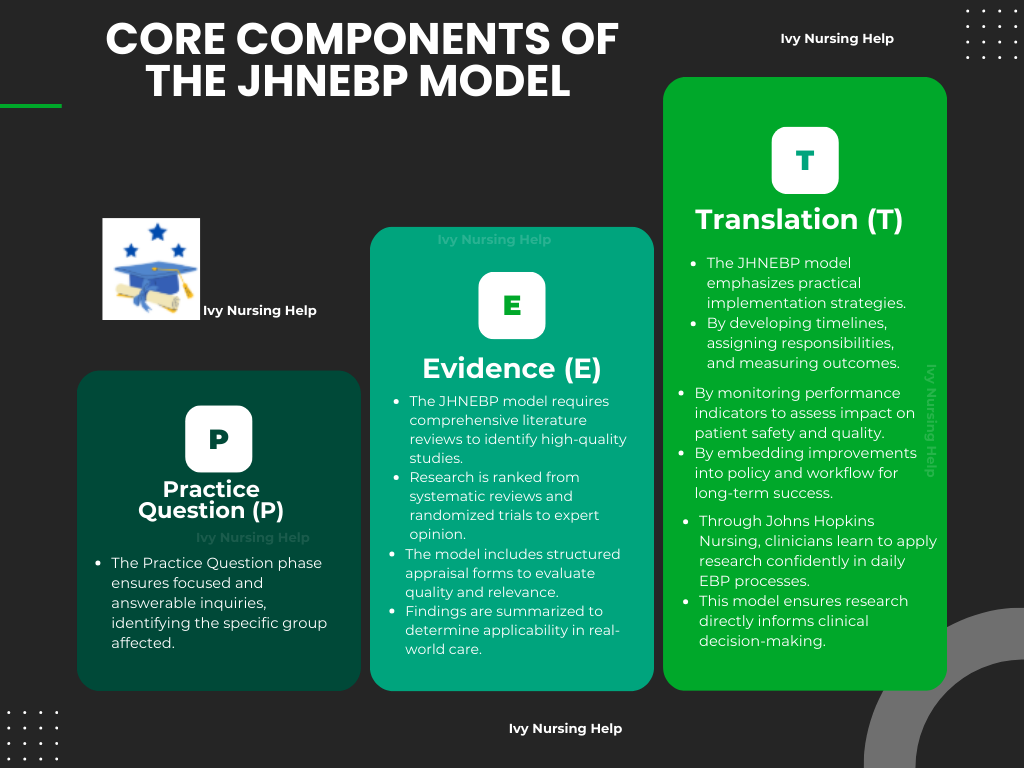
- The Johns Hopkins nursing evidence based practice model is structured around three essential phases: Practice Question (P), Evidence (E), and Translation (T).
- These steps guide evidence-based practice (EBP) from identifying a clinical issue to implementing sustainable change.
- The Johns Hopkins nursing evidence based practice model simplifies complex research processes for every nurse and healthcare team.
Practice Question (P): Asking the Right Clinical Question
- Foundation of EBP: In the Johns Hopkins nursing evidence based practice model, the Practice Question phase ensures focused and answerable inquiries.
- PET format explained:
- P (Patient/Population): Identify the specific group affected.
- E (Exposure/Intervention): Define the treatment, test, or condition.
- T (Type of Question): Clarify whether the issue involves diagnosis, intervention, or prognosis.
- Strengthens clinical decision-making: Clear questions improve outcomes within practice for nurses and healthcare settings.
- Structured support: As part of Johns Hopkins evidence-based practice, this phase ensures consistency using a standardized model and guidelines.
- The Johns Hopkins nursing evidence based practice model empowers nurses and healthcare professionals to approach care challenges systematically.
Evidence (E): Appraising and Synthesizing Research
- Search for best evidence: The Johns Hopkins nursing evidence based practice model requires comprehensive literature reviews to identify high-quality studies.
- Levels of evidence: Research is ranked from systematic reviews and randomized trials to expert opinion.
- Critical appraisal tools: The Johns Hopkins nursing evidence based practice model includes structured appraisal forms to evaluate quality and relevance.
- Synthesis methods: Findings are summarized to determine applicability in real-world care.
- Rooted in Hopkins evidence-based practice for nurses, this phase promotes rigorous evaluation standards aligned with Sigma Theta Tau International scholarly expectations.
- Through Johns Hopkins Nursing, clinicians learn to apply research confidently in daily EBP processes.
Translation (T): Implementing and Sustaining Change
- From evidence to action: The Johns Hopkins nursing evidence based practice model emphasizes practical implementation strategies.
- Actionable implementation steps: Develop timelines, assign responsibilities, and measure outcomes.
- Practice change evaluation: Monitor performance indicators to assess impact on patient safety and quality.
- Sustainability planning: Embed improvements into policy and workflow for long-term success.
- The Johns Hopkins nursing evidence based practice model ensures research directly informs clinical decision-making.
Visual Tools and Resources
- PET format worksheets: Guide structured question development.
- Evidence appraisal tools: Standardize evaluation of research strength.
- Implementation checklists: Support sustainable integration of best evidence.
- These resources make the Johns Hopkins nursing evidence based practice model practical, accessible, and adaptable across diverse healthcare environments.
4. Step-by-Step Process Using the JHNEBP Model
Step 1: Practice Question—Identifying Clinical Problems and Formulating a PET Question
- The Johns Hopkins nursing evidence based practice model begins with recognizing a gap in care that impacts patient safety, quality, or workflow.
- Within evidence-based practice, every nurse is encouraged to observe trends, incident reports, or inefficiencies requiring improvement.
- Using the PET format:
- Patient/Population: Define the affected group.
- Exposure/Intervention: Identify the treatment or process needing evaluation.
- Type of Question: Determine whether it relates to diagnosis, intervention, or prognosis.
- Supported by Johns Hopkins evidence-based practice, this structured approach strengthens clinical decision-making and aligns with the standardized model and guidelines used in practice for nurses and healthcare.
Step 2: Evidence Search—Databases, Strategies, and Criteria
- After defining the question, the Johns Hopkins nursing evidence based practice model directs nurses and healthcare professionals to locate the best evidence efficiently.
- Common databases include CINAHL, PubMed, and Cochrane, all foundational to strong EBP research.
- Effective search strategies involve Boolean operators, keyword mapping, and filters for peer-reviewed studies.
- Establish inclusion and exclusion criteria to prioritize relevance, timeliness, and methodological rigor.
- Rooted in Hopkins evidence-based practice for nurses, this phase ensures consistency across teams at Johns Hopkins Nursing and beyond.
- The Johns Hopkins nursing evidence based practice model promotes transparency so clinical teams can replicate searches confidently.
Step 3: Appraisal and Synthesis—Evaluating Evidence Strength
- The Johns Hopkins nursing evidence based practice model emphasizes critical appraisal to determine whether research is trustworthy and applicable.
- Evidence is categorized by level, with systematic reviews and randomized trials considered strongest for guiding clinical decision-making.
- Quality ratings evaluate sample size, bias risk, and methodological consistency.
- Teams summarize findings to identify patterns, contradictions, and applicability within practice for nurses and healthcare settings.
- Following Johns Hopkins evidence-based practice, clinicians synthesize results into actionable conclusions rather than relying on single studies.
- This process reflects scholarly standards supported by Sigma Theta Tau International, reinforcing professional accountability.
- By applying the Johns Hopkins nursing evidence based practice model, a nurse transforms research into meaningful insights that elevate evidence-based practice outcomes.
Step 4: Translation into Practice—Designing Interventions and Engaging Stakeholders
- The Johns Hopkins nursing evidence based practice model ensures that research moves from theory into real-world care.
- Interventions are designed based on the best evidence, organizational readiness, and patient needs.
- Pilot testing helps teams refine workflows before large-scale implementation.
- Stakeholder engagement—including leadership, frontline staff, and interdisciplinary partners—supports adoption.
- Guided by the model and guidelines, this stage exemplifies how Hopkins evidence-based practice for nurses advances collaboration among nurses and healthcare professionals.
- Ultimately, the Johns Hopkins nursing evidence based practice model enhances safety while improving operational efficiency.
Step 5: Evaluation and Dissemination—Measuring Outcomes and Sustaining Change
- The final phase of the Johns Hopkins nursing evidence based practice model focuses on outcome measurement, such as patient satisfaction, error reduction, and cost efficiency.
- Teams analyze metrics to confirm improvements in EBP initiatives.
- Sharing results through presentations or publications strengthens organizational learning and aligns with Johns Hopkins Nursing excellence.
- Sustaining change requires policy integration and continuous monitoring, ensuring the Johns Hopkins nursing evidence based practice model remains central to long-term clinical decision-making.
5. Practical Example / Case Study
Clinical Scenario Suitable for JHNEBP Application
- A hospital unit identifies rising catheter-associated urinary tract infections affecting patient care and quality of care. Using the Johns Hopkins nursing evidence based practice model, the team launches an EBP project grounded in a problem-solving approach to clinical decision-making.
- The JHNEBP model, recognized by the Institute for Johns Hopkins Nursing, is a powerful problem-solving approach accompanied by user-friendly tools to support individual or group use in nursing and healthcare environments.
PET Question Formulation
- Guided by the Johns Hopkins nursing evidence based practice model, the team begins question development through the PET process—a structured practice question method within the EBP process.
- EBP Question: In hospitalized adults with indwelling catheters (P), does a nurse-driven removal protocol (E) compared to standard care reduce infection rates (T)?
- This problem-solving approach reflects the needs of the practicing nurse and uses user-friendly tools to guide individual clinicians.
- The Hopkins nursing evidence-based practice framework ensures the practice model supports accurate patient-care decisions and effective clinical practice.
Evidence Search and Appraisal Process with Key Findings
- Following the Johns Hopkins nursing evidence based practice model, the team develops a focused search strategy using citation databases and strong citation management practices.
- Sources include systematic review, meta-analysis, RCTs, and quasi-experimental studies containing pre-appraised evidence aligned with best practices.
- Each article undergoes structured appraisal using levels of evidence and methodological quality checks recommended in the Johns Hopkins evidence-based practice model (5th ed).
- An evidence summary reveals that nurse-led catheter protocols significantly improve patient outcomes.
- Supported by EBP experts, the Johns Hopkins EBP model promotes integrating EBP into nursing practice, ensuring research findings translate into best-evidence recommendations for safer patient care.
Implementation Steps, Outcome Measures, and Results
- Using the Johns Hopkins nursing evidence based practice model, leaders initiate evidence-based practice implementation through strong project management and organizational support.
- Interventions include staff education led by Hopkins nurses, standardized removal checklists, and audit tools—tools to guide the practicing nurse during workflow changes.
- The Johns Hopkins nursing evidence-based practice framework—often called the Hopkins model or Johns Hopkins EBP—is a model is a powerful problem-solving structure for implementing evidence-based practice.
- Outcome measures track infection rates, adherence, and cost savings. Hypothetical results show fewer infections and better patient outcomes, reinforcing the Johns Hopkins nursing evidence based practice model as a nurses and healthcare professionals model designed for continuous improvement in clinical practice.
6. Benefits and Outcomes of Using the Model
Improved Patient Outcomes, Quality of Care, and Safety
- The Johns Hopkins nursing evidence based practice model is widely recognized as an effective evidence-based practice model that enhances patient outcomes, strengthens quality of care, and promotes safety across nursing and healthcare settings.
- Using the Johns Hopkins EBP model (5th ed), teams rely on pre-appraised evidence, systematic review, RCTs, quasi-experimental, and meta-analysis research to guide patient-care decisions.
- Through structured appraisal and levels of evidence, the JHNEBP model supports best-evidence recommendations grounded in strong research findings.
- This practice model, supported by the Institute for Johns Hopkins Nursing, ensures consistent clinical practice improvements during every EBP project.
Supports Clinical Decision-Making and Standardization of Best Practices
- The Johns Hopkins nursing evidence based practice model uses a problem-solving approach to clinical decision-making that helps the practicing nurse and uses structured question development through the PET process—a process called PET.
- With user-friendly tools and tools to guide individual or group use, the Hopkins model promotes integrating EBP into daily workflow.
- Supported by EBP experts, the Johns Hopkins evidence-based practice model strengthens best practices through a defined search strategy, evidence summary, and reliable citation management.
Facilitates Interdisciplinary Collaboration and Staff Engagement
- The Johns Hopkins nursing evidence based practice model—also called Johns Hopkins nursing evidence-based practice or Hopkins nursing evidence-based practice—serves as a nurses and healthcare professionals model that encourages teamwork.
- Its organizational, project management, and problem-solving approach—accompanied by user-friendly tools to guide individual clinicians—supports individual or group use.
- By focusing on the needs of the practicing nurse, the Johns Hopkins EBP framework empowers Hopkins nurses to excel in implementing evidence-based practice.
7. Challenges, Limitations, and Critiques
Common Barriers: Time, Resources, Skills, and Organizational Resistance
- Despite the strengths of the Johns Hopkins nursing evidence based practice model, organizations often face barriers when implementing evidence-based practice in fast-paced clinical practice environments.
- Limited time and staffing can delay an EBP project, even though the JHNEBP model is a problem-solving approach supported by user-friendly tools and tools to guide clinicians.
- Some Hopkins nurses and other teams lack training in search strategy, citation management, appraisal, and interpreting levels of evidence from systematic review, RCTs, quasi-experimental, and meta-analysis studies.
- Organizational resistance may hinder integrating EBP into nursing practice, impacting patient outcomes and quality of care despite the Johns Hopkins EBP model (5th ed) being recognized as a nurses and healthcare professionals’ model.
Limitations of the Model: Evidence Gaps and System Complexity
- Although the Johns Hopkins nursing evidence based practice model is a respected evidence-based practice model, gaps in pre-appraised evidence and inconsistent research findings may affect patient-care decisions.
- Large healthcare systems can struggle with project management and organizational alignment when applying the Johns Hopkins evidence-based practice model.
- Additionally, some critics note that the practice model may require adaptation for diverse populations, limiting generalizability despite strong best-evidence recommendations and a powerful problem-solving approach to clinical decision-making outlined by the Institute for Johns Hopkins Nursing.
Responses and Mitigations: Training, Leadership, and Adaptation
- Healthcare leaders can strengthen adoption of the Johns Hopkins nursing evidence based practice model by engaging EBP experts, supporting question development through the PET process—a process called PET—and reinforcing best practices.
- The Hopkins nursing evidence-based practice framework—accompanied by user-friendly tools to guide individual or group use—helps meet the needs of the practicing nurse and uses structured evidence summary methods to improve patient care across nursing and healthcare settings.
8. Strategies for Successful Implementation
Building EBP Capacity: Education, Mentorship, and Champions
- Successful adoption of the Johns Hopkins nursing evidence based practice model begins with structured education on the ebp process, including question development using the PET process—a process called PET.
- Training programs aligned with the Johns Hopkins EBP model (5th ed) and guidance from the Institute for Johns Hopkins Nursing prepare Hopkins nurses to lead each EBP project.
- Mentorship from EBP experts strengthens appraisal, interpretation of levels of evidence, and use of pre-appraised evidence such as systematic reviews, RCTs, quasi-experimental, and meta-analysis studies.
- The JHNEBP Model, an evidence-based practice model and nurses and healthcare professionals’ model, is accompanied by user-friendly tools and tools to guide individual or group use, meeting the needs of the practicing nurse and providing structured support.
Organizational Strategies: Leadership, Time, and Workflow Integration
- Leadership commitment is essential for implementing the Johns Hopkins nursing evidence based practice model within nursing and healthcare systems.
- Providing protected time for search strategy, citation management, and evidence summary development strengthens integrating EBP into daily clinical practice.
- Clear project management plans and alignment with organizational priorities ensure that the Hopkins model and Johns Hopkins evidence-based practice model are embedded into workflows.
- The practice model supports a problem-solving approach to clinical decision-making, enabling consistent patient-care decisions and sustainable evidence-based practice implementation.
Monitoring and Continuous Quality Improvement
- Ongoing evaluation is central to the Johns Hopkins nursing evidence based practice model, ensuring measurable improvements in quality of care and patient outcomes.
- Teams regularly appraise results, review updated research findings, and refine best-evidence recommendations.
- By reinforcing best practices, the Johns Hopkins nursing evidence-based practice framework remains a powerful problem-solving approach to clinical improvement across diverse care settings.
Unlock Excellence in Your Evidence-Based Practice Paper
Struggling with your nursing evidence-based practice paper? IvyNursingHelp.com delivers expertly researched, APA-formatted, and plagiarism-free papers tailored to your rubric. Boost your grades with evidence-driven analysis and clear clinical application. Order today and submit with total confidence!
9. Implications for Nursing Education, Leadership, and Policy
Integrating JHNEBP into Curricula and Continuing Education
- The Johns Hopkins nursing evidence based practice model should be embedded into academic curricula to prepare students for modern clinical practice.
- Programs aligned with the Johns Hopkins EBP model (5th ed) teach the EBP process, including question development through the PET process—a process called PET.
- Using user-friendly tools and pre-appraised evidence, the JHNEBP model supports integrating EBP and strengthening patient-care decisions across nursing and healthcare environments.
Role of Nurse Leaders in Fostering a Culture of EBP
- Nurse leaders play a critical role in advancing the Johns Hopkins nursing evidence based practice model by promoting a problem-solving approach to clinical decision-making.
- By mentoring teams, supporting search strategy, and encouraging rigorous appraisal of levels of evidence from systematic review, RCTs, and meta-analysis, leaders empower Hopkins nurses.
- This practice model, recognized by the Institute for Johns Hopkins Nursing, guides EBP projects and improves patient outcomes.
Policy Implications: Standard-Setting, Accreditation, and Funding
- Policymakers should support the Johns Hopkins nursing evidence based practice model as a nurses and healthcare professionals model for evidence-based practice implementation.
- Funding, accreditation standards, and organizational investment ensure sustainable best practices, stronger quality of care, and effective project management.
10. Conclusion
Recap of the Model’s Purpose, Strengths, and Practical Value
- The Johns Hopkins nursing evidence based practice model remains a leading framework for advancing evidence-based practice across practice for nurses and healthcare.
- Built on model and guidelines from Johns Hopkins Nursing, the JHEBP Model—now refined in the fifth edition—equips every nurse with the PET process to identify problems and apply best evidence confidently.
- Supported by Sigma Theta Tau International, the Johns Hopkins nursing evidence based practice model strengthens clinical decision-making and empowers nurses and healthcare professionals to deliver consistent, high-quality care using Johns Hopkins evidence-based practice principles.
Steps to Adopt the Model
- Healthcare teams should adopt the Johns Hopkins nursing evidence based practice model by integrating EBP training, encouraging collaboration, and embedding Hopkins evidence-based practice for nurses into daily workflows.
- Start small—form a practice team, apply the PET framework, and evaluate outcomes to build a sustainable culture of evidence-based practice.
- As healthcare evolves, the Johns Hopkins nursing evidence based practice model will continue guiding innovation, ensuring the future of EBP is driven by research, expertise, and patient-centered excellence.
11. FAQs: Johns Hopkins Nursing Evidence Based Practice Model
What is the John Hopkins nursing evidence-based practice model?
- Definition: The Johns Hopkins nursing evidence based practice model is a structured framework guiding the nurse in applying evidence-based practice (EBP) to improve patient outcomes.
- Core structure: Also called the JHEBP model, it uses the PET process—Practice question, Evidence, and Translation—to integrate research into clinical decisions.
- Edition reference: The fifth edition strengthens guidance for practice for nurses and healthcare teams, ensuring consistent, high-quality care.
What is the Hopkins model?
- Overview: The Johns Hopkins nursing evidence based practice model, often shortened to Johns Hopkins evidence-based practice, emphasizes collaboration and critical appraisal.
- Clinical relevance: Hopkins evidence-based practice for nurses supports real-world decision-making, enabling every nurse to translate research into safe interventions.
- Outcome focus: Promotes measurable improvements in safety, quality, and patient satisfaction.
What are the 5 phases of the Stetler model?
- Preparation: Identify purpose and readiness for EBP adoption.
- Validation: Critically evaluate research evidence.
- Comparative evaluation/decision making: Determine applicability to practice.
- Translation/application: Implement findings within healthcare settings.
- Evaluation: Assess outcomes and refine processes—similar to the translation emphasis in the Johns Hopkins nursing evidence based practice model.
How to cite the Johns Hopkins evidence-based practice model?
- APA guidance: Cite the fifth edition authors (Dang & Dearholt) when referencing Johns Hopkins evidence-based practice.
- Example: Dang, D., & Dearholt, S. (Year). Johns Hopkins Nursing Evidence-Based Practice Model.
- Best practice: Always credit the source when discussing the Johns Hopkins nursing evidence based practice model to maintain scholarly integrity.

