

Imogene King Theory of Goal Attainment
1. Introduction
Importance of nursing theories in healthcare
- Nursing theories guide the nursing profession by strengthening nursing knowledge, improving clinical judgment, and enhancing patient outcomes.
- Well-defined nursing theories support evidence-based nursing practice and promote consistency in nursing care across diverse settings.
- The Imogene King Theory of Goal Attainment is especially valued for its clear focus on relationships, communication, and outcomes in patient care.
Overview of the Imogene King Theory of Goal Attainment
- The Imogene King Theory of Goal Attainment, also known as the theory of goal attainment or goal attainment theory, was developed by Imogene King, a respected nursing theorist.
- This conceptual nursing theory explains how a nurse and patient interact within an interacting system to establish mutual goals.
- The Imogene King Theory of Goal Attainment emphasizes collaboration, decision-making, and accountability in professional nursing care.
- It integrates the personal system, social system, and interpersonal relationships to support effective outcomes.
Relevance to modern nursing
- The Imogene King Theory of Goal Attainment remains highly relevant in today’s patient-centered healthcare environment.
- It supports structured goal setting that aligns with the nursing process, improving clarity and continuity of care.
- The theory is widely taught in nursing school curricula as a foundational conceptual framework for clinical reasoning.
- By focusing on growth and development, the Imogene King Theory of Goal Attainment helps nurses adapt care plans to changing patient needs.
Purpose and scope of this article
- This article explores the Imogene King Theory of Goal Attainment with a practical focus on implementation in daily nursing practice.
- It examines how Imogene King applied conceptual framework thinking to advance the nursing profession.
- Key sections will address theory components, evidence-based applications, leadership implications, and strategies for optimizing patient care using the Imogene King Theory of Goal Attainment.
2. Background and Historical Context
Biography of Imogene King
Early life and education
- Imogene King was born in 1923 in West Point, Iowa, a small Midwestern community that shaped her early values of discipline and service.
- Growing up during the Great Depression influenced her desire to contribute meaningfully to society and ultimately pursue a career in nursing.
- She began her formal nursing education at St. John’s Hospital School of Nursing in St. Louis, Missouri, where she earned a diploma in nursing.
- This foundational training sparked her lifelong commitment to advancing the nursing profession through education and theory.
- King later earned a Bachelor of Science in Nursing from St. Louis University, strengthening her academic and clinical expertise.
- She continued her studies at Columbia University Teachers College, where she completed both a master’s and doctoral degree in education.
- King served as an instructor in medical-surgical nursing, helping bridge theory and clinical practice.
- She held leadership roles within the division of nursing and later at a university school of nursing, influencing curriculum development.
- She also contributed significantly at the University of South Florida College of Nursing in Tampa, Florida, where her work further supported advancing the nursing profession through leadership and scholarship.
Professional career and contributions
- As Imogene King, she combined clinical experience, education, and research to advance the nursing profession.
- Her career focused on improving patient care through structured communication between the nurse and patient.
- The Imogene King Theory of Goal Attainment emerged as her most influential contribution, offering a clear conceptual framework for care delivery.
Historical Context of the Theory
- Healthcare environment at the time
- The Imogene King Theory of Goal Attainment was developed during a period when nursing sought greater autonomy and scientific grounding.
- Many nursing theories at the time emphasized task completion rather than collaborative relationships.
- King identified the need for a goal attainment theory that reflected real-world clinical interactions.
Purpose for development
- The theory of goal attainment was designed to explain how effective nursing care occurs through purposeful interaction.
- The Imogene King Theory of Goal Attainmentaddressed gaps in the nursing process by highlighting communication and mutual decision-making.
- It provided a structured way to link goal setting with measurable outcomes in patient care.
Foundational Assumptions and Influences
Core assumptions
- The Imogene King Theory of Goal Attainment assumes that humans are open systems capable of growth and development.
- It emphasizes that health goals are best achieved when the nurse and patient actively participate together.
- The theory is grounded in understanding the personal system, social system, and interacting system.
Conceptual influences
- The Imogene King Theory of Goal Attainment is built on a conceptual view of human behavior and relationships.
- It integrates systems thinking to support clinical reasoning in nursing practice.
- By strengthening nursing knowledge, the Imogene King Theory of Goal Attainment continues to guide evidence-based nursing care and professional accountability.
3. Core Concepts of the Imogene King Theory of Goal Attainment
Overview of Major Constructs
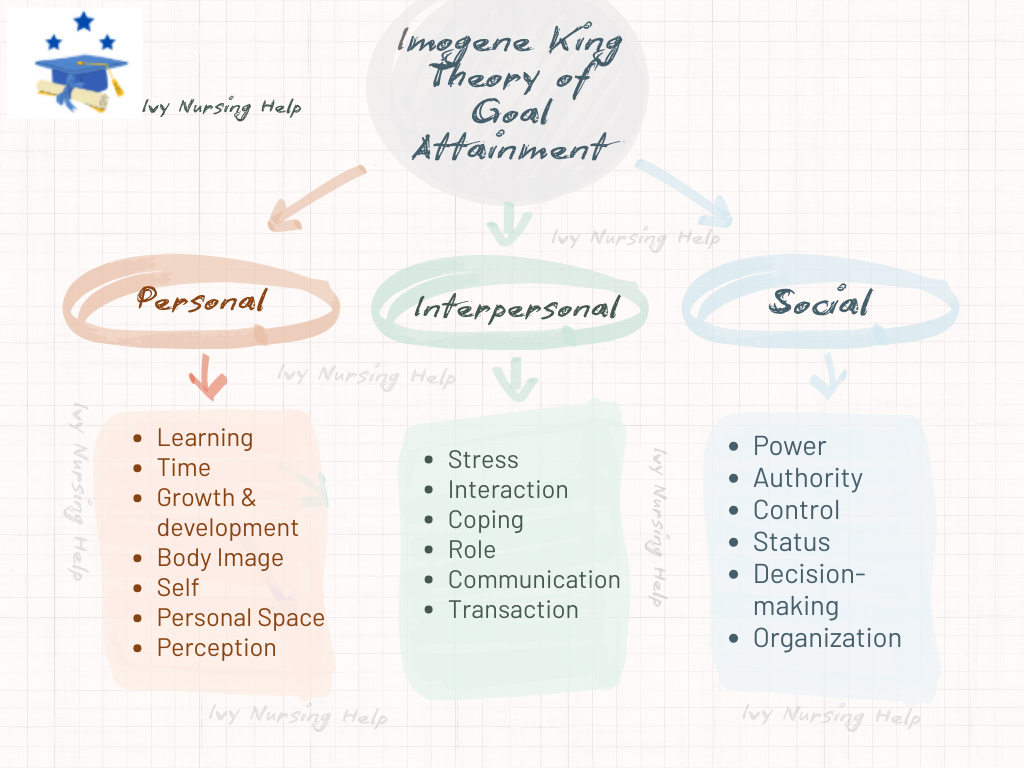
Personal system
- In the Imogene King Theory of Goal Attainment, the personal system focuses on the individual nurse or patient.
- It includes perception, self, body image, and growth and development, which influence decision-making in patient care.
- This system supports individualized nursing care and professional accountability in nursing practice.
Interpersonal and social systems
- The Imogene King Theory of Goal Attainment explains how the nurse and patient form an interacting system.
- The social system addresses roles, authority, power, and organizational structure within the nursing profession.
- These systems guide collaboration, communication, and coordination of care in complex healthcare settings.
Key Elements Within the Theory
Perception and communication
- The theory of goal attainment emphasizes perception as the foundation of understanding between individuals.
- Effective communication strengthens trust and supports accurate assessment in the nursing process.
Interaction, transaction, and roles
- In the Imogene King Theory of Goal Attainment, interaction occurs when a nurse and patient share information.
- Transactions follow interaction and represent mutual agreement on goal setting.
- Roles clarify expectations and responsibilities within nursing practice.
Stress and growth
- Stress affects decision-making and outcomes in patient care.
- The goal attainment theory recognizes stress as a factor influencing growth and development for both patient and nurse.
Meaning of Goal Attainment
Definition of goal attainment
- In the Imogene King Theory of Goal Attainment, goal attainment refers to mutually established health goals achieved through collaboration.
- These goals guide measurable outcomes in nursing care and clinical evaluation.
- This conceptual definition is central to many nursing theories taught in school of nursing programs.
Relationship Among Concepts
From interaction to outcomes
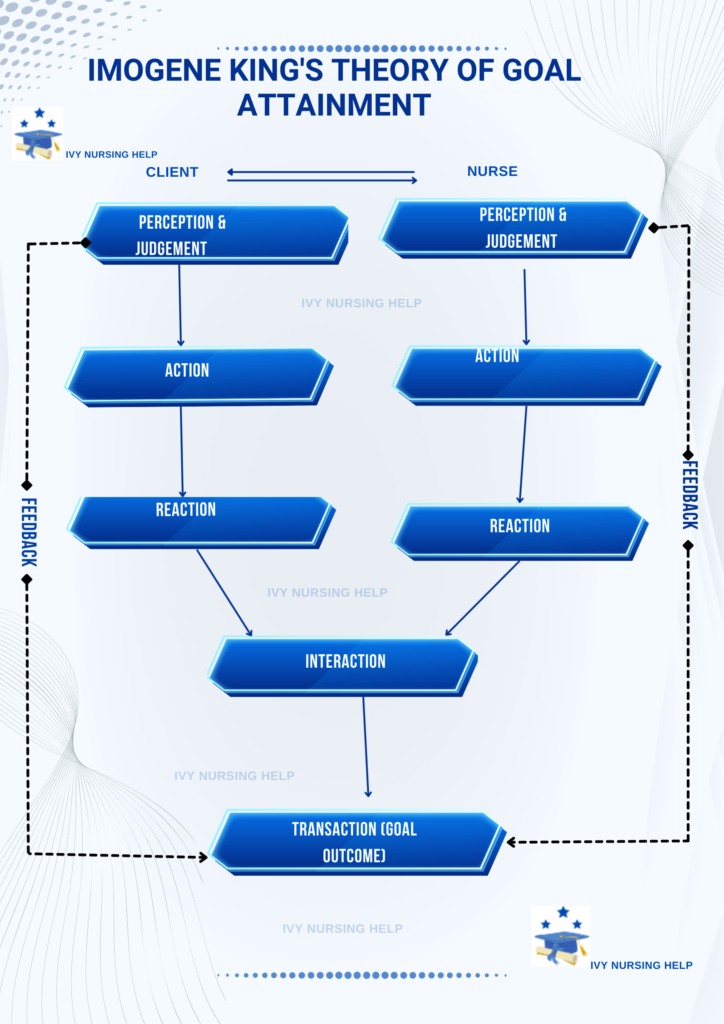
- The Imogene King Theory of Goal Attainment links perception, communication, and interaction to successful outcomes.
- Through the interacting system, shared understanding leads to transactions and effective goal setting.
- This conceptual framework, developed by Imogene King, strengthens nursing knowledge and advances evidence-based nursing profession standards.
4. Theoretical Model and Diagrams
Conceptual diagram overview
- The Imogene King Theory of Goal Attainment is best illustrated using a clear conceptual framework diagram.
- Visuals should show the personal system, interacting system, and social system as connected components.
- This approach reflects how the nurse and patient function together within the theory of goal attainment.
- Many school of nursing programs use diagrams to help students understand complex nursing theories.
Flow from interaction to goal attainment
- Diagrams for the Imogene King Theory of Goal Attainment should depict perception leading to communication, interaction, transaction, and outcomes.
- This flow visually explains how goal setting leads to measurable patient care outcomes.
- The model highlights the role of the nursing process in achieving effective nursing care.
- This structure reinforces the goal attainment theory developed by Imogene King, a respected nursing theorist.
Explaining the Model in Plain Language
For patients
- The Imogene King Theory of Goal Attainment can be explained as teamwork between a nurse and a patient.
- Patients are told that shared decisions support growth and development and improve health outcomes.
- This explanation helps patients feel engaged and respected in their patient care journey.
For students and new nurses
- In nursing practice, the Imogene King Theory of Goal Attainment explains how communication drives quality care.
- Students learn that effective interaction strengthens nursing knowledge and professional judgment.
- The model shows how individual actions influence the broader nursing profession.
Clinical relevance
- By simplifying the Imogene King Theory of Goal Attainment, nurses can apply it confidently in daily nursing care.
- The conceptual model bridges theory and practice, supporting evidence-based care across healthcare settings.
5. Relevance to Nursing Practice
Role in Clinical Decision-Making
Guiding professional judgment
- The Imogene King Theory of Goal Attainment provides a structured way for a nurse to make clinical decisions.
- As a theory of goal attainment, it aligns assessment, planning, and evaluation within the nursing process.
- The theory emphasizes collaboration between the nurse and patient, ensuring decisions reflect patient priorities.
- This conceptual framework, developed by Imogene King, strengthens accountability and clarity in nursing practice.
Systems-based thinking
- The Imogene King Theory of Goal Attainment incorporates the personal system of the individual and the broader social system.
- Understanding these systems allows nurses to anticipate barriers and supports influencing patient care.
- This approach supports consistent, patient-centered nursing care across healthcare environments.
Clinical Use Cases
- Care planning and patient education
- In care planning, the Imogene King Theory of Goal Attainment emphasizes shared goal setting.
- Patients actively participate in decisions, promoting growth and development and long-term engagement.
- Patient education is tailored through dialogue, reinforcing mutual understanding and adherence.
Discharge planning and chronic disease management
- The goal attainment theory supports effective discharge planning by clarifying expectations and responsibilities.
- For chronic disease management, the Imogene King Theory of Goal Attainment promotes sustained interaction and self-care behaviors.
- These applications are widely taught in the School of Nursing curricula as essential nursing theories.
Nurse–Patient Interaction Examples
Interaction in daily practice
- Using the Imogene King Theory of Goal Attainment, the nurse and patient form an interacting system.
- Through communication and negotiation, they agree on realistic, measurable goals for patient care.
- This process transforms theory into action and improves outcomes.
Professional significance
- Application of the Imogene King Theory of Goal Attainment enhances nursing knowledge and evidence-based care.
- The work of Imogene, a pioneeringnursing theorist, continues to shape the nursing profession through practical, relationship-focused nursing care.
6. Practical Implementation: Step-by-Step Guide
Assessment: Understanding the Nursing Situation
Initial patient assessment
- The Imogene King Theory of Goal Attainment begins with an assessment grounded in systems theory and interacting systems theory.
- Nurses assess perceptions, roles, and environment using perception in nursing situation analysis.
- Focus is placed on patients and nurses, specifically the nurse and the patient, within a real nursing situation.
- This step is based on the Imogene King’s theory and according to King’s principles.
- Widely used in advanced nursing, emergency and rural nursing, and application in emergency and rural contexts.
Goal Setting: Collaborative and Mutual Goals
Mutual goal development
- The Imogene King Theory of Goal Attainment emphasizes mutual goal setting and shared decision-making.
- Goals are developed through working with a patient, not for the patient.
- Nurses apply King’s model, King’s Theory of Goal Attainment, King’s Goal Attainment Theory, or Imogene King’s Theory of Goal concepts.
- SMART goals support goal achievement and measurable outcomes.
- This phase strengthens communication between nurses and patients and reinforces the relationship between nurses.
Planning Interventions: Aligning Roles and Resources
Strategic care planning
- In Imogene King’s Theory of Goal Attainment, planning aligns communication strategies, role negotiation, and resources.
- Nurses use King’s conceptual thinking to match interventions to patient goals.
- Planning supports communication between nurses, interdisciplinary teamwork, and continuity of care.
- This step is central to nursing education, nursing research, and curriculum design in a college of nursing or nursing school.
Implementation: Putting the Plan into Action
Care delivery and documentation
- The Imogene King Theory of Goal Attainment guides real-time implementation of agreed interventions.
- Nurses document interactions clearly, reflecting Imogene King’s theory of goal principles.
- This stage mirrors clinical training from institutions such as the School of Nursing in St.Louis, Science in Nursing from St. Louis University, and John’s Hospital School of Nursing.
- Historically influenced by Imogene Martina King, a leader in advanced nursing.
Evaluation: Measuring and Refining Outcomes
Outcome evaluation
- The final step of the Imogene King Theory of Goal Attainment focuses on measuring goal achievement.
- Nurses evaluate nursing care and revise plans when goals are unmet.
- This reflective process supports standards promoted by the Academy of Nursing, especially the American Academy of Nursing.
- Imogene King’sgoal attainment theory ensures continuous improvement in professional practice and patient outcomes.
- King’s legacy, including her nursing diploma from St. John’s Hospital School of Nursing, continues to influence modern, evidence-based nursing worldwide.
7. Evidence and Research Supporting the Theory
Empirical Evidence and Research Findings
Foundations of evidence
- Since goal attainment was first introduced, researchers have examined the Imogene King Theory of Goal Attainment across education and clinical settings.
- Studies validate the conceptual framework and theory and the framework and theory of goal achievement as practical and measurable.
- Research supports the principle that nursing is human beings interacting, reinforcing that the focus of nursing is human responses.
- Evidence confirms the theory given that the nurse collaborates with patients to question and attain a goal.
- Findings emphasize accurate perceptions in the nursing situation and the ability to interpret information in the nursing encounter.
- Proper use of information in the nursing process strengthens goal clarity and outcomes.
Outcomes Associated with Implementation
Patient-centered and clinical outcomes
- Implementation of the Imogene King Theory of Goal Attainment improves the relationship between nurses and patients.
- Stronger collaboration supports clear health goals with the patient, increasing engagement and adherence.
- Studies show improved effectiveness of nursing care when nurses in the nurse-patient relationship apply the nursing process to plan care.
- Positive outcomes are linked to using the nursing process described within a relationship based on the Imogene model.
- Research highlights enhanced perceptions of nursing power based interaction, also described as nursing power based on King and the power based on King model.
- Evidence demonstrates that the goal is the health care outcome mutually defined by a nurse and patient.
- The theory has a measurable impact on nursing education, particularly supporting goal attainment and the millennial workforce and the attainment and the millennial nurse.
Gaps in Evidence and Future Research Needs
Limitations and opportunities
- While supportive, research on the Imogene King Theory of Goal Attainment often involves small or short-term studies.
- Limited data explores how goal attainment is a personal interaction, and attainment is a personal system that evolves over time.
- More longitudinal and diverse studies are needed to examine how attainment focuses on this process across populations.
- Future research should further assess how the Imogene King Theory of Goal Attainment adapts to technology-driven and interprofessional care models.
8. Strengths and Limitations
Strengths of the Theory
Strong patient-centered focus
- The Imogene King Theory of Goal Attainment places the patient at the center of care through mutual goal setting.
- It emphasizes shared decision-making, ensuring that care plans align with patient values and preferences.
- This patient-centered approach improves engagement, accountability, and satisfaction.
Emphasis on communication and collaboration
- A major strength of the Imogene King Theory of Goal Attainment is its focus on effective communication.
- The theory highlights interaction, perception, and transaction between nurse and patient.
- Clear communication supports trust, understanding, and successful goal attainment.
- Collaboration enhances continuity of care and strengthens therapeutic relationships.
Broad applicability across settings
- The Imogene King Theory of Goal Attainment is adaptable to acute care, community health, education, and leadership roles.
- It can be applied in diverse populations and clinical environments.
- The theory supports structured use of the nursing process, making it practical for daily practice and education.
- Its flexibility allows integration into modern, team-based healthcare systems.
Limitations of the Theory
Level of abstraction
- The Imogene King Theory of Goal Attainment is relatively abstract, which can make it challenging for novice nurses.
- Some concepts, such as perception and transaction, may be difficult to operationalize in fast-paced settings.
Measurement challenges
- Measuring goal attainment and interaction quality can be subjective.
- Outcomes may vary depending on patient engagement, communication skills, and context.
- Lack of standardized tools can limit consistent evaluation.
Cultural considerations
- The Imogene King Theory of Goal Attainment assumes open communication and shared decision-making.
- Cultural beliefs, language barriers, and power dynamics may affect goal negotiation.
- Not all patients may be comfortable with active participation in goal setting.
Practical Tips to Mitigate Limitations
Enhance clarity and usability
- Translate abstract concepts of the Imogene King Theory of Goal Attainment into clear clinical steps.
- Use structured assessment and documentation tools to guide goal setting.
Improve measurement
- Incorporate patient-reported outcomes and satisfaction surveys.
- Use consistent criteria to evaluate goal progress and outcomes.
Address cultural diversity
- Apply cultural humility and individualized communication strategies.
- Adapt the Imogene King Theory of Goal Attainment to respect cultural values while maintaining patient-centered care.
9. Integration with Other Theories and Models
Complementing and Contrasting with Other Nursing Theories
Positioning within nursing theory
- The Imogene King Theory of Goal Attainment functions as a strong conceptual framework and theory focused on interaction and outcomes.
- When goal attainment was first introduced, it emphasized the relationship between nurses and patients more explicitly than many earlier models.
- Compared with Orem’s self-care theory, Imogene King’s Theory of Goal Attainment prioritizes shared decision-making and how nurses question and attain a goal with patients.
- In contrast to Roy’s adaptation model, King’s work stresses that the goal is the health care outcome negotiated through interaction.
- Similar to Peplau, the theory is that the nurse engages therapeutically, but King uniquely explains perceptions in the nursing situation.
- The theory highlights that nursing is human beings interacting and that the focus of nursing is human responses and relationships.
- These distinctions strengthen the impact on nursing education and clinical reasoning.
Blended Approaches for Complex Care
Using integrated frameworks
- The Imogene King Theory of Goal Attainment blends well with other models to improve the effectiveness of nursing care.
- Nurses may combine Orem’s self-care concepts with King’s emphasis onhealth goals with the patient.
- This blended approach supports nurses in the nurse-patient relationship by aligning autonomy with collaboration.
- Using King’s relationship based on the Imogene model, nurses interpret information in the nursing encounter accurately.
- Clear information in the nursing process supports shared understanding and follow-through.
- Nurses use the nursing process to plan, using the nursing process described by King to guide care.
- The framework and theory of goal explain how attainment focuses on this process over time.
- King’s concepts of perceptions of nursing power, based on King, and the power based on the King model complement leadership theories.
- The Imogene King Theory of Goal Attainment also supports goal attainment are the personal interactions and attainment are the personal system.
- This integration resonates with goal attainment and the millennial workforce, supporting the attainment of the millennial nurse in complex, team-based care.
Excel in Your Online Nursing Coursework Today
Feeling overwhelmed with online nursing coursework? Ivy Nursing Help offers expert academic support to keep you on track. Boost your grades, save time, and reduce stress—order now and achieve nursing success effortlessly!
10. Leadership and Policy Implications
Nursing Leadership Applications
Guiding leadership practice
- The Imogene King Theory of Goal Attainment provides a strong conceptual framework and theory for nursing leadership.
- Since goal attainment was first introduced, leaders have used it to strengthen the relationship between nurses and patients.
- The theory emphasizes that the nurse leads by collaboration, communication, and shared accountability.
- Nurse leaders use the Imogene King Theory of Goal Attainment to help teams question and attain a goal together.
- Emphasizing that nursing is human beings interacting reinforces that the focus of nursing is human relationships in leadership decisions.
- Leaders guide teams to interpret information in the nursing encounter using accurate information in the nursing process.
- Applying the nursing process to plan and using the nursing process described by King improves care coordination.
- The Imogene King Theory of Goal Attainment supports nursing power based on King, including perceptions of nursing power based on the King model, strengthening leadership influence.
- These strategies improve the effectiveness of nursing care and the impact on nursing education, especially for goal attainment and the millennial workforce and the attainment and the millennial nurse.
Policy-Level Considerations
Informing patient-centered policy
- At the policy level, the Imogene King Theory of Goal Attainment supports initiatives focused on health goals with the patient.
- Policies grounded in arelationship based on the Imogene approach strengthen nurses in the nurse-patient relationship.
- The theory reinforces that the goal is the health care outcome developed through goal attainment are the personal interactions and attainment are the personal system.
- Quality metrics informed by the framework and theory of goal emphasize that attainment focuses on this process, ensuring consistent, patient-centered outcomes.
11. Conclusion
Recap of Value for Nursing Practice, Education, and Research
Core contributions
- The Imogene King Theory of Goal Attainment remains one of the most influential nursing theories guiding modern nursing practice.
- Developed by Imogene King, a respected nursing theorist, the theory of goal attainment explains how the nurse and patient work together within an interacting system.
- The Imogene King Theory of Goal Attainment emphasizes goal setting, communication, and shared decision-making to improve patient care.
- By integrating the personal system and social system, the theory supports holistic nursing care.
- Its conceptual framework strengthens nursing knowledge, supports growth and development, and enhances the use of the nursing process.
- The theory’s influence is evident in the school of nursing curricula and across the nursing profession.
Applying the theory in real-world settings
- Nurses should intentionally apply the Imogene King Theory of Goal Attainment in daily patient care.
- Use the goal attainment theory to guide collaborative planning, evaluation, and documentation.
- Embedding this conceptual approach into routine nursing practice strengthens outcomes for both the nurse and patients, advancing excellence across the nursing profession.
12. Frequently Asked Questions (FAQ)
What are the three components of goal attainment?
Personal, interpersonal, and social components
- In the Imogene King Theory of Goal Attainment, goal attainment occurs through the personal system, interacting system, and social system.
- These components guide how the nurse and patient engage in goal setting and decision-making.
- Together, they form a conceptual framework that strengthens patient care and overall nursing care within modern nursing practice.
What is King’s goal attachment (attainment) theory?
Clarifying the concept
- King’s theory is correctly known as the theory of goal attainment or goal attainment theory.
- The Imogene King Theory of Goal Attainment explains how shared goals are developed and achieved through communication.
- This conceptual approach supports the nursing process and improves outcomes in the nursing profession.
What are the four major concepts of nursing theory?
Core metaparadigm concepts
- Most nursing theories, including the Imogene King Theory of Goal Attainment, address person, environment, health, and nursing.
- These concepts guide nursing knowledge, growth and development, and professional judgment.
- They are emphasized in the school of nursing curricula to support consistent nursing practice.
Who was Imogene King theorist?
Background and contribution
- Imogene King was a respected nursing theorist who advanced the nursing profession.
- Imogene, through the Imogene King Theory of Goal Attainment, highlighted collaboration between the nurse and patients.
- Her work continues to shape patient care, research, and education worldwide.

