

Duties of ER Nurse
Introduction
Why ER nurses are vital to emergency care
The duties of ER nurse professionals are essential in modern healthcare, as they often serve as the first line of defense in life-threatening and acute situations. In a fast-paced emergency department and across busy emergency rooms, these highly trained professionals help save lives through rapid assessment, decisive action, and expert patient care.
Define “ER nurse” and the scope of practice
An ER nurse, also called an emergency nurse or emergency room nurse, is a registered nurse (RN) who specializes in critical care within urgent care settings. The core duties of ER nurse roles include performingtriage, helping stabilize patients, initiating life support such as BLS, and supporting physicians during emergencies.
ER nurses must apply advanced nursing practice skills, maintain active licensure, and often pursue credentials like Certified Emergency Nurse to strengthen their nursing roles.
Brief preview of main duties to be covered
The primary duties of ER nurse positions involve rapid decision-making, coordinating with triage nurses, and delivering high-quality care. Nurses work with diverse populations, and nurses also educate families while managing complex cases.
To become an ER nurse, candidates typically earn a Bachelor of Science in Nursing (BSN) or another degree in nursing, complete nursing education, become a registered nurse, and gain years of experience as RNs. This rewarding nurse career shows strongjob growth, according to the Bureau of Labor Statistics, making it ideal for professionals ready to handle demanding responsibilities.
Role Overview
Dynamic work environment and typical shifts
The duties of ER nurse professionals begin in a fast-paced care setting such as the emergency department, trauma units, or urgent care centers where acute and life-threatening conditions are treated daily.
An ER nurse, also called an emergency nurse or emergency room nurse, often works 8–12-hour shifts in busy emergency rooms, including nights, weekends, and holidays.
A nurse must quickly assess patients using triage protocols, initiate BLS or advanced life support, and help stabilize patients to save lives—all core duties of ER nurse professionals.
In modern healthcare, ER nursesmust combine strong clinical judgment with efficient patient care, making this nurse career both challenging and rewarding.
Interdisciplinary team collaboration
The duties of ER nurse roles require close collaboration with physicians, paramedics, respiratory therapists, and technicians to deliver safe, coordinated care.
As a registered nurse (RN), the ER nurse plays a central role in critical care, ensuring seamless communication across teams. Nurses work together during high-pressure scenarios, and nurses also support families during emergencies.
These nursing roles demand accountability, active licensure, and adherence to professional nursing practice standards. Many pursue the Certified Emergency Nurse credential after gaining years of experience to strengthen expertise in this specialized field.
Levels of emergency nurses
The duties of ER nurse professionals vary by responsibility level. Triage nurses prioritize patients based on severity, bedside RNs deliver hands-on patient care, charge nurses coordinate workflow, and nurse practitioners provide advanced treatment.
To become an ER nurse, candidates typically complete a degree in nursing, often a Bachelor of Science in Nursing (BSN), fulfill nursing education requirements, and become a registered nurse.
Strong job growth, highlighted by the Bureau of Labor Statistics, makes this path attractive. ER nurses need resilience, clinical skill, and compassion to succeed in demanding environments where the duties of ER nurse professionals directly impact outcomes.
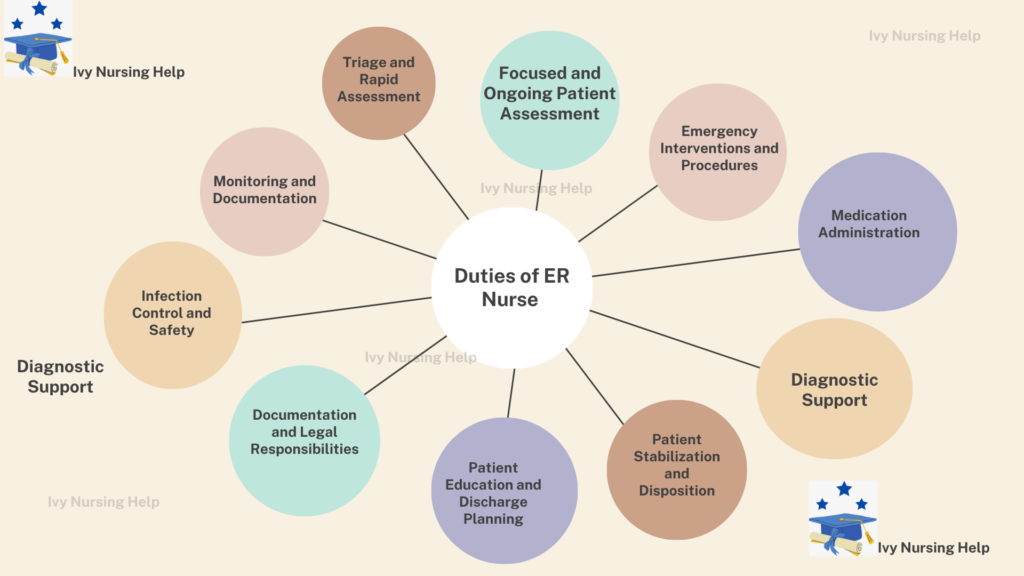
Core Duties of ER Nurse
1. Triage and Rapid Assessment
The duties of ER nurse professionals start with immediate triage in a fast-paced emergency department or other high-risk care setting.
An ER nurse, often called an emergency nurse or emergency room nurse, performs the primary survey (ABCDE) to detect life-threatening conditions and initiateBLS or advanced life support when needed.
Triage nurses assign acuity using standardized scales such as ESI, ensuring the sickest patients receive priority patient care.
A nurse must communicate delays clearly while working to stabilize patients—one of the most critical duties of ER nurse teams in modern healthcare.
2. Focused and Ongoing Patient Assessment
Another essential component of the duties of ER nurse roles is collecting history, identifying the chief complaint, and conducting a focused exam based on the presenting acute condition.
As a registered nurse (RN), the ER nurse continuously monitors vital signs and detects deterioration early.
ER nurses must rely on strong nursing practice skills developed through nursing education and years of experience to help save lives in busy emergency rooms.
3. Emergency Interventions and Procedures
The duties of ER nurse staff include airway management using oxygen, BVM, and assist devices during critical care events.
Nurses work quickly to insert IV lines, administer fluids or blood products, provide wound care, perform splinting, and assist with intubation, chest tubes, or central lines.
These advanced nursing roles require active licensure, and many professionals pursue the Certified Emergency Nurse credential to demonstrate expertise.
4. Medication Administration
Safe medication delivery is among the top duties of ER nurse professionals. The RN administers analgesics, sedatives, and emergency medications such as epinephrine or nitroglycerin.
ER nurses need precision in reconciliation, documentation, and dosage verification to protect patients in high-acuity environments.
5. Diagnostic Support
Key duties of ER nurse responsibilities include collecting specimens, drawing labs, and preparing patients for imaging like X-rays or CT scans.
Nurses also interpret telemetry and monitoring data, strengthening clinical decisions within the emergency department.
6. Patient Stabilization and Disposition
The duties of ER nurse professionals frequently involve preparing patients for admission, transfer, or discharge.
RNs coordinate with EMS, specialists, and inpatient teams to ensure seamless transitions while continuing to stabilize patients.
7. Patient Education and Discharge Planning
An often-overlooked part of the duties of ER nurse roles is education. The nurse provides discharge instructions, medication teaching, and follow-up guidance.
Clear documentation of understanding supports safe patient care outcomes.
8. Documentation and Legal Responsibilities
Accurate charting is a fundamental duty of ER nurse professionals. Time-sensitive records protect both patients and providers legally and financially.
Reporting incidents and controlled substances aligns with regulatory healthcare standards.
9. Infection Control and Safety
The duties of ER nurse teams include PPE use, isolation precautions, sharps safety, and hygiene protocols to reduce risk in demanding environments.
To become an ER nurse, candidates typically earn a degree in nursing, such as a Bachelor of Science in Nursing (BSN) or another bachelor’s degree in nursing, and then become a registered nurse. This rewarding nurse career offers strong job growth, according to the Bureau of Labor Statistics, making it ideal for professionals ready to excel in high-impact roles across healthcare.
Communication and Teamwork
Effective Handoffs (SBAR Format)
One of the most critical duties of ER nurse professionals is ensuring accurate communication during patient transitions within the emergency department and across other care settings.
An ER nurse, also known as an emergency nurse or emergency room nurse, uses the SBAR (Situation, Background, Assessment, Recommendation) format to share essential updates quickly in fast-paced emergency rooms.
ER nurses must communicate clearly with physicians and RNs to maintain safe patient care, especially in acute or life-threatening cases requiring critical care and immediate life support such as BLS.
This structured approach supports strong nursing practice, helps stabilize patients, and reflects the communication-focused duties of ER nurse roles in modern healthcare.
Communicating with Families Under Stress
Another key area within the duties of ER nurse responsibilities is guiding families through emotionally charged situations. A compassionate registered nurse (RN) explains diagnoses, treatments, and wait times following triage.
A nurse must remain calm and professional while addressing concerns, as nurses also provide reassurance that the care team is working to save lives.
These interpersonal nursing roles develop through strong nursing education, often beginning with a degree in nursing, such as a Bachelor of Science in Nursing (BSN), before professionalsbecome registered nurses. Many gain additional years of experience or become a Certified Emergency Nurse to enhance credibility in this rewarding nursing career with strong job growth, according to the Bureau of Labor Statistics.
Coordination During Codes and Mass Casualty Incidents
High-level teamwork is central to the duties of ER nurse professionals during codes or disasters. Triage nurses rapidly prioritize patients while nurses work alongside paramedics and providers to deliver urgent care.
ER nurses need active licensure and advanced training to respond effectively in these high-pressure environments. For those planning to become an ER nurse, completing a Bachelor of Science in Nursing or another degree in nursing prepares them for collaborative, high-impact roles where expert communication directly improves outcomes.
Special Populations and Situations
Pediatrics: Family-Centered Care and Dosing Differences
The duties of ER nurse professionals include delivering specialized patient care to children in a fast-paced emergency department. An ER nurse, also called an emergency nurse or emergency room nurse, must adapt communication for both pediatric patients and caregivers.
ER nurses must calculate weight-based medications accurately and initiate BLS or advanced life support for life-threatening conditions.
Triage nurses prioritize young patients quickly, while nurses work to stabilize symptoms and reduce anxiety. These pediatric-focused duties of ER nurse roles require strong nursing practice, advanced nursing education, and often years of experience as a registered nurse (RN).
Geriatrics: Polypharmacy and Atypical Presentations
Another critical area within the duties of ER nurse responsibilities is caring for older adults who may present with subtle or acute symptoms.
A nurse must review medications carefully due to polypharmacy risks and identify atypical signs of critical care conditions.
RNs coordinate with providers across healthcare teams to prevent complications in busy emergency rooms. Many professionals strengthen these nursing roles by earning the Certified Emergency Nurse credential and maintaining active licensure.
Mental Health and Agitation Management
The duties of ER nurse professionals frequently include supporting patients experiencing psychiatric crises. Nurses also apply de-escalation strategies, ensure safety, and assist with therapeutic interventions in this complex care setting.
ER nurses need emotional intelligence and clinical expertise to protect patients and staff while helping save lives.
Trauma, Stroke, STEMI Protocols, and Sepsis Bundles
High-risk protocols highlight the advanced duties of ER nurse teams. Rapid triage, stroke alerts, STEMI activation, and sepsis bundles demand immediate action from the RN to stabilize patients.
To become an ER nurse, candidates typically complete a degree in nursing, such as a Bachelor of Science in Nursing (BSN) or another bachelor’s degree in nursing, then become a registered nurse. This dynamic nurse career offers strong job growth, according to the Bureau of Labor Statistics, and prepares professionals to excel in diverse scenarios within modern healthcare.
Skills, Certifications, and Competencies
Required Certifications
The duties of ER nurse professionals demand advanced credentials to safely deliver emergency care in hospital emergency departments and other high-risk environments. Within a typical job description, certifications validate readiness to perform emergency interventions.
Required credentials often include BLS, ACLS, PALS, and TNCC/ENPC through organizations like the Emergency Nurses Association and theBoard of Certification for Emergency Nursing, which provides certification for emergency nursing.
To become an emergency room nurse, candidates must earn a nursing degree through an accredited degree program or bachelor’s degree, then pass the National Council Licensure exam. These steps prepare professionals for the demanding duties and responsibilities found within emergency environments.
Clinical Skills
Strong clinical expertise is central to the duties of ER nurse roles. Emergency department nurses must master IV/IO access, ECG interpretation, wound care, and rapid emergency interventions for patients admitted to the emergency room.
Nurses in the emergency room frequently triage patients, while ER nurses work quickly to manage complex cases, including emergency room trauma.
The ER nurse’s ability to apply deep nursing knowledge highlights their vital role in emergency medicine, especially when patients arrive at a hospital emergency department in critical condition.
Soft Skills
The duties of ER nurse professionals extend beyond technical care. Nurses who work in an emergency setting rely on critical thinking, situational awareness, and emotional resilience.
ER nurses are often leaders during crises, and a nurse manager may assign teams to coordinate care. Because nurses are often the first clinicians patients encounter, communication is essential when working in the emergency environment.
Working as an ER nurse requires adaptability since ER nurses typically handle unpredictable caseloads, reinforcing their importance in professional nursing.
Continuing Education and Competency Validation
Ongoing learning is a major part of the duties of ER nurse professionals. Emergency nursing education ensures skills remain current as technology and protocols evolve.
Along the nursing career journey, many pursue specialty training after gaining two years of experience to strengthen their ER nurse career.
According tosalary information and the median annual salary reported in workforce data, the ER nurse makes competitive wages, supported by projected job growth and a strong job outlook. Understanding ER nurses’ responsibilities helps clarify expectations, benefits, and realistic ER nurse salary expectations for those entering this challenging yet rewarding field.
Legal and Ethical Considerations
Scope of Practice and Delegation
The duties of ER nurse professionals require strict adherence to legal standards outlined in their job description and state regulations governing professional nursing.
Emergency department nurses must understand their scope when delivering emergency care and performing emergency interventions in a hospital emergency department or other emergency setting.
The ER nurse’s accountability includes safe delegation. A nurse manager ensures tasks are appropriately assigned because nurses who work within emergency environments must protect patient safety.
These legal expectations shape the duties of ER nurse roles and define the broader duties and responsibilities seen across hospital emergency departments where ER nurses work daily.
Consent, Capacity Assessment, and Privacy (HIPAA)
Respecting patient rights is central to the duties of ER nurse professionals. Nurses in the emergency room frequently treat individuals admitted to the emergency room who may lack decision-making capacity.
Nurses are often responsible for verifying consent before emergency interventions, except when immediate action is required in emergency medicine to preserve life.
Protecting confidentiality reinforces ethical nursing knowledge, particularly when working in the emergency environment where sensitive data is shared rapidly.
These ethical safeguards highlight how the duties of ER nurse professionals support trust while delivering care, including emergency room services.
Mandatory Reporting and Documentation for Legal Protection
Accurate charting is one of the most critical duties of ER nurse teams. Documentation supports legal defense, continuity of care, and regulatory compliance for nurses in the emergency environment.
ER nurses also report abuse, injuries, and public health risks according to the law. Because ER nurses are often the first to triage patients, their records carry significant legal weight.
To become an emergency room nurse, individuals must earn a nursing degree through a degree program or a bachelor’s degree, pass the National Council Licensure Examination, and pursue emergency nursing education. Many seek credentials from the Emergency Nurses Association or the Board of Certification for Emergency Nursing to advance their ER nurse career.
Along the nursing career journey, professionals gain two years of experience or more, strengthening competence in high-risk settings. Workforce salary information shows the ER nurse makes competitive wages aligned with median annual salary data, meeting realistic ER nurse salary expectations amid strong projected job growth and a favorable job outlook.
Common Challenges and Stress Management
Dealing with Overcrowding and Resource Limitations
One of the most demanding duties of ER nurse professionals is delivering safe emergency care despite overcrowding in hospital emergency departments. The typical job description highlights rapid prioritization when patients are admitted to the emergency room.
Emergency department nurses must quickly triage patients, allocate limited supplies, and coordinate emergency interventions in a high-pressure emergency setting.
The ER nurses’ adaptability supports their vital role in emergency medicine, as ER nurses work to maintain efficiency and safety within emergency workflows.
These realities emphasize how the duties of ER nurse professionals extend beyond clinical tasks into operational decision-making.
Managing Burnout, Compassion Fatigue, and Shift Work
Emotional strain is another challenge tied closely to the duties of ER nurse teams. Nurses in the emergency room frequently encounter trauma, loss, and unpredictable workloads while working in the emergency environment.
ER nurses are often scheduled for rotating shifts, and nurses are often expected to remain focused for long hours. Over time, this can impact wellness across an ER nurse’s career.
Strong nursing knowledge and preparation through emergency nursing education help professionals cope with stress while maintaining high standards inprofessional nursing.
Although the ER nurse makes competitive wages based on salary information and median annual salary data, meeting realistic ER nurse salary expectations requires balancing compensation with job demands.
Strategies: Debriefing, Peer Support, and Workplace Resources
Effective coping strategies are essential to sustain the duties of ER nurse professionals. Debriefings led by a nurse manager allow nurses who work in crisis settings to reflect after difficult cases.
ER nurses also benefit from mentorship, peer support, and resources offered by organizations like the Emergency Nurses Association and the Board of Certification for Emergency Nursing, which promotes certification for emergency nursing.
Despite the stressors, strong projected job growth and a positive job outlook continue to attract professionals committed to the challenging yet rewarding duties and responsibilities found in emergency room care.
Career Development and Advancement
Advanced Roles: Clinical Nurse Specialist, Nurse Practitioner, Educator
The duties of ER nurse professionals often evolve as they progress along their nursing career journey, opening doors to advanced positions in emergency medicine. After working as an ER nurse, many pursue leadership or specialty paths while continuing to perform emergency care.
Advanced opportunities include clinical nurse specialist, nurse practitioner, and educator roles, all of which expand the ER nurse’s influence in hospital emergency departments. These professionals strengthen emergency care delivery and support nurses in the emergency environment.
Because ER nurses are often recognized for their vital role, they may mentor teams, guide triage patients, and improve protocols within emergency systems. This progression highlights the expanding duties of ER nurse professionals beyond bedside care.
Power Through Your Nursing E-Learning Journey
Struggling with your online nursing coursework? IvyNursingHelp.com offers expert support for E-learning nursing modules, assignments, and quizzes. Get reliable, round-the-clock academic help and boost your grades today. Your success starts here—contact us now!
Certifications and Graduate Education Paths
Career growth begins with completing a degree program or bachelor’s degree, then meeting licensure requirements to pass the National Council Licensure exam. Those planning to become an emergency room nurse must first earn a nursing degree and build strong nursing knowledge through emergency nursing education.
Many emergency department nurses gain two years of experience before pursuing credentials from the Emergency Nurses Association or the Board of Certification for Emergency Nursing, earning certification for emergency nursing.
These qualifications enhance the duties of ER nurse professionals and support long-term success in professional nursing.
Leadership Opportunities Within the ED
Leadership is a natural extension of the duties of ER nurse roles. Experienced professionals may transition into nurse manager positions where nurses are assigned responsibilities and workflows are optimized.
ER nurses work collaboratively in a fast-moving emergency setting, ensuring patients admitted to the emergency room receive timely care, including emergency room interventions. ER nurses also help implement policies that strengthen the job description and clarify ER nurses’ responsibilities.
Financial and career incentives remain strong. According to workforce salary information, the ER nurse makes competitive pay aligned with median annual salary data and realistic ER nurse salary expectations. Combined with projected job growth and a favorable job outlook, the expanding duties and responsibilities of emergency room nurses work continue to attract professionals committed to excellence in emergency care.
Conclusion
The duties of ER nurse professionals encompass rapid assessment, lifesaving emergency interventions, and compassionate emergency care across hospital emergency departments. From the moment patients are admitted to the emergency room, emergency department nurses triage patients, coordinate treatment, and ensure safe outcomes.
The ER nurse’s daily job description reflects complex duties and responsibilities, proving that ER nurses work efficiently in high-risk environments, including emergency room settings. These core functions define the long-term value of the duties of ER nurse within modern emergency medicine.
The duties of ER nurse professionals support the vital role of nurses in the emergency room and throughout the broader emergency setting. Nurses are often the first clinicians patients encounter, and ER nurses are often responsible for stabilizing critical conditions.
With strong nursing knowledge and emergency nursing education, nurses who work in these roles elevate standards in professional nursing while strengthening outcomes across hospital emergency systems.
The growing demand reflected in projected job growth and a positive job outlook highlights the expanding ER nurses’ responsibilities. Competitive salary information, median annual salary, and realistic ER nurse salary expectations make this ER nurse career appealing.
Those planning to become an emergency room nurse should earn a nursing degree through a degree program or bachelor’s degree, pass the National Council Licensure, and gain two years of experience while working in the emergency field.
Professionals can advance their nursing career journey through the Emergency Nurses Association or the Board of Certification for Emergency Nursing, obtaining certification for emergency nursing.
Whether working as an ER nurse or exploring leadership with a nurse manager, the evolving duties of ER nurse continue to attract dedicated professionals ready to perform emergency care within emergency environments.
FAQs: Duties of ER Nurse
What are the duties of an ER nurse?
The duties of ER nurse professionals center on delivering rapid emergency care in hospital emergency departments. Their job description includes assessing patients admitted to the emergency room, initiating emergency interventions, and coordinating treatment within emergency workflows.
The ER nurse’s daily tasks reflect critical duties and responsibilities, as emergency department nurses triage patients, monitor conditions, and collaborate with providers.
Because ER nurses work in a high-pressure emergency setting, they hold a vital role in emergency medicine, ensuring safe outcomes for patients in the emergency room and the broader care team.
What are 10 responsibilities of a nurse?
Key duties of ER nurse teams include triage, patient assessment, medication administration, documentation, communication, infection control, care coordination, patient education, leadership support, and discharge planning.
ER nurses also guide families, manage crises, and help optimize workflows when nurses are assigned to complex cases.
These ER nurses’ responsibilities demonstrate why nurses are often viewed as the backbone of professional nursing, especially when working in the emergency environment.
What skills do ER nurses need?
Success in the duties of ER nurse roles requires advanced nursing knowledge, critical thinking, and resilience. ER nurses are often expected to act decisively while performing emergency care.
Preparation starts by completing a degree program or bachelor’s degree, then passing the National Council Licensure Examination to earn a nursing degree and become an emergency room nurse.
Many professionals pursue emergency nursing education, certifications from the Emergency Nurses Association or the Board of Certification for Emergency Nursing, and gain two years of experience while working as an ER nurse.
What are the 7 roles of a nurse?
The duties of ER nurse professionals align with seven core roles: caregiver, advocate, educator, communicator, leader, collaborator, and evaluator.
Emergency room nurses work closely with a nurse manager and teams across hospital emergency units, strengthening their nursing career journey.
With strong projected job growth, a favorable job outlook, and competitive salary information, including median annual salary data, the ER nurse makes high wages that meet realistic ER nurse salary expectations, making the ER nurse career highly rewarding.

