

Betty Neuman Systems Model Theory
1. Introduction
Purpose and Scope of the Outline
The purpose of this section is to introduce the Betty Neuman Systems ModelTheory, a widely recognized conceptual model used across nursing education, nursing practice, administration, and research.
This outline explains how the Betty Neuman Systems Model Theory guides a nurse in assessing the client system, identifying stressor interactions, and promoting system stability through structured nursing intervention.
The scope emphasizes applying the Betty Neuman Systems Model Theory to patient care, highlighting its relevance to both internal and external environmental stressors.
Brief Definition of the Betty Neuman Systems Model Theory
The Betty Neuman Systems Model Theory is a holistic approach that views the client system as an open system model constantly interacting with various stressor sources.
Developed by Betty Neuman, the model focuses on protecting the normal line of defense, strengthening the flexible line of defense, and activating the line of resistance to maintain or restore system balance.
According to Neuman, the model helps the nurse apply structured nursing theories to achieve optimal nursing goals.
Relevance to Contemporary Nursing Practice, Education, Research, and Administration
The Betty Neuman Systems Model Theory supports nursing practice by guiding the nursing process—assessment, diagnosis, planning, nursing intervention, and evaluation.
It promotes primary prevention, secondary prevention, and tertiary prevention, making it essential for comprehensive nursing care.
In the school of nursing, students learn how using the Neuman approach enhances critical thinking and clinical judgment.
The model strengthens patient care by helping nurses manage physiological, psychological, sociocultural, spiritual, and developmental factors within the Neuman system model.
Its focus on the client system enables effective care administration, research planning, and evidence-based practice.
Because the Betty Neuman Systems Model Theory integrates the Neuman system, system model, and lines of defense, it remains foundational to modern nursing frameworks.
2. Historical Background and Development
Biographical Note on Betty Neuman
Betty Neuman, founder of the Betty Neuman Systems Model Theory, was a dedicated nurse, educator, and therapist known for integrating psychology, physiology, and community health into innovative nursing theories.
Her diverse clinical experience inspired the creation of a holistic approach to understanding the client system, the stressor environment, and the importance of system stability in patient care.
According to Neuman, the goal of nursing is to strengthen the line of defense and enhance wellness through effective nursing intervention.
Her leadership in the school of nursing helped institutionalize the Neuman system, influencing generations of nurses.
Origins and Evolution of the Systems Model
The Betty Neuman Systems Model Theory originated in the early 1970s when Betty Neuman developed the conceptual model to help nurses understand how internal and external stressors influence the physiological, psychological, sociocultural, and developmental aspects of the client system.
The system model was built around core components such as the normal lineof defense, flexible line of defense, and line of resistance, which determine the client’s ability to maintain system stability.
Using the Neuman perspective, the model emphasizes primary prevention, secondary prevention, and tertiary prevention within the nursing process, making it a dynamic guide for modern nursing practice and nursing care.
Over time, the Neuman system model evolved to address complex healthcare needs, reinforcing the importance of evidence-based nursing goals.
The continued adoption of the Betty Neuman Systems Model Theory in research and education demonstrates its long-standing relevance to the nursing profession
Key Publications and Milestones
Milestones for the Betty Neuman Systems Model Theory include the publication of her landmark text, The Neuman Systems Model, which formalized the Neuman system for global nursing audiences.
Subsequent revisions strengthened guidance on assessing the client system, managing stressor variables, and improving patient care through strategic nursing intervention.
Her publications reinforced the essential role of the system model in blending theory with practice.
Major milestones include the model’s integration into the school of nursing curricula, expanded use in community and acute care settings, and recognition as a foundational framework within nursing theories.
Today, the widespread use of the Betty Neuman Systems Model Theory reflects its enduring influence on holistic assessment, prevention-focused interventions, and the advancement of the nursing discipline.
3. Philosophical and Theoretical Foundations
Metaparadigm Linkages: Person, Environment, Health, Nursing.
The Betty Neuman Systems Model Theory aligns closely with nursing’s four metaparadigm concepts—person, environment, health, and nursing—creating a comprehensive conceptual model for understanding human responses.
Person: Defined as a client system composed of physiological, psychological, sociocultural, developmental, and spiritual variables interacting with stressors.
Environment: The Betty Neuman Systems Model Theory emphasizes internal and external environmental influences that affect the normal line of defense and overall system stability.
Health: According to Neuman, health reflects a continuum of wellness to illness based on how effectively the line of defense and line of resistance respond to stress.
Nursing: Within nursing theories, the nurse plays a critical role in identifying stressors, strengthening defenses, and implementing strategic nursing interventions to enhance patient care.
Systems Theory and General Systems Concepts
The Betty Neuman Systems Model Theory is deeply rooted in systems theory, viewing the person as an open system model constantly interacting with the environment.
The Neuman system model integrates energy exchange, feedback loops, and system regulation to explain how the client system maintains balance.
Using the Neuman approach, the nurse analyzes stressor impacts and assesses the client’s reaction through the nursing process.
The focus on system organization and regulation enhances nursing practice by helping nurses predict responses and promote system stability.
Holism and Client-Centered Care
A hallmark of the Betty Neuman Systems Model Theory is its holistic approach, recognizing that each part of the client system influences total wellness.
This holism supports nursing goals that prioritize individualized nursing care, respect cultural and developmental needs, and promote whole-person healing.
The Neuman system encourages patient care that examines emotional, physical, and social components simultaneously rather than separately.
Focus on Prevention and Stressor Management
A central feature of the Betty Neuman Systems Model Theory is prevention as intervention. It emphasizes three levels:
Primary prevention: Protecting the normal line of defense through early action before stressors disrupt balance.
Secondary prevention: Strengthening the flexible line of defense and initiating targeted nursing intervention to address reactions to a stressor.
Tertiary prevention: Supporting system recovery and preventing further damage after the line of resistance has been activated.
The model assists the nurse in assessing internal and external stressors, restoring stability, and improving long-term outcomes.
Widely taught in nursing schools, the Betty Neuman Systems Model Theory remains a cornerstone of prevention-focused nursing practice, reinforcing its standing among dominant nursing theories.
Client as a System (Open System Concept)
The Betty Neuman Systems Model Theory views every person as an open client system that constantly interacts with internal and external stressors.
In this conceptual model, the client system includes physiological, psychological, sociocultural, developmental, and spiritual variables that influence individual responses.
Betty Neuman emphasized that open systems exchange energy with the environment, and maintaining system stability is essential for wellness.
The normal line of defense, flexible line of defense, and line of resistance are key structural protections within the Neuman system model that determine how the client reacts to stress.
Using the Neuman perspective, the nurse assesses the interaction between the client system and its environment to guide effective nursing care and nursing intervention.
Environmental Variables: intra-personal, inter-personal, extra-personal
The Betty Neuman Systems Model Theory categorizes environmental stressors into three groups:
Intra-personal stressor: Occurs within the person (e.g., emotions, thoughts, physiological changes).
Inter-personal stressor: Arises from interactions with others (e.g., relationships, communication barriers).
Extra-personal stressor: Originates outside the client (e.g., finances, work environment, community factors).
These stressors influence the neuman system and require targeted nursing intervention to preserve theline of defense.
This structure reflects why the system model is widely used in nursing practice and nursing theories.
Health as a Continuum and Wellness-illness Spectrum
According to the Betty Neuman Systems Model Theory, health is not static; it exists on a continuum from optimal wellness to illness.
According to Neuman, movement along this continuum depends on the client’s ability to maintain system stability through the nursing process and preventive strategies.
The nurse evaluates changes in the client system using prevention strategies—primary prevention, secondary prevention, and tertiary prevention—to maintain or restore balance.
Viewing health as a continuum helps enhance patient care, promote resilience, and strengthen the line of resistance.
Nursing as a Unique Profession With Preventing Reaction, and Reconstitution Roles
The Betty Neuman Systems Model Theory highlights nursing as a distinct discipline responsible for reducing stressor impact and enhancing recovery.
Prevention roles include:
Primary prevention: Protects the normal line of defense before stressors penetrate.
Secondary prevention: Strengthens the flexible line of defense after a reaction occurs.
Tertiary prevention: Promotes reconstitution and prevents further harm once the line of resistance has been activated.
These roles help the nurse achieve essential nursing goals and deliver holistic, evidence-based patient care.
Widely taught in the school of nursing, the Betty Neuman Systems Model Theory continues to guide comprehensive nursing practice, offering a holistic approach supported by strongnursing theories.
5. System Variables
Intra-personal Variables: Physiological, Psychological, Developmental, Spiritual
The Betty Neuman Systems Model Theory identifies intra-personal variables as forces occurring within the client system, influencing the person’s response to any stressor.
Physiological: Includes bodily functions, health status, and physical changes that affect the normal line of defense.
Psychological: Encompasses emotions, coping skills, thought patterns, and mental health, influencing system stability.
Developmental: Represents growth-related tasks and age-specific needs affecting wellness across the lifespan.
Spiritual: Involves beliefs, values, and meaning, which, according to Neuman, strengthen resilience and enhance patient care.
These intra-personal variables demonstrate how the Neuman system model functions as a conceptual model grounded in holistic assessment.
Inter-personal Variables: Interactions, Relationships, Family, Social Systems
The Betty Neuman Systems Model Theory views inter-personal variables as stressors arising frominteractionsand relationships with others.
Examples include communication patterns, family dynamics, and social expectations that affect the flexible line of defense.
These variables influence nursing practice because the nurse must assess how social systems shape coping responses.
Using the Neuman approach, inter-personal stressors guide tailored nursing intervention during the nursing process, supporting effective nursing care and stronger nursing goals.
Inter-personal factors reinforce the importance of a holistic approach within the system model.
Extra-personal Variables: Socioeconomic, Environmental, Cultural, Political
The Betty Neuman Systems Model Theory defines extra-personal variables as internal and external forces outside the individual but still affecting the client system.
These may include economic status, living conditions, cultural beliefs, policies, and access to resources—all of which influence the line of resistance and overall system stability.
Extra-personal variables require the nurse to incorporate primary prevention, secondary prevention, and tertiary prevention strategies.
For example:
Primary prevention: Strengthening the normal line of defense before stressors occur.
Secondary prevention: Responding to reactions caused by environmental stress.
Tertiary prevention: Supporting reconstitution and long-term wellness.
These variables highlight why the Neuman system is foundational in nursing theories and widely taught in the school of nursing.
The integrated nature of extra-personal stressors demonstrates how the Betty Neuman Systems Model Theory helps nurses deliver informed, comprehensive, and context-sensitive patient care.
6. Structure of the Model: Lines and Core
Basic Structure: Central Core (Normal Line of Defense and Flexible Line of Defense)
The Betty Neuman Systems Model theory presents the client system as a core surrounded by protective lines of defense that maintain system stability.
The central core includes essential physiological, psychological, developmental, sociocultural, and spiritual components that define basic human functioning.
The normal line of defense represents the client’s baseline wellness state.
The flexible line of defense is a dynamic, expandable buffer that protects the normal line of defense from internal and external stressors.
Using the Neuman perspective, the nurse evaluates how these lines interact within the Neuman system model to support effective nursing care.
The structure reinforces why the Betty Neuman Systems Model Theory is one of the most influential nursing theories and a widely used conceptual model in the school of nursing.
Lines of Resistance: Internal Protective Mechanisms Activated When Stressors Invade
In the Betty Neuman Systems Model Theory, the line of resistance consists of internal defenses activated when a stressor penetrates the outer lines of defense.
These mechanisms attempt to restore system stability, often involving biological, emotional, or cognitive responses.
According to Neuman, strong lines of resistance help the client system recover more quickly and maintain wellness.
The nurse uses targeted nursing intervention to strengthen these lines through the nursing process, integrating primary prevention, secondary prevention, and tertiary prevention.
The Neuman system demonstrates how resistance mechanisms serve as the last protective layer before system disruption.
Normal Line of Defense: Standard Level of Health and Stability
The normal line of defense in the Betty Neuman Systems Model Theory represents the individual’s typical health patterns and response capabilities.
It is shaped by long-term lifestyle habits, coping behaviors, and patient care history.
Damage to this line due to a stressor can lead to illness or decreased functioning.
The nurse aims to preserve this line through preventive measures and adaptive nursing goals.
Flexible Line of Defense: Dynamic, Temporary Buffer Protecting the Normal Line
The normal line of defense in the Betty Neuman Systems Model Theory represents the individual’s typical health patterns and response capabilities.
It is shaped by long-term lifestyle habits, coping behaviors, and patient care history.
Damage to this line due to a stressor can lead to illness or decreased functioning.
The nurse aims to preserve this line through preventive measures and adaptive nursing goals.
7. Stressors
Definition and Role of Stressors in the Neuman Model
In the Betty Neuman Systems Model Theory, a stressor is any environmental force that has the potential to disrupt the client system and affect overall system stability.
Betty Neuman defined stressors as energy-producing factors that interact with the person’s physiological, psychological, sociocultural, developmental, and spiritual variables.
Stressors influence the line of defense, the flexible line of defense, and eventually the line of resistance when unmitigated.
According to Neuman, identifying stressors early helps thenurse implement preventive strategies through the nursing process.
This emphasis on stressor identification is a core reason why the Neuman system model is widely applied in nursing practice and nursing theories.
Types of Stressors: Intra-Personal, Inter-Personal, Extra-Personal
The Betty Neuman Systems Model Theory classifies stressors into three major types:
Intra-Personal Stressors: Occur within the client and may include emotional conflict, physiological imbalance, or cognitive overload.
Inter-Personal Stressors: Arise from relationships, communication patterns, or role expectations within family or social systems.
Extra-Personal Stressors: Originate outside the individual, such as financial challenges, environmental threats, or limited access to resources.
These three categories help the nurse assess how internal and external pressures affect the system model, enabling targeted nursing intervention.
Characteristics: Internal/External, Predictable/Unpredictable, Chronic/Acute
The Betty Neuman Systems Model Theory highlights that stressors vary in nature and impact.
Internal and external: Stressors may arise from within the person or from outside influences.
Predictable or unpredictable: Some stressors can be anticipated (e.g., developmental milestones), while others occur suddenly (e.g., accidents).
Chronic or acute: Long-term stressors may wear down the normal line of defense, while acute stressors may overwhelm the flexible line of defense.
These characteristics influence how quickly the line of resistance activates and how urgently the nurse must intervene.
How Stressors Disrupt System Stability and Trigger Lines of Resistance
In the Betty Neuman Systems Model Theory, stressors first challenge the flexible line of defense, which serves as the initial protective buffer.
If the stressor penetrates this line, the normal line of defense becomes threatened, reducing system stability.
When stressors invade deeper, the line of resistance activates to defend the client system through innate and acquired mechanisms.
The nurse applies primary prevention, secondary prevention, and tertiary prevention within the nursing process to restore equilibrium.
Taught widely in the school of nursing, the Neuman system reinforces a holistic approach to patient care, ensuring that stressor management aligns with long-term nursing goals.
8. Levels of Prevention
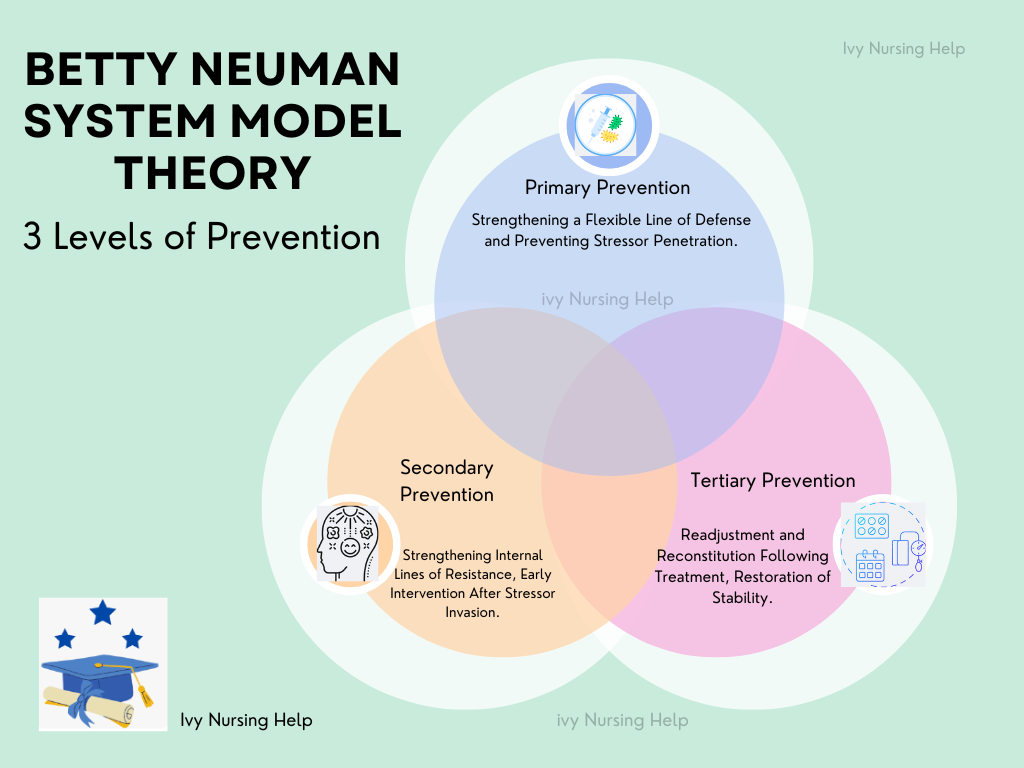
Primary Prevention: Strengthening a Flexible Line of Defense and Preventing Stressor Penetration
In the Betty Neuman Systems Model Theory, primary prevention focuses on protecting the flexible line of defense of the client system before a stressor causes harm.
This level supports wellness by promoting healthy habits, reducing risk exposure, and enhancing physiological, psychological, and social resilience.
Examples include health education, vaccination, nutrition counseling, exercise promotion, stress-management training, and environmental safety measures.
Using the Neuman approach, thenurseaims to keep the normal line ofdefense intact and maintain optimal system stability.
Secondary Prevention: Strengthening Internal Lines of Resistance, Early Intervention After Stressor Invasion
Secondary prevention in the Betty Neuman Systems Model Theory begins after the stressor has penetrated the flexible line of defense and threatens the normal line of defense.
The goal is to strengthen the line of resistance through timely assessment, early diagnosis, and targeted nursing intervention.
Examples include screening programs, acute symptom management, mental-health crisis intervention, medication administration, and monitoring for complications.
This aligns with thenursing process, guiding the nurse in rapid response to preserve or restore system stability within the Neuman system model.
Tertiary Prevention: Readjustment and Reconstitution Following Treatment, Restoration of Stability
In the Betty Neuman Systems Model Theory, tertiary prevention supports recovery after treatment and focuses on rebuilding strength, function, and long-term wellness.
It helps the client system regain balance following activation of the line of resistance and promotes reconstitution toward the highest possible level of wellness.
Examples include rehabilitation, chronic-disease management, support groups, follow-up evaluations, and lifestyle modification programs.
This level emphasizes a holistic approach that enhances patient care and long-term nursing goals.
Examples of Nursing Interventions at Each Prevention Level
Primary prevention: teaching stress-reduction strategies, promoting safe environments, encouraging vaccinations, and offering wellness screenings to reduce internal and external risks.
Secondary prevention: administering medications, providing crisis counseling, performing diagnostic tests, and initiating early treatment to decrease stressor impact.
Tertiary prevention: coordinating rehabilitation services, developing long-term care plans, reinforcing lifestyle changes, and supporting community reintegration.
These actions demonstrate how the system model, grounded in the work of Betty Neuman, shapes evidence-based nursing practice and remains a central framework taught in the school of nursing.
Master Your Nursing Theory Paper
Stuck on complex nursing theories? Ivy Nursing Help delivers original, well-researched papers tailored to your rubric, APA standards, and deadlines, helping you earn higher grades confidently. Order now for support.
9. Nursing Process within the Neuman Systems Model
Assessment: Comprehensive System Appraisal Across Variables and Lines of Defense
In the Betty Neuman Systems Model Theory, assessment is the foundation of the nursing process and begins with evaluating the core of the client system as an open system that interacts with its environment.
The nurse assesses intra-personal, inter-personal, and extra-personal stressors that influence the client system in interaction with surroundings.
Assessment also examines the normal line of defense, the flexible line of defense, and the line of resistance to determine vulnerabilities and strengths.
This step aligns with using the Neuman Systems Model to understand how the system reacts to a stressor, ensuring holistic nursing care plans.
Diagnosis/Problem Identification: Identification of Stressors and System Responses
In the Betty Neuman Systems Model Theory, nursing diagnoses are based on how stressors disrupt the stability of the system.
Diagnoses reflect actual or potential nursing problems, helping the nurse identify patterns defined in Neuman’s model.
Neuman defined problem identification as understanding the relationship between stressors and client responses within the open system.
Goal setting/Outcome Identification: Stabilization, Prevention, Reconstitution
In the Betty Neuman Systems Model Theory, nursing diagnoses are based on how stressors disrupt the system’s stability.
Diagnoses reflect actual or potential nursing problems, helping the nurse identify patterns defined in Neuman’s model.
Neuman defined problem identification as understanding the relationship between stressors and client responses within the open system.
Planning: Selecting Interventions at Appropriate Prevention Levels
The use of the Neuman model guides nurses in choosing appropriate nursing strategies at the primary, secondary, or tertiary prevention levels.
Planning incorporates health promotion, early interventions, and long-term restorative care.
Implementation: Specific Nursing Actions (Health Education, Environmental Modification, Advocacy, Coordination)
Implementation uses targeted nursing actions such as health education, environmental modification, advocacy, and coordination of care.
These actions reflect the models for nursing practice and align with Betty Neuman’s nursing theory as applied in clinical and community settings.
Implementation supports the nursing profession, nursing education, and public health and psychology domains.
Evaluation: Measuring System Stability, Integrity of Lines of Defense, and Client Reconstitution
Evaluation within the Betty Neuman Systems Model Theory measures how well interventions restored system stability and strengthened defenses.
The nurse determines whether the client has achieved reconstitution and returned to an optimal level of health.
Evaluation ensures that the model provides a comprehensive framework for continuous improvement in current nursing and nursing research.
10. Intervention Strategies and Examples
Primary Prevention Examples: Health Promotion, Immunization, Stress Management Education
In the Betty Neuman Systems Model Theory, primary prevention focuses on protecting the core of the client system before any system reacts to a stressor.
Examples include:
Health promotion education to strengthen resilience and maintain the highest possible level of health.
Immunization programs to prevent illness in an open system thatinteracts with multiple environments.
Stress-management workshops are designed to minimize nursing problems by reinforcing the flexible line of defense.
These interventions align with using the Neuman Systems Model to promote balance within the client system and support long-term wellness.
Nursing actions at this level reflect models of nursing to guide preventive care, emphasizing the nursing profession and evidence-based strategies taught in nursing education.
Secondary Prevention Examples: Early Screening, Acute Care Interventions, Crisis Management
The Betty Neuman Systems Model Theory identifies secondary prevention as intervention after stressor penetration.
Examples include:
Early screening to detect physiological or psychological changes in the client system in interaction with stress.
Acute care management to stabilize thesystem using targeted nursing care plans.
Crisis-intervention strategies that strengthen the line of resistance and restore system balance.
These actions match the intent of Betty Neuman’ssystems model and reflect the model in nursing, designed to enhance nursing outcomes through timely action.
Neuman defined secondary prevention as essential for maintaining health as a continuum and improving adaptation.
Tertiary Prevention Examples: rehabilitation, relapse prevention, long-term support
Tertiary prevention in the Betty Neuman Systems Model Theory promotes reconstitution and long-term wellness after treatment.
Examples include rehabilitation programs, relapse-prevention plans, chronic disease support, and long-term care coordination.
These actions reflect Betty Neuman’s nursing theory, which promotes optimal functioning despite ongoing stressors.
Tertiary interventions strengthen long-term adaptation within the client system, improving resilience and long-term nursing outcomes.
This approach is taught widely in nursing education, public health, and psychology, and various models for nursing practice.
Interdisciplinary Interventions and Community-level Strategies
The Betty Neuman Systems Model Theory supports collaborative interventions across professions, emphasizing that an open system that interacts benefits from multidisciplinary care.
Examples include community outreach programs, environmental modifications, mental-health partnerships, and public health initiatives grounded in science in nursing.
The model encourages appropriate nursing collaboration with social workers, physicians, psychologists, and community organizations.
Neuman’s model emphasizes that interdisciplinary care enhances the overall functioning of the client system, especially in complex environments.
The model provides a comprehensive framework that models nursing practice, guides nursing research, and enriches the domain of nursing.
Whether applied by nursing students, researchers, or clinicians, the Betty Neuman Systems Model Theory continues to influence current nursing, supporting meaningful application of Betty Neuman’s systems model in diverse care settings.
11. Theoretical Propositions and Assumptions
Major Propositions Derived From the Model (e.g., nursing actions can increase client stability)
The Betty Neuman Systems Model Theory proposes that the client system, in interaction with its environment, functions as an open system that continually exchanges energy.
Neuman defined that when the system reacts to a stressor, the effectiveness of nursing actions determines whether the stability of the system is strengthened or weakened.
A core proposition is that preventive interventions—primary, secondary, and tertiary—help maintain the highest possible level of health within the core of the client system.
Within Neuman’s model, appropriate nursing diagnoses and targeted interventions enhance nursing outcomes, guiding the nursing profession toward evidence-based practice.
The Betty Neuman Systems Model Theory also proposes that health as a continuum reflects a dynamic balance influenced by stressors and the client’s adaptive capacity.
These propositions continue to guide nursing, nursing education, and nursing research, making the model essential in current nursing and public health practice.
Underlying Assumptions About Human Systems, Stress, and Prevention
The Betty Neuman Systems Model Theory assumes that every person is an open system that interacts with internal and external forces.
Neuman emphasizes that each individual possesses a unique response pattern within the client system, shaped by developmental, sociocultural, and physiological factors.
Stress is assumed to be universal, and the Neuman model holds that reactions may be positive or negative depending on protective mechanisms and available resources.
Prevention is central: Betty Neuman’snursing theory asserts that appropriate nursing interventions at various prevention levels can buffer stress and strengthen resistance.
The model assumes that the nursing model must incorporate holistic and interdisciplinary strategies to support adaptation and wellness.
Using conceptual models of nursing, the Betty Neuman Systems Model Theory positions the nurse as a key agent in stabilizing the system and improving nursing outcomes.
The model further assumes that nursing care plans must reflect individual differences, environmental influences, and the dynamic nature of human responses.
These assumptions, originally developed when Neuman published the model in 1982, remain influential in shaping how nursing students, scholars, and clinicians apply Betty Neuman’s framework in practice.
12. Application in Clinical Practice
Acute Care and Critical Care Settings
The Betty Neuman Systems Model Theory supports acute care by helping nurses assess how the system reacts to a stressor during crises.
In emergency and critical-care units, nursing actions focus on stabilizing the core of the client system through rapid intervention.
Nursing diagnoses are formed using the Neuman model, prioritizing stressor reduction and restoration of the highest possible level of health.
This aligns with models for nursing practice and principles defined in Neuman’s model, making it essential in high-acuity care.
Community and Public Health Nursing
The Betty Neuman Systems Model Theory guides community nursing by emphasizing health promotion, prevention, and population-focused care.
Using the Neuman Systems Model, public health nurses assess environmental risk factors and design interventions to strengthen community lines of defense.
This reflects Betty Neuman’s nursing theory, particularly in evaluating how community stressors influence the client system and the stability of the system.
The model is widely applied in public health and psychology due to its holistic and preventive approach.
Mental Health and Chronic Disease Management
The Betty Neuman Systems Model Theory is effective in mental health because it views each person as an open system that interacts with psychological, social, and biological stressors.
Mental health nurses use the model to develop individualized nursing care plans based on long-term adaptation.
In chronic disease management, the model supports continuous assessment and symptom control to maintain health as a continuum.
These applications align with nursing to guide nursing research and are endorsed by many nursing theorists.
Examples of Care Plans and Documentation Aligned With the Model
Application of Betty Neuman’s framework results in care plans that:
Identify stressors within and around the client (client system in interaction).
Tailor appropriate nursing interventions based on prevention levels.
Document measurable nursing outcomes tied to reconstitution and resilience.
Care plans include structured problem identification, nursing diagnoses, and goals aligned within the model.
This process is taught widely in the nursing profession, nursing education, and among nursing students, particularly at institutions like Peoples Hospital School of Nursing, where Neuman spent significant years refining her ideas.
13. Strengths and Limitations
Strengths: Holistic Focus, Prevention Orientation, Versatile Across Settings
The Betty Neuman Systems Model Theory is praised for its strong holistic focus, viewing every person as an open system that interacts continuously with stressors.
The model emphasizes prevention—primary, secondary, and tertiary—making it particularly effective for improving the level of health and strengthening the core of the client system.
It is applicable in acute care, public health, mental health, and community settings, showing its versatility as a model in nursing.
Nursing theorists note that the model enhances nursing outcomes by guiding structured nursing actions, nursing diagnoses, and the development of effective nursing care plans.
The Neuman model also supports nursing education, helping nursing students understand stressor interactions and the dynamic nature of health as a continuum.
Limitations: Broadness May Limit Specificity, Challenges in Operationalizing Some Concepts, and Measurement Issues
A noted limitation of the Betty Neuman Systems Model Theory is its broad scope, which may reduce specificity when addressing focused nursing problems.
Some aspects of the theory—such as defining precise stressor interactions—are challenging to operationalize in empirical nursing research.
Measurement issues arise when quantifying variables defined in Neuman’s model, such as the strength of client lines of defense or the stability of the system.
Critics argue that while the model incorporates valuable concepts, its abstract nature sometimes complicates real-world application without additional frameworks.
Critiques and Responses From the Nursing Literature
Some scholars critique the Betty Neuman Systems Model Theory for its complexity, noting that its multi-layered structure may challenge newer practitioners.
Others in the nursing profession argue that the model’s generality limits its diagnostic precision in certain cases.
In response, supporters—including members of the model trustees group—highlight how utilizing the Neuman Systems Model offers a comprehensive approach for diverse populations and promotes effective prevention.
Literature also emphasizes that the application of Betty Neuman’s framework improves integration of science in nursing, provides a structure for nursing to guide nursing research, and remains foundational in current nursing practice.
Since Neuman published the model in 1982, continual refinement and real-world case studies have strengthened its relevance within the model and across the broader domain of nursing.
14. Comparative Analysis with Other Nursing Theories
Comparison with Roy’s Adaptation Model, Orem’s Self-Care Deficit Theory, and Watson’s Human Caring Theory
Compared with Roy’s Adaptation Model, the Betty Neuman Systems Model Theory emphasizes the person as an open system that interacts with stressors, while Roy focuses on adaptive responses to environmental stimuli.
Unlike Orem’s Self-Care Deficit Theory—which centers on self-care abilities—the Neuman model examines the client system in interaction with intra-, inter-, and extra-personal stressors that influence the stability of the system.
Watson’s Human Caring Theory highlights transpersonal caring, whereas Betty Neuman’s nursing theory stresses prevention, stressor reduction, and maintaining the highest possible level of health.
All these theories contribute significantly to the domain of nursing, but the Betty Neuman Systems Model Theory remains distinctive because it incorporates nursing diagnoses, prevention levels, and whole-system responses.
Scholars and nursing theorists note that Neuman’s approach aligns closely with science in nursing, public health frameworks, and interdisciplinary collaboration.
Unique Contributions of the Betty Neuman Systems Model Theory
The Betty Neuman Systems Model Theory offers a model in nursing that focuses on stressor analysis and prevention—key components defined in Neuman’s model and central to maintaining the core of the client system.
Neuman developed a structure that helps guide nursing practice through primary, secondary, and tertiary prevention, supported by targeted nursing actions and evidence-based plans.
The model supports nursing education, helping nursing students understand how a system reacts to a stressor and how appropriate nursing interventions enhance outcomes.
Because the model incorporates concepts from public health, psychology, and systems theory, it remains relevant in current nursing, nursing research, and models for nursing practice.
Through utilizing the Neuman Systems Model, practitioners apply Betty Neuman’s principles to promote resilience, enhance adaptation, and strengthen the client system, reinforcing its standing as a comprehensive and prevention-oriented theory within the profession.
15. Future Directions
Potential Areas for Further Research and Model Refinement
The Betty Neuman Systems Model Theory presents multiple opportunities for expanded nursing research, especially in exploring how emerging stressors—such as climate change, global pandemics, and digital overload—affect the client system.
Researchers can further develop the Neuman Systems Model by testing its predictive capabilities in high-acuity and chronic-care environments.
Additional inquiry is needed to refine aspects of the theory, such as quantifying stressor impact and strengthening tools for measuring system responses.
Members of the Model Trustees Group continue to encourage research that deepens understanding of prevention levels and whole-system stability in the case of the Neuman Systems across cultures and populations.
Integration With Contemporary Health Technologies and Systems Thinking
The Betty Neuman Systems Model Theory aligns naturally with modern systems thinking, making it adaptable to digital health, telehealth monitoring, and AI-driven care coordination.
Wearable technologies and remote-monitoring tools provide new ways to evaluate physiological and psychosocial stressors, enhancing the model’s practical utility.
The model’s foundation in concepts of nursing and whole-system assessment supports its integration into electronic health records, decision-support tools, and predictive analytics used in Neuman’s systems model nursing practice.
These technologies can help practitioners track prevention levels in real time, improving patient outcomes and reinforcing the model’s relevance in modern healthcare.
Opportunities for Global and Interdisciplinary Application
The Betty Neuman Systems Model Theory offers significant global potential due to its holistic, prevention-oriented structure.
Its adaptability allows for use in diverse healthcare settings—from low-resource communities to advanced hospital systems—supporting culturally sensitive care.
Interdisciplinary teams in public health, psychology, social work, and global health can apply Betty Neuman’s nursing principles to design coordinated responses to population-level stressors.
As global health challenges evolve, the model provides a robust foundation for collaborative planning that protects system stability and improves well-being within the client system.
16. Summary and Key Takeaways
Concise Restatement of the Model’s Central Ideas: System Focus, Stressors, Lines of Defense, Prevention
The Betty Neuman Systems Model Theory centers on viewing every person as an open, dynamic system influenced by internal and external stressors.
It highlights how the lines of defense—normal, flexible, and lines of resistance—protect the client system and maintain stability.
Prevention (primary, secondary, tertiary) remains the core organizing principle of the Betty Neuman Systems Model Theory, guiding nurses in addressing stressors before, during, and after they impact wellness.
These foundations align with key concepts of nursing, emphasizing holistic assessment, stressor management, and system-focused care.
The case of the Neuman Systems illustrates how stress, environment, and wellness operate together in shaping patient outcomes.
Practical Implications for Nursing Practice, Education, Research, and Policy
In clinical practice, the Betty Neuman Systems Model Theory supports evidence-based care planning, stressor identification, and prevention-focused interventions—strengthening outcomes in Betty Neuman nursing and Neuman Systems Model nursing contexts.
In nursing education, the model helps students understand whole-system approaches and strengthens critical thinking required for complex care environments.
For research, the model provides structured pathways to develop the Neuman Systems Model further, especially through evaluating aspects of the theory such as stress-response patterns and system stability.
Policy implications include designing prevention-oriented health programs, community interventions, and population-health strategies guided by Neuman’s principles.
Members of the Model Trustees Group continue advancing the model internationally, reinforcing how its structure informs global nursing policy and interdisciplinary collaboration.
Overall, the Betty Neuman Systems Model Theory remains a foundational framework in modern nursing, supporting holistic practice, system-level thinking, and continuous improvement across the domain of nursing.
17. FAQs: Betty Neuman Systems Model Theory
What are the 5 variables of the Neuman system model?
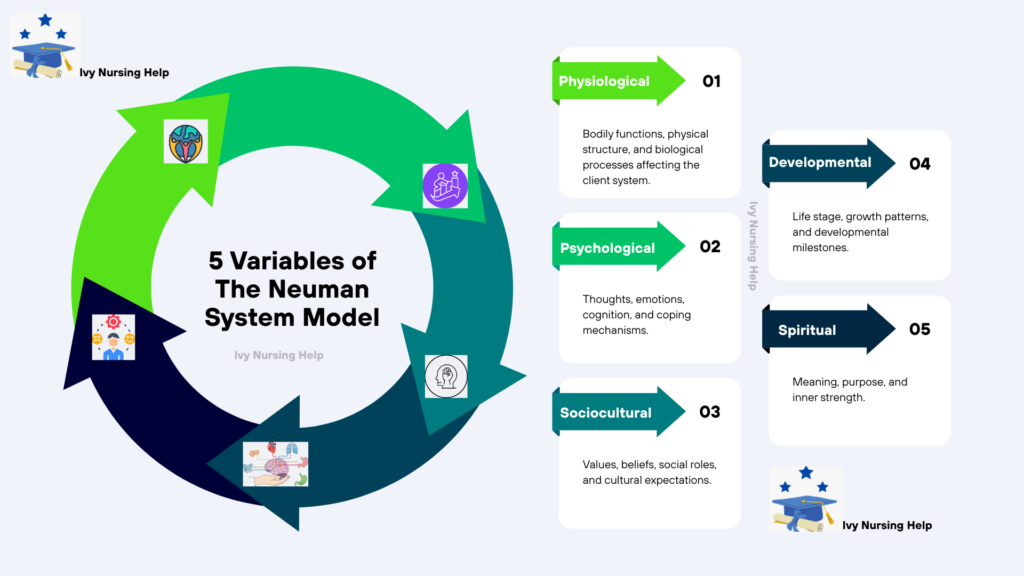
In the Betty Neuman Systems Model Theory, the Neuman system model identifies five key variables that interact to shape a person’s response to any stressor:
Physiological: bodily functions, physical structure, and biological processes affecting the client system.
Psychological: thoughts, emotions, cognition, and coping mechanisms.
Sociocultural: values, beliefs, social roles, and cultural expectations.
Developmental: life stage, growth patterns, and developmental milestones.
Spiritual: meaning, purpose, and inner strength.
These variables form the foundation of the conceptual model, influencing nursing practice, nursing goals, and overall system stability.
What are the three types of prevention identified in Betty Neuman’s model?
The Betty Neuman Systems Model Theory outlines three prevention levels applied within the nursing process to protect the line of defense and promote wellness:
Primary prevention: actions taken before a stressor invades the normal line of defense; includes health education, screenings, and risk reduction.
Secondary prevention: occurs after stressor invasion; focuses on early diagnosis, timely nursing intervention, and strengthening the line of resistance.
Tertiary prevention: supports recovery after treatment; aims to restore system stability, enhance reconstitution, and prevent further complications.
These prevention strategies are widely taught in the school of nursing and applied in diverse areas of nursing care.
What is the Neuman concept?
According to the Betty Neuman Systems Model Theory, the Neuman concept views the person as an open system interacting withinternal and external environments.
Using the Neuman approach, the goal is to maintain wellness by protecting theflexible line of defense and preventing stressor penetration.
This concept supports holistic patient care, emphasizing comprehensive assessment and prevention-focused nursing practice.
What did Betty Neuman theorize health as?
Betty Neuman theorized health as a continuum of wellness to illness, shaped by the balance between stressors and the strength of the client’s defenses.
In the Betty Neuman Systems Model Theory, health represents optimal patient care, functional stability, and harmonious interaction within the Neuman system.
Health reflects the ability of the client system to maintain balance, supported by effective nursing intervention, prevention strategies, and a holistic approach that aligns with major nursing theories.

