

Ace Star Model
1. Introduction
Why Organizational Models Matter
- In modern clinical practice, healthcare professionals must translate research into action quickly.
- Without structured models like the Ace Star Model, evidence-based practice can remain unused, affecting patient outcomes and healthcare quality.
Overview of the Ace Star Model
- The Ace Star Model—also called the star model of knowledge transformation—was developed by Dr. Kathleen Stevens to guide the transformation of research into practical application.
- The model explains how knowledge moves from discovery to improved clinical practice through structured stages.
- Widely used in evidence-based practice in nursing, the star model helps clinicians implement EBP effectively.
- This article explains the model, its stages, its role in evidence-based practice, and how healthcare professionals apply it to improve decision-making and patient care.
Relevance: Who Should Care and Why
- The Ace Star Model is important for many professionals involved in healthcare improvement and evidence-based practice implementation.
- Key audiences include:
- Healthcare leaders – use the Ace Star Model to guide system-level adoption of research in clinical practice.
- Nurse educators and clinicians – apply the star model to strengthen competency in evidence-based practice in nursing.
- Healthcare consultants – rely on the star model of knowledge transformation to translate research findings into policy and workflow improvements.
- HR professionals and project managers – use the model to align organizational goals with EBP initiatives.
- The model supports the creation of evidence summary resources that guide better healthcare decisions.
Transition to Main Sections
- Understanding the Ace Star Model provides a foundation for applying evidence-based practice effectively.
- In the following sections, we will explore the five stages of the model, how the star model of knowledge transformation works, and practical strategies for implementing evidence-based practice in nursing and healthcare systems.
2. Background and Origins
History: Development of the Ace Star Model
- The Ace Star Model originated in healthcare research to support the implementation of evidence-based practice in healthcare settings.
- The model was developed by Dr. Kathleen Stevens, who introduced the star model of knowledge transformation in 2004 to explain how research findings move from discovery into real-world clinical practice.
- The Ace Star Model gained recognition in evidence-based practice in nursing because it provides a structured pathway for converting scientific research into practical care improvements.
- Through the star model, healthcare professionals can transform raw research into an evidence summary, practice guidelines, and improved patient outcomes.
- Today, the Ace Star Model is widely used to guide EBP implementation and strengthen healthcare provider competency in applying research evidence.
Conceptual Foundations: Theoretical Influences
- The Ace Star Model builds on several conceptual foundations that guide knowledge transformation and organizational change.
- Systems thinking – The Ace Star Model views healthcare systems as interconnected environments where research influences clinical practice, policy, and professional competency.
- Star frameworks – Similar to other star model frameworks in organizational design, the model uses a structured approach to explain relationships between knowledge, implementation, and outcomes.
- Evidence translation theory – The star model of knowledge transformation emphasizes moving research into actionable evidence summary resources that clinicians can use.
- These concepts support effective EBP adoption and promote stronger evidence-based practice in nursing and interdisciplinary healthcare improvement.
Core Principles: Structure of the Ace Star Model
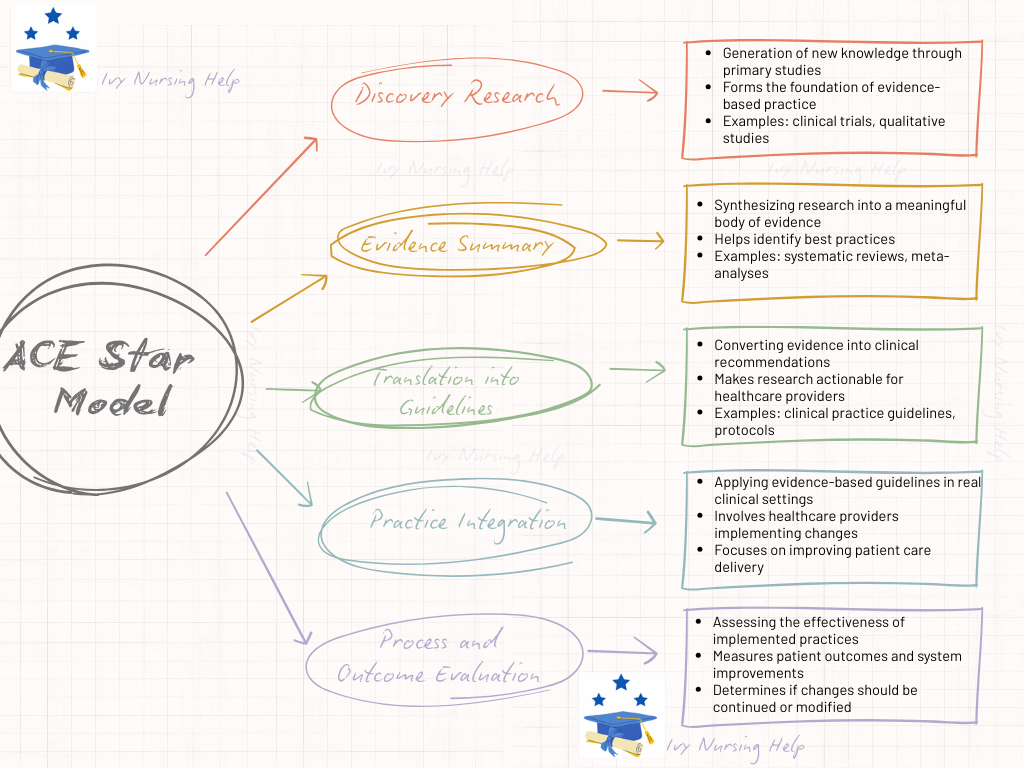
- The Ace Star Model is built on a five-point structure that represents stages of knowledge transformation.
- Each point of the star model reflects a step-in turning research into practice:
- Knowledge discovery – generation of research evidence relevant to clinical practice.
- Evidence summary – synthesis of findings into usable knowledge.
- Translation into guidelines – converting research into practical protocols supporting evidence-based practice.
- Practice integration – implementing EBP strategies in healthcare settings.
- Evaluation of outcomes – assessing whether evidence-based practice in nursing improves patient care.
- By following these principles, the Ace Star Model strengthens professional competency and supports systematic implementation of research findings.
3. Components of the Ace Star Model
Overview of the Five Points
- The Ace Star Model represents a structured star model framework designed to guide organizations in implementing evidence-based practice.
- The five points of the model—Alignment, Capability, Execution, Stakeholders, and Technology—support the star model of knowledge transformation, enabling effective EBP adoption and improved clinical practice through strong competency, collaboration, and evidence summary use.
Point A — Alignment
Definition
- Alignment within the Ace Star Model refers to ensuring that organizational goals, strategies, and priorities support evidence-based practice initiatives.
- The star model emphasizes aligning policies, leadership vision, and healthcare standards with evidence-based practice in nursing.
Objectives
- Integrate EBP principles into institutional missions and strategic plans.
- Ensure research evidence and evidence summary findings guide decision-making.
- Strengthen clinical practice by aligning professional standards with the Ace Star Model framework.
Typical Practices
- Leadership endorsement of the Ace Star Model for knowledge translation.
- Development of policies supporting the star model of knowledge transformation.
- Establishment of competency-based training to reinforce evidence-based practice in nursing.
- Alignment of care guidelines with research evidence developed by Stevens and other scholars.
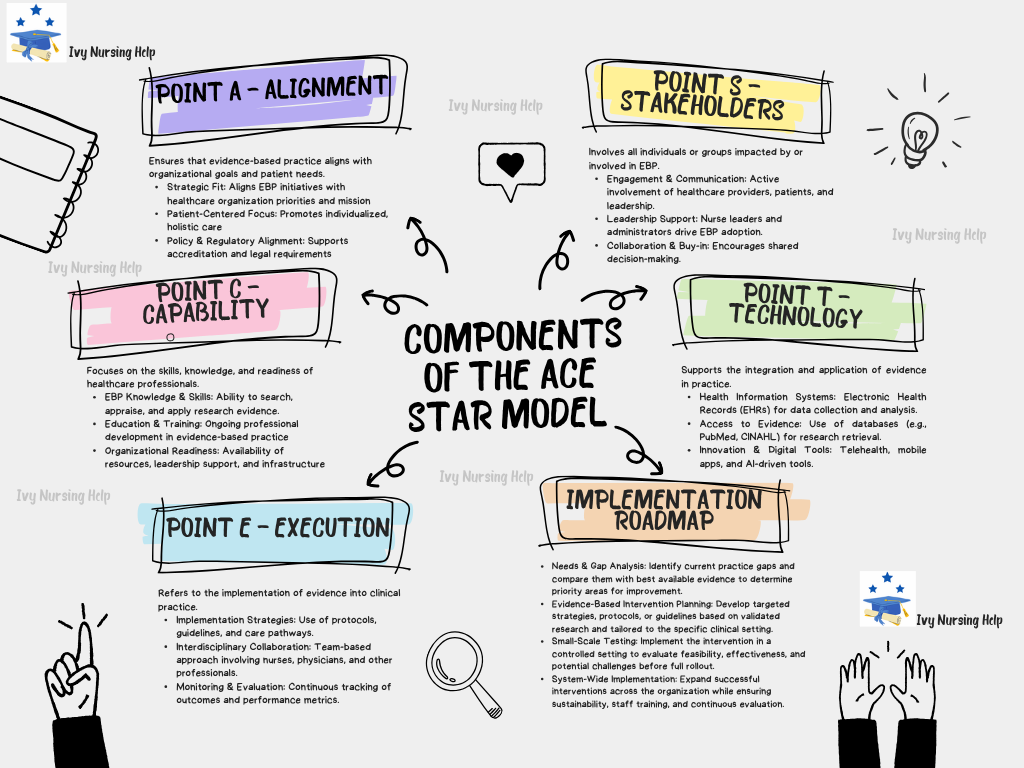
Point C — Capability
Skills Development
- The Ace Star Model highlights the importance of professional competency in implementing evidence-based practice.
- Healthcare providers must develop skills in research appraisal, evidence summary interpretation, and EBP integration.
Resources and Infrastructure
- Organizations adopting the Ace Star Model must provide access to research databases, learning platforms, and mentorship programs.
- The star model framework supports continuous professional development in evidence-based practice in nursing.
Training and Education
- Workshops on the star model of knowledge transformation help clinicians understand research translation.
- Simulation training enhances clinical practice decision-making based on EBP.
Measurement of Capability
- Competency assessments ensure clinicians apply evidence-based practice effectively.
- Evaluation tools measure the success of Ace Star Model training initiatives.
Point E — Execution
Definition and Processes
- Execution in the Ace Star Model refers to implementing evidence-based practice strategies in real healthcare settings.
- The star model guides organizations in converting research findings into practical clinical practice protocols.
Governance and Leadership
- Effective governance ensures EBP initiatives follow the Ace Star Model principles.
- Leaders monitor compliance with evidence-based standards and support interdisciplinary collaboration.
Implementation Strategies
- Integration of research findings and evidence summary materials into clinical guidelines.
- Application of the star model of knowledge transformation to ensure consistent practice improvements.
Key Performance Indicators (KPIs)
- Patient outcomes improvement.
- Adoption rates of evidence-based practice in nursing.
- Staff competency in implementing the Ace Star Model.
Point S — Stakeholders
Stakeholder Engagement
- The Ace Star Model recognizes that successful evidence-based practice implementation depends on strong stakeholder participation.
- Stakeholders include clinicians, administrators, educators, and policymakers.
Communication Strategies
- Clear communication ensures that the star model principles are understood across departments.
- Sharing evidence summary reports helps stakeholders make informed decisions.
Defined Roles and Responsibilities
- Nurses apply evidence-based practice in nursing within daily clinical practice.
- Leaders champion the Ace Star Model to strengthen EBP culture.
- Educators train healthcare professionals on the Star model of knowledge transformation.
Collaborative Impact
- Stakeholder engagement strengthens organizational competency and promotes sustained adoption of the Ace Star Model.
Point T — Technology
Technology as an Enabler
- Technology supports the Ace Star Model by enabling efficient knowledge sharing and evidence-based practice implementation.
- Clinical decision-support systems integrate evidence summary findings into clinical practice workflows.
Integration Considerations
- Electronic health records support EBP integration.
- Digital learning platforms enhance competency in evidence-based practice in nursing and support the star model of knowledge transformation developed by Stevens.
4. How the Ace Star Model Works in Practice
Implementation Roadmap: Assessment, Design, Pilot, and Scale
- The Ace Star Model explains how organizations move research findings into practice through a structured model of evidence-based practice.
- The model of knowledge transformation begins with assessment, where clinicians examine a clinical problem using nursing research, research articles, and best available evidence. This step often includes reviewing a systematic review, determining the level of evidence, and assessing the strength of evidence.
- Design involves developing an EBP project that translates research findings into evidence-based clinical practice guidelines or a clinical practice guideline.
- During the pilot phase, healthcare teams test the implementation of evidence-based practice within a limited setting to evaluate patient care outcomes.
- Finally, organizations scale implementation, expanding the use of evidence-based practice across departments to improve nursing care, nursing practice, and patient-centered care through the Ace Star Model framework.
Interaction Between Points: Feedback Loops and Governance
- The Ace Star Model functions as an interactive model that depicts research as a dynamic process of interconnected decisions guiding practice in nursing and healthcare.
- The Star model provides a framework where organizational participants use their knowledge and use their knowledge and skills to guide practice integration and practice change.
- Through governance structures, leaders oversee EBP implementation, ensuring that integrating best evidence into practice occurs consistently.
- The Star Model highlights five major stages, where primary research evolves into an evidence summary, then into evidence-based clinical practice guidelines, and finally into practice integration.
- Continuous feedback loops ensure teams can accept or reject the evidence in relation to outcomes, supporting quality improvement and strengthening the implementation of EBP.
Case Example: Applying the Ace Star Model
- Consider a clinical nurse team addressing high infection rates in a hospital unit. Using the Ace Star Model, the team begins with primary research and research articles published in the Journal of Nursing and other information resources for the model.
- Through the Star model, clinicians identify the best evidence and conduct a systematic review to determine best practice interventions.
- The team develops a practice model and a new clinical practice guideline based on integrating best evidence into practice.
- During EBP implementation, the hospital provides education and training for conducting the implementation of practice change and strengthening evidence-based practice competencies.
- After applying the intervention, the organization evaluates patient care improvements and confirms that the Ace Star Model successfully translated research into practice and enhanced nursing care.
Achieve Excellence in Your Nursing Capstone Project
Get support to research, write, and polish a capstone project today at Ivy Nursing Help. Start for impressive grades and success.
Common Pitfalls and How to Avoid Them
- While the Ace Star Model supports the implementation of evidence-based practice, several challenges may arise:
- Limited knowledge and skills – Clinicians may lack knowledge and skills to foster effective EBP models’ adoption. Organizations should provide the necessary education and training for conducting the implementation of EBP projects.
- Weak organizational culture – Without leadership support, practice change may fail. The Ace Star Model emphasizes strengthening organizational culture to support implementing EBP.
- Poor evidence appraisal – Teams must evaluate forms of evidence carefully, using model definitions and salient points from recognized frameworks, such as Sigma Theta Tau International guidance.
- By addressing these barriers, the Ace Star Model helps healthcare organizations systematically integrate best evidence and improve patient-centered care.
5. Measuring Success and KPIs
Quantitative Metrics: Productivity, Cycle Time, Cost, and Adoption Rates
- The Ace Star Model helps organizations evaluate the implementation of evidence-based practice through measurable indicators that show whether research findings are being put into practice and are improving outcomes.
Productivity metrics
- Measure how efficiently healthcare teams implement evidence based practice within nursing practice and practice in nursing and healthcare.
- The Ace Star Model of knowledge transformation ensures research into practice improves workflow and clinical outcomes.
Cycle time
- Tracks how quickly primary research, research articles, and systematic review findings move toward practice integration and implementation of practice change.
Cost and resource utilization
- Monitoring costs helps determine whether EBP implementation and quality improvement initiatives improve patient care without unnecessary resource use.
Adoption rates
- Organizations track how many clinical nurse teams adopt evidence-based clinical practice guidelines, reflecting the use of evidence-based practice and successful implementation of EBP using the Ace Star Model.
Qualitative Indicators: Engagement, Satisfaction, and Cultural Alignment
- The Ace Star Model also measures success using qualitative indicators that reflect cultural and behavioral change.
Employee engagement
- Clinicians participating in EBP projects demonstrate improved knowledge and skills, strengthening evidence-based practice competencies.
Stakeholder satisfaction
- Healthcare leaders evaluate whether best available evidence, clinical practice guideline implementation, and best practice standards improve patient-centered care.
Organizational culture alignment
- A supportive organizational culture promotes the adoption of practice change and encourages teams to integrate the most current research.
- The Ace Star Model and other evidence-based practice models help organizations determine whether staff are effectively systematically integrating best evidence into nursing care and daily clinical practice.
Tools and Dashboards: Monitoring and Evaluation
- Healthcare organizations use digital tools to monitor Ace Star Model implementation and EBP process outcomes.
- Dashboards may track the level of evidence, the strength of evidence, and the progress of research implementation in health services.
- These monitoring tools support action on research implementation and ensure practice change aligns with best evidence.
- The star model provides a framework where organizational participants use their knowledge and use their knowledge and skills to evaluate progress.
- By using structured dashboards, leaders can accept or reject the evidence in relation to outcomes and refine nursing practice strategies accordingly.
6. Comparison with Other Models
ACE Star vs. SWOT, RACI, Balanced Scorecard: Similarities and Differences
- The Ace Star Model is a widely recognized model of evidence-based practice that focuses on translating nursing research and research findings into practice through five major stages.
- The Ace Star Model of knowledge transformation helps clinicians convert primary research into evidence-based clinical practice guidelines that improve patient care and nursing practice.
Compared with the SWOT analysis
- SWOT evaluates strengths, weaknesses, opportunities, and threats in an organization, while the Ace Star Model focuses on research into practice and implementation of evidence-based practice.
Compared with RACI frameworks
- RACI clarifies roles in projects, whereas the Ace Star Model supports practice integration by transforming best available evidence into clinical practice guideline recommendations.
Compared with the Balanced Scorecard
- Balanced Scorecard measures organizational performance, while the star model provides a framework for integrating best evidence into practice and supporting quality improvement in nursing and healthcare.
When to Choose Ace Star Over Alternatives
- The Ace Star Model is ideal when organizations want to move research findings into practice and strengthen evidence-based nursing initiatives.
- Unlike general management frameworks, the star model emphasizes systematically integrating best evidence from research articles, systematic reviews, and other forms of evidence into nursing care.
- Healthcare organizations often select the Ace Star Model when implementing EBP projects, improving evidence-based practice competencies, and supporting the implementation of EBP initiatives that enhance patient-centered care and clinical nurse decision-making.
Hybrid Approaches and Integration Tips
- Many healthcare organizations combine the Ace Star Model with other evidence-based practice models.
- For example, the Iowa Model focuses on identifying clinical triggers, while the Ottawa model is an interactive framework for the implementation of practice change.
- Using hybrid approaches helps organizational participants use their knowledge and skills to integrate the most current research and strengthen EBP implementation.
7. Practical Tips for Leaders and Practitioners
Quick Wins to Start Implementing Ace Star
- The Ace Star Model helps organizations translate new knowledge into practical improvements in healthcare delivery.
- Leaders can start by following essential steps that encourage clinicians to adopt a problem-solving approach to clinical challenges.
- The model involves searching for new knowledge through current research and evidence resources such as the Hopkins nursing databases.
- The star model aids in systematically guiding teams through a relative sequence of research translation activities.
- This model aids in systematically integrating current research to create effective solutions that meet the needs of modern healthcare practice.
Change Management and Stakeholder Buy-In Tactics
- Successful adoption of the Ace Star Model requires strong leadership and stakeholder engagement.
- The Ace Star Model is an interactive framework because it is an interactive model where collaboration drives improvement.
- Leaders should provide clinicians with a practice framework and develop a practice document that outlines procedures regarding evidence-based practice.
- These strategies help the model meet the needs of teams implementing practice change.
Maintaining Momentum and Continuous Improvement
- The Ace Star Model supports ongoing learning and improvement in healthcare systems.
- Because models serve as organizing guides, the Ace Star Model encourages teams to continually evaluate practice outcomes.
- These models help organizations sustain progress while integrating evidence into practice and ensuring improvements continue to meet the needs of healthcare professionals and patients.
8. Conclusion
Recap of Main Benefits and Takeaways
- The Ace Star Model is a powerful framework that guides healthcare professionals in translating new knowledge into improved clinical outcomes.
- The Ace Star Model shows how research moves through a relative sequence of essential steps that support a problem-solving approach to clinical challenges.
- Because the model is an interactive model, it encourages teams to collaborate and apply evidence regarding evidence-based practice.
- The star model aids in systematically organizing knowledge so healthcare professionals can meet the needs of patients and improve care delivery.
- Ultimately, the Ace Star Model demonstrates how structured framework models serve as organizing guides for healthcare improvement.
Next Steps and Further Learning
- Healthcare leaders and practitioners can use the Ace Star Model to strengthen practice change and evidence translation.
- The Ace Star Model involves searching for new knowledge and applying current research to create better healthcare solutions.
- Organizations should provide clinicians with a practice framework and develop a practice document to guide implementation.
9. FAQs: ACE Star Model
How to Use the Ace Star Model?
- The Ace Star Model is used to guide healthcare professionals in translating research into improved patient care.
- The Ace Star Model involves searching for new knowledge from research and applying it through essential steps regarding evidence-based practice.
- The star model aids in systematically transforming evidence so clinicians can follow a problem-solving approach to clinical decision-making.
- This process helps organizations provide clinicians with a practice framework and create a practice document to support implementation.
- Because the model is an interactive model, teams collaborate to meet the needs of modern healthcare practice.
What Are the Stages of the ACE Star Model?
- The Ace Star Model follows a relative sequence of stages designed to move research into practice.
- These stages include knowledge discovery, evidence summary, translation into guidelines, practice integration, and evaluation.
- The Ace Star model aids in systematically integrating current research to create practical improvements in care.
- These stages help ensure healthcare teams apply evidence effectively and continuously improve practice.
What Are the 5 Stages in Benner’s Model?
- Benner’s nursing framework describes professional growth through five stages: novice, advanced beginner, competent, proficient, and expert.
- While different from the Ace Star Model, both models serve as organizing guides that help clinicians develop skills and improve decision-making in healthcare environments.
What Are the 7 Priority Setting Frameworks in Nursing?
- Priority frameworks help nurses make safe clinical decisions.
- Common frameworks include ABCs (Airway, Breathing, Circulation), Maslow’s hierarchy, safety-risk reduction, urgent vs. non-urgent care, nursing process priorities, patient-centered care, and clinical stability.
- These frameworks complement the Ace Star Model and other models to help healthcare teams improve patient outcomes and clinical efficiency.
