

Virginia Henderson Need Theory
I. Introduction
- Definition of Nursing According to Virginia Henderson
- Virginia Henderson Need Theory defines nursing as assisting individuals who are either sick or well in performing activities that improve their health, recovery, or contribute to a peaceful death—activities they would perform unaided if they had the necessary strength, will, or knowledge. This definition of nursing highlights the nature of nursing as an empowering profession that promotes human needs and independence.
- Virginia Henderson, a renowned nurse theorist, developed the nursing need theory based on the idea that nurses serve to help patients meet their basic needs until they can do so themselves. Educated at the Army School of Nursing, Henderson became one of the most influential figures in the nursing profession, emphasizing the importance of evidence-based and holistic nursing care. She identified the 14 basic needs necessary for human survival and wellness, forming the core of the Virginia Henderson Need Theory.
- Nursing theories, such as the Virginia Henderson Need Theory, provide a structured foundation for nursing practice, guiding nurses in assessment, intervention, and evaluation. The theory integrates the nursing process with the patient’s 14 basic needs, allowing nurses to create individualized nursing care plans that restore autonomy and promote health. In nursing schools, the Virginia Henderson Need Theory continues to shape the education of future nurses by illustrating the nature of nursing as compassionate, scientific, and human-centered. By focusing on nursing care, basic needs, and human needs, Henderson’s model bridges theory and real-world nursing practice, reinforcing the nurse’s role in promoting holistic well-being.
II. Origin of the Theory
- A. Background of Virginia Henderson
- Virginia Henderson was a distinguished nurse theorist whose work became one of the most influential nursing theories in the 20th century. She studied at the Army School of Nursing in Washington, D.C., where her early experiences shaped her understanding of patient independence and holistic nursing care. Her teaching career at the Yale University School of Nursing further strengthened her belief in combining theory with nursing practice, leading to the creation of the Virginia Henderson Need Theory. Henderson’s goal was to define the nature of nursing clearly and distinguish it from other healthcare professions. Her definition of nursing emphasized assisting individuals in meeting their basic needs, a concept that became central to her theoretical framework.
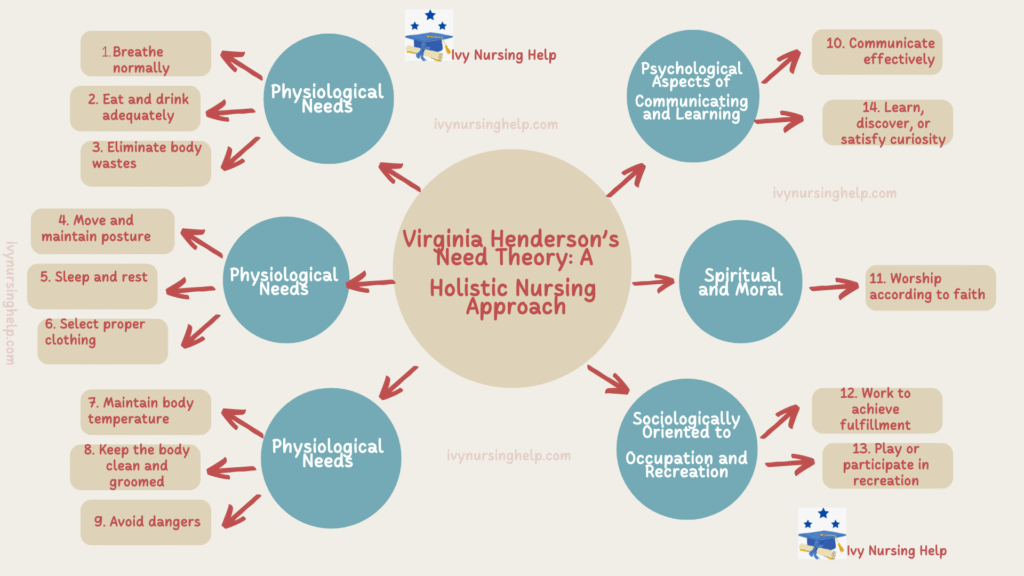
- The Virginia Henderson Need Theory evolved from her recognition that patients require support in fulfilling 14 basic needs—essential elements of human survival and well-being. These 14 basic components address human needs, such as breathing, eating, moving, resting, communicating, and maintaining personal hygiene. Each of these elements helps guide nurses in assessing patients and creating effective nursing care plans. Henderson’s nursing need theory is grounded in the nursing process, where assessment, diagnosis, planning, implementation, and evaluation are centered on promoting patient independence. Her theory aligns with the holistic approach to nursing care, acknowledging the biological, psychological, sociological, and spiritual dimensions of human beings. The Virginia Henderson Need Theory continues to influence nursing education, helping students understand how theoretical principles are applied in practical care strategies.
- The Army School of Nursing instilled in Virginia Henderson a disciplined approach to patient care, emphasizing efficiency, compassion, and responsibility—values that became the foundation of her nursing need theory. Later, at Yale University School of Nursing, she advanced her research on the nature of nursing, making significant contributions to professional education and developing her ideas into a structured theoretical model. These institutions provided her with the academic and practical grounding necessary to refine the Virginia Henderson Need Theory, making it one of the most applicable nursing theories in the nursing profession today.
- A. Background of Virginia Henderson
III. Fundamental Cores of the Theory
- A. Explanation of the 14 Basic Needs
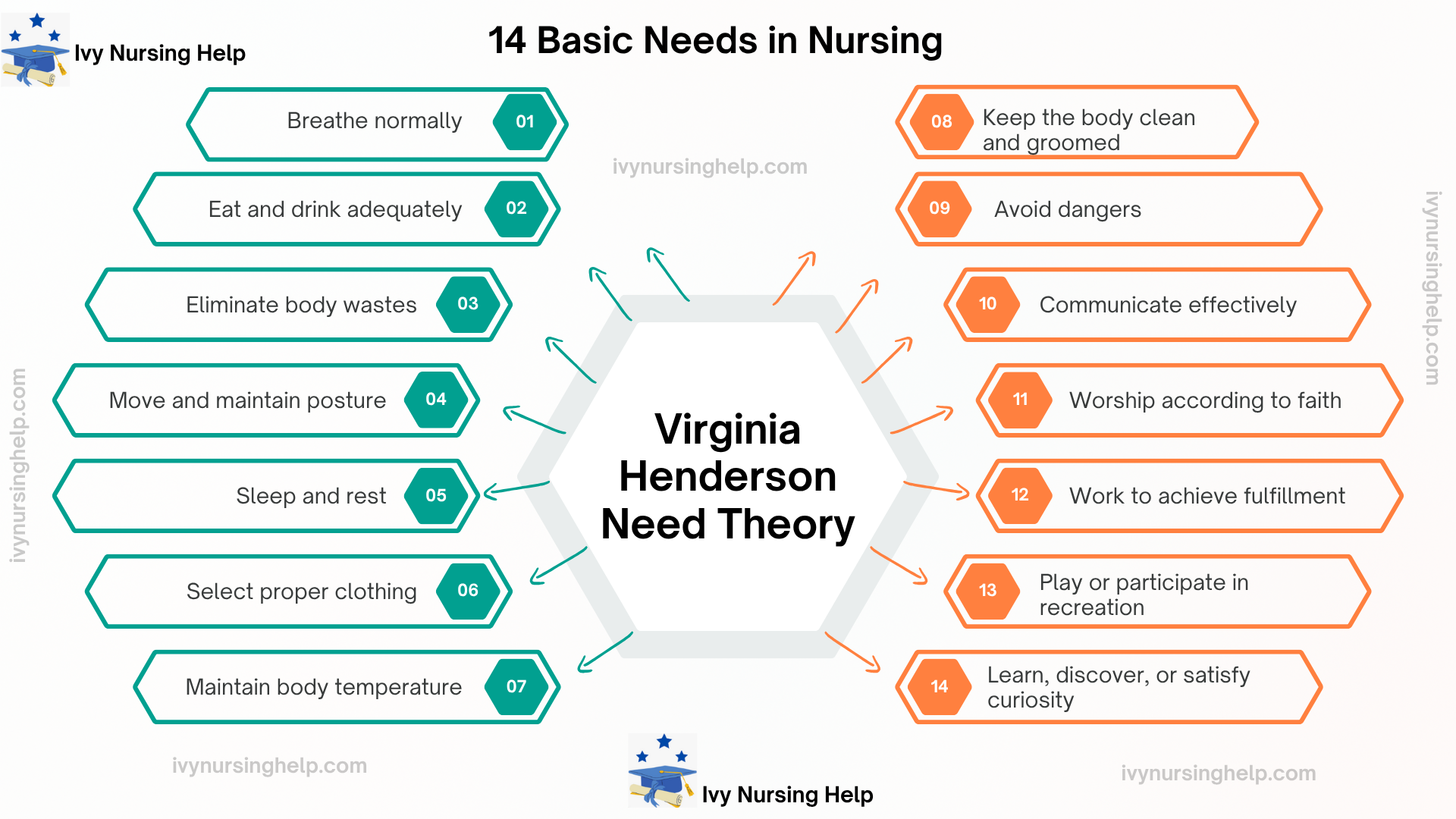
- The Virginia Henderson Need Theory centers around 14 basic needs that form the foundation of effective nursing care. These basic needs represent essential human needs for health and independence.The 14 basic components include breathing, eating, eliminating body wastes, moving, resting, dressing, maintaining body temperature, hygiene, avoiding danger, communicating, worshiping, working, recreating, and learning.Each need helps nurses identify where patients require support to regain independence. The Virginia Henderson Need Theory utilizes these elements to inform individualized nursing care plans, which are based on the nursing process: assessment, diagnosis, planning, implementation, and evaluation.By understanding these basic needs, nurses can tailor interventions that promote patient comfort, safety, and recovery, embodying the holistic nature of nursing described by Virginia Henderson.
- According to the Virginia Henderson Need Theory, the nature of nursing lies in helping patients perform tasks they would do unaided if they had the strength, will, or knowledge.As a pioneering nurse theorist, Virginia Henderson emphasized that it is a nurse’s duty to promote independence and dignity through compassionate nursing care.The nurse acts as a substitute when patients lack strength, a helper when patients need assistance, and a partner when promoting health. This framework distinguishes the nursing profession from other healthcare roles, reinforcing the definition of nursing as a supportive, restorative, and educational process.
- The Virginia Henderson Need Theory remains one of the most influential nursing theories in modern nursing schools and nursing practice.It provides a structured theoretical base for the nursing process, ensuring that care is systematic and centered on meeting patient needs.Henderson’s nursing need theory links human needs to care delivery, allowing nurses to address physical, emotional, and social well-being holistically.The theory also encourages evidence-based nursing care, ensuring that each nursing care plan aligns with the patient’s ability to meet their own basic needs independently.
- The main goal of the Virginia Henderson Need Theory is to help individuals achieve independence in meeting their 14 basic needs.Virginia Henderson believed that nurses must focus on restoring the balance between health and illness through personalized nursing care.The nursing need theory underscores the nurse’s responsibility to promote wellness, prevent illness, and support recovery.Drawing from her education at the Army School of Nursing, Henderson developed a practical framework that connects the nature of nursing with patient-centered outcomes.Ultimately, the Virginia Henderson Need Theory provides a universal model for nursing practice, empowering the nursing profession to deliver holistic, compassionate, and evidence-based care across all healthcare settings.
Excel in Your Nursing Theory Paper with Ease
Need help writing your nursing theory paper? Ivy Nursing Help delivers expertly researched, plagiarism-free papers tailored to your topic. Impress your professors—order now and achieve academic excellence effortlessly!
IV. Impact on Nursing Research
- A. Contribution to Nursing Education and Nursing Schools
- The Virginia Henderson Need Theory transformed the way nursing schools teach the science of nursing and the concept of nursing.
- Virginia Avenel Henderson, often called “the first lady of nursing,” began teaching nursing at the Norfolk Protestant Hospital in Virginia and later at the School of Nursing at Walter Reed Hospital. These experiences shaped Virginia Henderson’s nursing theory, which connects education, research, and clinical care.
- The Virginia Henderson Need Theory emphasizes that nurses must understand basic human needs and how they relate to health and illness. This concept remains integral in modern teaching nursing programs and nursing theories study guides.
- Henderson graduated from the Army School of Nursing in 1921, which deeply influenced her philosophy on independence and care. Her need theory emphasizes the importance of developing competent and compassionate nurses who can apply Henderson’s theory in various settings.
- B. Application of Henderson’s Theory in Nursing Research
- The Virginia Henderson Need Theory provides a guide for nursing research focused on basic health needs and required assistance.
- Researchers useVirginia Henderson’s definition of nursing to explore how the practice of nursing promotes independence and patient well-being.
- Henderson’s theory emphasizes that patients are individuals with basic needs who sometimes require assistance to maintain health.
- Many studies applied to nursing practice use Henderson’s nursing theory to assess patient care quality, the nurse-patient relationship, and outcomes from nursing care plans.
- The Virginia Henderson Need Theory remains an essential nursing theory guide for scholars and educators worldwide.
- C. Influence on Nursing Care Plans and Implementation of Nursing
- The Virginia Henderson Need Theory serves as a foundation for the implementation of the nursing process and individualized nursing care plans.
- Each nursing care plan integrates the needs identified by Virginia Henderson, ensuring care aligns with patients’ basic health needs and requires assistance only where necessary.
- The theory emphasizes a structured approach to the practice of nursing, promoting autonomy and holistic nursing care.
- Virginia Henderson developed a universal model that acts as a guide for nursing practice across all health systems, making her work vital for advanced nursing practice.
- D. International Nursing and Promotion of Nursing Theories
- The Virginia Henderson Need Theory has had a lasting impact on international nursing education and policy.
- Henderson worked with the International Nursing Council, helping to establish the Virginia Henderson International Nursing Library as a global repository for nursing research.
- She was honored by the Virginia Nurses Association, receiving the Virginia Historical Nurse Leadership Award for being among the pioneer nurses in Virginia.
- Henderson received numerous recognitions for her role in global nursing, where Virginia Henderson’s nursing theory became a standard reference in the nursing and allied health sections of many universities.
- Today, Virginia Henderson Need Theory continues to guide nursing practice and research, bridging theory and action to uphold the focus of nursing on independence, dignity, and patient-centered care.
In essence, the Virginia Henderson Need Theory stands as a cornerstone of the nursing profession, connecting the description of nursing with education, research, and basic nursing care worldwide.
V. Criticism of the Theory
- A. Limitations of Henderson’s Nursing Need Theory
- The Virginia Henderson Need Theory has been widely praised but also critiqued for certain limitations in the practice of nursing.
- Critics argue that while Henderson’s theory emphasizes independence and basic human needs, it may not fully address complex emotional and cultural factors that influence care.
- The Virginia Henderson Nursing Need Theory assumes that all patients share the exact basic health needs and require assistance, which may not apply universally across diverse populations.
- Although Virginia Henderson developed her model as a guide for nursing, some believe it lacks clear operational guidelines for advanced nursing practice and research.
- Nonetheless, the Virginia Henderson Need Theory remains a foundational theory in action that shaped the science of nursing worldwide.
- B. Comparison with Other Nursing Theories, such as the Adaptation Model of Nursing
- When compared to the Adaptation Model of Nursing, the Virginia Henderson Need Theory differs in focus and structure.
- The Adaptation Model highlights environmental stimuli and coping mechanisms, while the Virginia Henderson’s nursing theory focuses on meeting needs identified by Virginia Henderson—the 14 basic needs essential to independence and well-being.
- The need theory emphasizes the importance of maintaining balance between body, mind, and environment, whereas the Adaptation Model stresses adaptation to stressors.
- Both models have been applied to nursing practice and education, yet Virginia Henderson’s definition of nursing provides a more direct and human-centered approach.
- C. Discussions on Self-Care Deficit Theory versus Henderson’s Theory
- In comparing Orem’s Self-Care Deficit Theory and the Virginia Henderson Need Theory, both share a focus on assisting patients who require assistance to meet their basic health needs.
- However, Virginia Henderson’s nursing theory is broader, encompassing physical, emotional, and social well-being, while Orem’s framework emphasizes self-care activities.
- Henderson also believes that nurses act as temporary substitutes to restore independence, while Orem emphasizes the patient’s long-term ability to self-manage care.
- Many nursing theories study guides and nursing theories guides note that the Virginia Henderson Need Theory provides a more holistic concept of nursing, adaptable to all patient populations.
- D. Perspectives from the Royal College of Nursing
- The Royal College of Nursing acknowledges Virginia Avenel Henderson as one of the pioneer nurses in Virginia and a first lady of nursing whose description of nursing continues to inspire global standards.
- The College recognizes the Virginia Henderson Need Theory as vital to defining the focus of nursing and promoting patient autonomy in the implementation of the nursing process.
- Henderson worked with the International Nursing Council and helped establish the Virginia Henderson International Nursing Library, extending her influence beyond the United States.
- She was honored by the Virginia Nurses Association, receiving the Virginia Historical Nurse Leadership Award, celebrating her legacy in teaching nursing at the Norfolk Protestant Hospital in Virginia and the School of Nursing at Walter Reed Hospital.
Even though the Virginia Henderson Need Theory has faced critique for simplicity and limited cultural scope, it remains a timeless guide for nursing practice frameworks that connect the theory of human needs with the art and science of nursing worldwide.
VI. Conclusion
- A. Summary of Virginia Henderson’s Need Theory
- The Virginia Henderson Need Theory remains one of the most significant frameworks in the nursing profession. It emphasizes that nursing’s primary role is to assist individuals in performing activities that promote health, recovery, and independence.
- Virginia Henderson was born in Kansas City in 1897 and became widely known as “the first lady of nursing” for her lasting contributions to the science of nursing.
- According to Henderson, nurses must focus on restoring a patient’s independence by meeting the needs of Virginia Henderson—the 14 fundamental human needs that form the foundation of her model.
- The Virginia Henderson Need Theory integrates compassion, competence, and scientific reasoning into nursing practice, making it a timeless guide in patient-centered care.
- B. Reflection on Its Ongoing Relevance in the Nursing Profession
- The Virginia Henderson Need Theory continues to shape modern nursing education, research, and clinical application.
- Even decades after Virginia Henderson worked in hospitals and academic settings, her ideas remain relevant to current healthcare challenges.
- Henderson worked at the Henry Street Visiting Nurse Service, where she gained insight into the realities of patient dependency and independence, experiences that influenced her theoretical approach.
- The Virginia Nurses Association recognized Henderson for her leadership and awarded her multiple honors for her pioneering role in developing theory-based nursing care.
- Her influence is often compared to other major models, including the 21 Nursing Problems Theory, showing her enduring presence among global nurse theorists.
- C. Future Implications for Nursing Practice and Research
- The Virginia Henderson Need Theory continues to guide new generations of nurses in developing evidence-based interventions that meet patients’ holistic needs.
- As healthcare evolves, Henderson was asked repeatedly to adapt her theory to modern systems—her ideas remain flexible and applicable in advanced nursing practice.
- Virginia Henderson received international acclaim for shaping the conceptual focus of nursing around independence and dignity.
- Today, scholars and practitioners apply the Virginia Henderson Need Theory to improve nursing education, research, and patient outcomes globally.
- De Virginia Henderson, whose work is known for her need theory, remains a cornerstone of professional identity and theoretical growth within nursing worldwide.
In essence, the Virginia Henderson Need Theory endures as a living framework, connecting compassion, autonomy, and science to elevate the global practice of nursing.
FAQs: Virginia Henderson Need Theory
- A. What is Virginia Henderson’s Basic Needs Theory?
- The Virginia Henderson Need Theory is a foundational framework in modern nursing practice that focuses on helping patients meet their basic needs to achieve health and independence.
- Developed by Virginia Henderson, the nursing need theory defines nursing as assisting individuals—sick or well—in activities that promote health or recovery.
- The Virginia Henderson Need Theory views the nurse as a key supporter who enables patients to regain independence, aligning nursing care with compassion, science, and patient dignity.
- This nursing theory remains a central guide for nursing professionals and educators worldwide.
- B. What are the 14 Needs of Virginia Henderson in Order?
- The needs of Virginia Henderson are summarized as 14 basic needs that represent the holistic dimensions of nursing care.
- These 14 basic needs include:
- Breathe normally
- Eat and drink adequately
- Eliminate body wastes
- Move and maintain posture
- Sleep and rest
- Select proper clothing
- Maintain body temperature
- Keep the body clean and groomed
- Avoid dangers
- Communicate effectively
- Worship according to faith
- Work to achieve fulfillment
- Play or participate in recreation
- Learn, discover, or satisfy curiosity
- These 14 basic needs form the core of the Virginia Henderson Need Theory, shaping how nurses assess and plan patient care.
- C. What are the Weaknesses of Henderson’s Theory?
- While highly influential, theVirginia Henderson Need Theory is sometimes seen as limited in addressing complex psychological or environmental aspects of care.
- It focuses more on physical basic needs than emotional or social challenges that patients may face.
- Despite these critiques, Virginia Henderson’s nursing theory remains a practical and widely used model in nursing practice.
- D. What was Virginia Henderson’s Most Significant Contribution to Nursing?
- Virginia Henderson made history when she started teaching nursing and later developed her renowned nursing need theory, which revolutionized the science of nursing.
- Her most significant contribution was the Virginia Henderson Need Theory, which clearly defined the nature of nursing, highlighting nurses’ roles in helping patients meet their basic needs and achieve independence.
E. What Inspired Henderson to Create the Theory?
- Virginia Henderson, often called “The First Lady of Nursing”, was inspired to develop the Virginia Henderson Need Theory through her passion for patient independence and holistic nursing care.
- She started teaching nursing after observing that many nurses lacked a clear understanding of their professional role.
- The needs of Virginia Henderson—centered on dignity, compassion, and health—led her to define thenature of nursingas helping patients meet their basic needs.
- Influenced by earliernursing theories, Henderson developed her framework to guide nurses toward promoting autonomy and evidence-based care.

