

Translation Science Models in Nursing
1. Introduction
- What Are Translation Science Models in Nursing?
- Translation science models in nursing refer to structured frameworks that guide how findings from translational research are systematically moved into real-world clinical practice. These models ensure that discoveries do not remain in journals but are transformed into safer, more effective patient care strategies.
- Rooted in translational science, these frameworks emphasize bridging the long-standing gap between research and bedside care by promoting the rapid integration of evidence-based practice.
- Many translation science models in nursing align with principles promoted by the National Institutes of Health, which advocate turning scientific knowledge into measurable improvements in public health and health services.
- Closely related to implementation science, translation science models in nursing focus on understanding the best methods for adopting innovations across diverse healthcare settings.
- Improve patient outcomes: By converting evidence into practice, translation science models in nursing help clinicians deliver interventions proven to work.
- Strengthen nursing practice: These models provide nurses with structured approaches to integrate research findings into daily workflows.
- Enhance research design: Nurse scholars use translation science models in nursing to build studies that are practical, scalable, and applicable to modern healthcare environments.
- Support healthcare systems: Effective application of translation science models in nursing improves care coordination, reduces variability, and advances population health initiatives.
- Purpose: This article presents a clear overview and comparison of major translation science models in nursing, highlighting their role in advancing clinical practice and professional decision-making.
- Scope: Readers will explore how translational science, implementation science, and evidence-based practice intersect to modernize nursing practice.
- Structure: The discussion examines leading frameworks, their application in health services, and how nurses translate research into actionable care strategies that benefit both individual patients and broader communities.
2. Background: Evidence-to-Practice Gap in Nursing
- Persistent Gap Between Research and Clinical Practice
- Translation science models in nursing address the long-standing disconnect between high-quality translational research and everyday clinical practice, where evidence is often underused or delayed.
- Despite growth in evidence-based practice, many research findings take years to influence real-world nursing practice, limiting their impact on patient care.
- Barriers such as limited resources, lack of training, organizational culture, and poor research design translation contribute to the evidence-to-practice gap.
- Translation science models in nursing provide structured pathways that help nurses systematically move knowledge from theory into action.
- Patient outcomes: Failure to apply current evidence can lead to inconsistent care, increased complications, and preventable adverse events.
- Patient safety: Without translation science models in nursing, outdated practices may persist, increasing the risk of medical errors.
- Healthcare costs: Inefficient health services delivery and unnecessary interventions raise operational and treatment expenses.
- Public health impact: Delayed uptake of innovations weakens population-level interventions and slows progress in public health improvement.
- Nursing practice strain: Nurses may rely on tradition rather than science, reducing confidence in clinical decision-making and professional autonomy.
- Translational science focuses on converting discoveries into practical solutions that improve patient and system-level outcomes.
- Implementation science complements this process by identifying strategies that support the consistent adoption of innovations in clinical practice settings.
- Translation science models in nursing integrate both disciplines to ensure evidence into practice is timely, feasible, and sustainable.
- Organizations such as the National Institutes of Health emphasize the importance of structured frameworks to close the research-to-care gap.
- By guiding nurses in applying research across settings, translation science models in nursing strengthen nursing practice, enhance care quality, and align research with real-world healthcare needs.
- Thus, translation science models in nursing are essential tools for transforming research evidence into meaningful, cost-effective, and safe patient care across modern healthcare systems.
3. Core Concepts in Translation Science
- Key Terms in Translation Science Models in Nursing
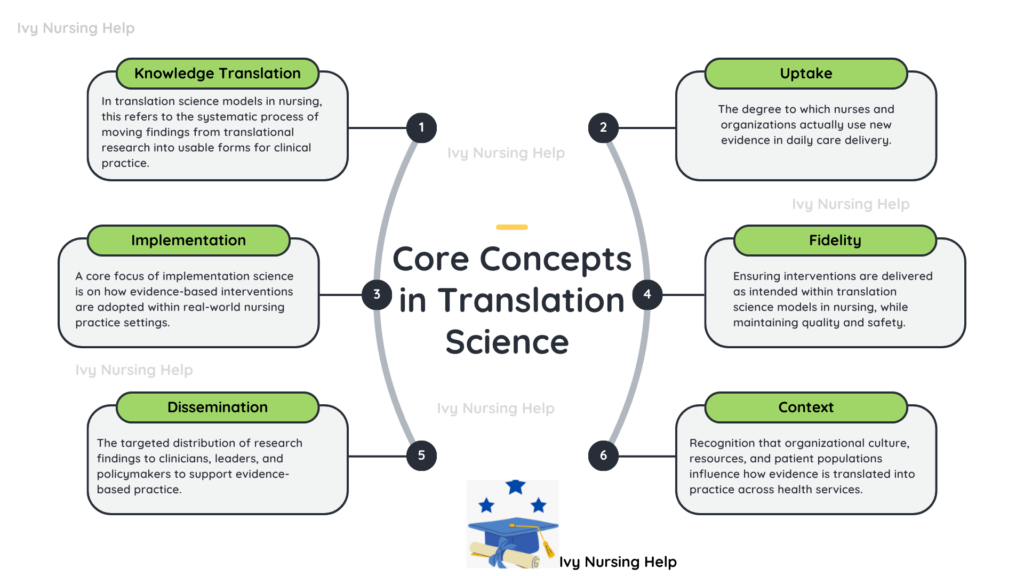
- Knowledge translation: In translation science models in nursing, this refers to the systematic process of moving findings from translational research into usable forms for clinical practice.
- Implementation: A core focus of implementation science is on how evidence-based interventions are adopted within real-world nursing practice settings.
- Dissemination: The targeted distribution of research findings to clinicians, leaders, and policymakers to support evidence-based practice.
- Uptake: The degree to which nurses and organizations actually use new evidence in daily care delivery.
- Fidelity: Ensuring interventions are delivered as intended within translation science models in nursing, while maintaining quality and safety.
- Context: Recognition that organizational culture, resources, and patient populations influence how evidence is translated into practice across health services.
- Stakeholder engagement: Translation science models in nursing prioritize collaboration among nurses, patients, leaders, and communities to improve relevance and outcomes in public health.
- Tailoring: Interventions are adapted to specific clinical settings without compromising scientific integrity orresearch design rigor.
- Sustainability: Long-term integration of evidence is essential so improvements persist beyond initial implementation efforts.
- Measurement: Ongoing evaluation ensures translation science models in nursing achieve meaningful clinical and system-level outcomes.
- System-level support: Guidance from organizations such as the National Institutes of Health reinforces the importance of translational science and structured frameworks.
- Overall impact: By addressing barriers and leveraging facilitators, translation science models in nursing help transform research findings into consistent, high-quality patient care across diverse healthcare environments.
4. Overview of Prominent Translation Science Models
4.1 Diffusion of Innovations (Everett Rogers)
- The Diffusion of Innovations theory is one of the foundational theoretical models frequently referenced within translation science models in nursing. Developed to explain how new ideas spread across social systems, it remains central to clinical and translational science and modern implementation science.
- Main constructs:
- Innovation: Refers to new evidence-based interventions, technologies, or clinical practice guideline updates derived from basic research, clinical research, and health research. Within translation science models in nursing, innovation supports the translation of research into safer care.
- Communication channels: Knowledge moves through professional networks, nursing literature, and dissemination research, strengthening knowledge translation and exchange.
- Time: Adoption occurs gradually along the translational spectrum, emphasizing the ongoing impact of knowledge translation.
- Social system: Organizational culture influences practice behaviors, leadership engagement, and the use of research.
- Adopter categories: Innovators, early adopters, early majority, late majority, and laggards illustrate the gap between research and practice.
- Application in nursing practice:
- Nurse leaders use this translation research model to guide vaccination campaigns, health promotion, infection prevention, and community and public health initiatives that improve the health of populations.
- Supports advanced practice nurses in integrating research findings into care pathways and practice recommendations.
- Strengths: Simple conceptual model, strong history in nursing science, and useful for dissemination and implementation research.
- Limitations: May oversimplify complex environments within implementation in health services. Still, translation science models in nursing frequently incorporate diffusion principles to translate evidence into practice and provide effective health services and products supported by agencies such as the National Institutes of Health and the National Center for Advancing Translational Sciences, part of the U.S. Department of Health and Human Services.
4.2 Knowledge-to-Action (KTA) Framework
- The Knowledge-to-Action framework is among the most widely applied models and frameworks in translation science models in nursing, offering a structured framework for knowledge translation that bridges research and practice. Rooted in clinical and translational approaches, KTA ensures the use of evidence derived from comparative effectiveness research and systematic review of studies.
- Core components:
- Knowledge creation funnel: Synthesizes best available research evidence from nursing research, health services research, and basic science into actionable tools.
- Action cycle:
- Identify a problem using research findings.
- Adapt knowledge to local public health settings.
- Assess barriers within health services.
- Select tailored implementation strategies.
- Monitor health outcomes.
- Evaluate the implementation of evidence-based practice.
- Sustain gains through leadership support.
- How nurses use KTA:
- Guides advanced practice nurses in translating research into protocols that provide evidence-based care.
- Functions as a model to guide organizational practice change, reinforcing the translation of evidence into practice.
- Encourages knowledge into practice through ongoing implementation research and research utilization.
- Why it matters:
- Reduces the gap between research and practice.
- Promotes safer nursing interventions and stronger health promotion strategies.
- Aligns with priorities supported by the National Academy of Medicine to develop effective health services.
Hence, translation science models in nursing frequently rely on KTA because it systematically connects research across the translational continuum and strengthens the application of evidence in modern healthcare systems.
4.3 PARIHS / i-PARIHS (Promoting Action on Research Implementation in Health Services)
- The Promoting Action on Research Implementation in Health Services framework—commonly called PARIHS—is a cornerstone of translation science models in nursing and a respected model of strategic change within implementation in health services. It emphasizes that successful research implementation in health services depends on three interacting elements: evidence, context, and facilitation.
- Core elements:
- Evidence: Combines research evidence, patient preferences, clinical expertise, and local data to support evidence based practice.
- Context: Evaluates readiness for practice change, leadership engagement, and organizational culture within the nursing discipline.
- Facilitation: Skilled facilitators help teams adopt innovations and encourage the adoption of research.
- i-PARIHS update: Adds recipients and strengthens facilitation, reinforcing the translation within complex healthcare environments.
- Practical facilitation approaches:
- Coaching teams on implementing evidence-based practice.
- Supporting knowledge translation workshops.
- Using audit-and-feedback methods to enhance research use.
- Aligning initiatives with clinical practice guideline recommendations.
- Empirical support:
- Frequently cited in nursing literature and dissemination and implementation research.
- Demonstrates measurable improvements in health outcomes when facilitation is strong.
Because of its emphasis on context, translation science models in nursing often integrate PARIHS concepts to ensure the implementation of evidence is sustainable and capable of helping organizations provide more effective health services and advance public health goals.
4.4 Iowa Model of Evidence-Based Practice
- The Iowa Model of Evidence-Based Practice—often shortened to the Iowa Model—is a highly practical evidence-based practice model and a widely adopted model of EBP within translation science models in nursing. Designed to promote team-driven decision-making, it helps clinicians translate evidence into practice while maintaining strong methodological rigor.
- Key steps:
- Triggering issues: Problems identified through clinical practice, risk data, or new evidence-based findings prompt inquiry.
- Team-based approach: Interdisciplinary teams evaluate the best available research evidence.
- Pilot testing: Small-scale trials validate feasibility before widespread implementation of evidence.
- Evaluation: Outcomes are measured to confirm improvements in effective health delivery.
- Dissemination: Results are shared through dissemination research channels to encourage broader research use.
- Usefulness for unit-level change:
- Ideal for hospital departments seeking structured practice change.
- Helps nurses move research into practice using a clear action model.
- Encourages using research to strengthen safety protocols and patient-centered care.
- Compared with the Stetler Model, the Iowa Model places stronger emphasis on organizational readiness and collaboration. For this reason, translation science models in nursing frequently highlight the Iowa Model as a gold standard for integrating research into workflows and closing the gap between research and practice across healthcare organizations.
4.5 Ottawa Model of Research Use
- The Ottawa Model of Research Use is a comprehensive conceptual model embedded within many translation science models in nursing, focusing on how the use of research leads to measurable improvements in care. Grounded in implementation research, it supports the translation of evidence into practice across diverse health services environments.
- Core processes:
- Assess barriers and facilitators affecting research utilization.
- Select targeted implementation strategies aligned with organizational goals.
- Promote adoption of evidence-based interventions.
- Monitor outcomes to ensure positive health outcomes and sustained change.
- Clinical examples:
- Implementing fall-prevention nursing interventions in acute care.
- Improving chronic disease management in community and public health settings.
- Standardizing care pathways based on clinical practice guideline recommendations.
- Why it stands out:
- Encourages continuous evaluation along the translational spectrum.
- Strengthens the connection between research and practice.
- Helps organizations develop evidence-based programs that improve the health of populations.
As healthcare systems prioritize clinical and translational science, translation science models in nursing frequently incorporate the Ottawa approach to ensure the application of evidence is systematic, measurable, and capable of advancing both public health and frontline care delivery.
4.6 Consolidated Framework for Implementation Research (CFIR)
- The Consolidated Framework for Implementation Research (CFIR) is an advanced structure within translation science models in nursing, synthesizing multiple models and frameworks into one comprehensive tool for planning and evaluation. Frequently used in health services research, CFIR supports rigorous research design and informed decision-making.
- Five domains:
- Intervention characteristics: Strength and adaptability of evidence-based interventions.
- Outer setting: Policies, incentives, and population needs influencing public health priorities.
- Inner setting: Organizational readiness for implementation of evidence-based practice.
- Characteristics of individuals: Skills and beliefs shaping practice behaviors.
- Implementation process: Structured steps that model to guide sustainable change.
- Benefits for nursing implementations:
- Enables systematic assessment before launching initiatives.
- Enhances knowledge translation across departments.
- Supports dissemination and implementation research aimed at improving quality.
Because it integrates insights from translational science, translation science models in nursing often rely on CFIR to strengthen planning, reduce uncertainty, and ensure innovations successfully move along the translational pathway from discovery to bedside care.
4.7 RE-AIM (Reach, Effectiveness, Adoption, Implementation, Maintenance)
- The RE-AIM framework is a powerful evaluation tool within translation science models in nursing, designed to measure the real-world impact of interventions across public health settings and clinical environments. Emerging from clinical and translational science, it emphasizes scalability and long-term sustainability.
- Key dimensions:
- Reach: The proportion of patients benefiting from interventions that provide evidence-based care.
- Effectiveness: Impact on safety, quality, and overall health outcomes.
- Adoption: Organizational willingness to support the implementation of evidence.
- Implementation: Consistency in delivering interventions as intended.
- Maintenance: Long-term integration into routine nursing practice.
- Nursing-relevant examples:
- Evaluating telehealth programs that expand access to effective health services.
- Measuring infection-control initiatives rooted in evidence-based practice.
- Scaling preventive programs that support health promotion.
By prioritizing measurable results, translation science models in nursing use RE-AIM to ensure innovations derived from translational research lead to meaningful improvements in patient care and help healthcare systems provide more effective health services across diverse populations.
Power Up Your Capstone Project Today
Struggling with your nursing Capstone Project? Let Ivynursinghelp.com guide you to excellence with expert support, research writing, and formatting. Get personalized help now and submit with confidence. Start your Capstone success journey today!
5. Comparative Analysis of Models
- Key Comparison Criteria for Translation Science Models in Nursing
- Translation science models in nursing differ based on purpose, scope, and methodological rigor, yet all aim to close the gap between research and practice through structured knowledge translation and implementation science.
- Purpose: Some translation science models in nursing focus on planning (e.g., Iowa Model, a widely recognized model of evidence-based practice), while others emphasize evaluation, measurement, and research utilization across health services research.
- Level of application: Models may target individual clinicians, unit-level nursing practice, organizational implementation in health services, or broader public health settings aligned with clinical and translational science priorities.
- Context and facilitation: Frameworks such as Promoting Action on Research Implementation in Health Services act as a model of strategic change, stressing organizational readiness and leadership—critical for implementing evidence-based practice.
- Measurement and complexity: Evaluation-driven translation research models use metrics tied to health outcomes, comparative effectiveness research, and dissemination and implementation research.
- Evidence base: Most translation science models in nursing are grounded in nursing research, basic science, clinical research, and systematic review of studies, ensuring the application of evidence reflects the best available research evidence.
- These models and frameworks, many supported by the National Institutes of Health, the National Center for Advancing Translational Sciences, and guidance from the National Academy of Medicine, advance translational science and help organizations provide more effective health services.
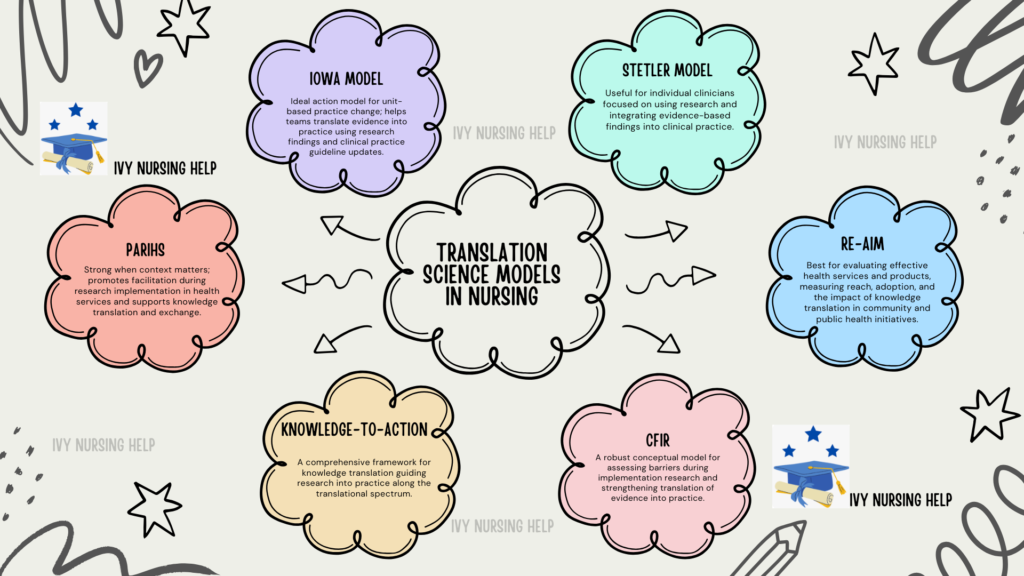
- Iowa Model: Ideal action model for unit-based practice change; helps teams translate evidence into practice using research findings and clinical practice guideline updates.
- PARIHS: Strong when context matters; promotes facilitation during research implementation in health services and supports knowledge translation and exchange.
- Knowledge-to-Action: A comprehensive framework for knowledge translation guiding research into practice along the translational spectrum.
- CFIR: A robust conceptual model for assessing barriers during implementation research and strengthening translation of evidence into practice.
- RE-AIM: Best for evaluating effective health services and products, measuring reach, adoption, and the impact of knowledge translation in community and public health initiatives.
- Stetler Model: Useful for individual clinicians focused on using research and integrating evidence-based findings into clinical practice.
- Select translation science models in nursing based on project scope, research design, and desired health promotion outcomes.
- For rapid practice recommendations, choose models that provide evidence-based pathways and strengthen the implementation of evidence-based practice.
- Organizational initiatives should prioritize frameworks that support integrating research, guide practice behaviors, and encourage the adoption of research across the nursing discipline.
- Nurse leaders and advanced practice nurses should align models with health research, clinical and translational priorities, and goals of the Department of Health and Human Services to improve the health of populations.
- Ultimately, translation science models in nursing help transform research across the continuum—from basic research to bedside care—ensuring consistent evidence based practice, stronger nursing interventions, and safer patient-centered systems.
6. Practical Steps for Applying Translation Science Models in Nursing
- Stepwise Guidance for Implementation
- Translation science models in nursing provide a structured framework for knowledge translation that helps clinicians move research into practice and close the gap between research and practice.
- Assess the problem and context: Use health services research, nursing research, and a systematic review of studies to evaluate research findings, organizational readiness, and factors influencing practice behaviors within clinical practice and public health settings.
- Engage stakeholders: Collaborate with advanced practice nurses, nursing leaders, and interdisciplinary teams to strengthen knowledge translation and exchange and promote the adoption of research across the nursing discipline.
- Select an appropriate model: Choose from established models and frameworks such as the Iowa Model, a respected model of EBP, the Stetler Model, or Promoting Action on Research Implementation in Health Services—each serving as a model to guide practice change and the implementation of evidence-based practice.
- Tailor implementation strategies: Adapt evidence-based interventions derived from basic research, clinical research, and comparative effectiveness research to support community and public health goals and health promotion.
- Pilot and evaluate: Apply strong research design principles to measure health outcomes, ensure effective research utilization, and confirm that the application of evidence reflects the best available research evidence.
- Plan sustainability: Maintain progress along the translational continuum by embedding workflows that translate evidence into practice, helping organizations provide more effective health services and products. Many initiatives are supported by the National Institutes of Health, the National Center for Advancing Translational Sciences, and the U.S. Department of Health and Human Services to improve the health of populations.
- Successful use of translation science models in nursing depends on practical tools that advance implementation science and the translation of evidence into practice.
- Audit tools: Evaluate adherence to a clinical practice guideline and reinforce evidence based practice across health services.
- Barrier assessments: Identify organizational challenges affecting implementation in health services and strengthen implementation research efforts.
- Implementation checklists: Provide an action model for implementing evidence-based practice, ensuring consistency in nursing interventions and research implementation in health services.
- Measurement instruments: Track the impact of knowledge translation, monitor effective health delivery, and support dissemination and implementation research.
- By leveraging these resources, translation science models in nursing help clinicians transform research across the clinical and translational science spectrum into sustainable improvements in nursing practice, enabling teams to develop evidence-based solutions and deliver safer, high-quality care.
7. Case Examples
- Vignette 1: Unit-Level Evidence Implementation Using the Iowa Model
- Translation science models in nursing guide frontline teams in closing the gap between research and practice through structured knowledge translation and implementation science.
- A medical-surgical unit identified rising pressure ulcer rates through health services research and internal audits. Nurse champions reviewed nursing literature, systematic review of studies, and research findings grounded in basic science and clinical research.
- Using the Iowa Model, a recognized model of evidence-based practice, the team selected evidence-based interventions aligned with a clinical practice guideline. This conceptual model served as amodel to guide practice change and strengthen nursing practice.
- Implementation strategies included staff education, risk assessment tools, and standardized nursing interventions, supporting the translation of evidence into practice and reinforcing the use of research.
- Outcomes showed improved health outcomes, fewer ulcers, and stronger practice behaviors, demonstrating the impact of knowledge translation across clinical practice.
- This vignette highlights how translation science models in nursing help advanced practice nurses integrate research evidence, translate evidence into practice, and deliver effective health services and products supported by organizations such as the National Institutes of Health and the National Academy of Medicine to improve the health of patients.
- Hospitals applied translation science models in nursing to implement a sepsis bundle across departments, emphasizing clinical and translational science and dissemination and implementation research.
- Guided by Promoting Action on Research Implementation in Health Services and CFIR—two influential theoretical models—leaders evaluated context, readiness, and barriers within implementation in health services.
- Interdisciplinary teams used research utilization, comparative effectiveness research, and best available research evidence to develop evidence-based protocols and promote theadoption of research across the nursing discipline.
- Measurement tools tracked compliance and mortality, confirming successful implementation of evidence-based practice and meaningful improvements in public health settings.
- Key lesson: Translation science models in nursing enable a scalable model of strategic change, helping systems provide more effective health services, advance health promotion, and ensure continuous progress along the translational pathway from discovery to bedside care.
8. Challenges, Future Directions, and Research Needs
- Common Challenges in Translation Science Models in Nursing
- Translation science models in nursing continue to face barriers when moving research into practice, particularly across complex health services environments.
- Measuring outcomes: Evaluating health outcomes and the impact of knowledge translation requires a strong research design, reliable metrics, and alignment with dissemination and implementation research standards.
- Sustainability: Maintaining the implementation of evidence-based practice is difficult when leadership, funding, or workforce engagement fluctuates, widening the gap between research and practice.
- Resource constraints: Limited staffing and infrastructure hinder implementation in health services, reducing the consistent use of evidence and slowingpractice change.
- Workforce training: Nurses must strengthen competencies in implementation science, knowledge translation and exchange, and research utilization to effectively translate evidence into practice. Frameworks such as the Iowa Model and Stetler Model serve as a model to guide teams toward applying the best available research evidence.
- Innovation in implementation strategies: Modern translation science models in nursing emphasize hybrid trials combining clinical research with implementation research to accelerate the translation of evidence into practice.
- Digital tools and data: Analytics improve research implementation in health services, support comparative effectiveness research, and enhance evidence-based interventions across community and public health settings.
- Equity-focused translation: Integrating health promotion and population-based approaches helps improve the health of underserved groups within the translational spectrum.
- Research priorities: Nurse scholars should advance nursing research, strengthen theoretical models, and promote integrating research across the clinical and translational science continuum.
- Efforts supported by the National Institutes of Health, the National Center for Advancing Translational Sciences, and guidance from the National Academy of Medicine encourage organizations to develop evidence-based solutions and provide more effective health services, ensuring translation science models in nursing remain central to advancing the nursing discipline.
9. Conclusion
- Summary of Key Insights
- Translation science models in nursing are essential for closing the gap between research findings and everyday clinical practice, ensuring that discoveries from translational research lead to safer, high-quality care.
- By strengthening knowledge translation andimplementation science, these frameworks help nurses move evidence into practice, elevate evidence-based practice, and improve outcomes across health services and public health environments.
- Selecting the right translation science models in nursing supports effective implementation strategies, aligns with strong research design, and encourages consistent use of clinical practice guideline recommendations.
- As thestate of science advances, healthcare organizations increasingly rely on translation science models in nursing to standardize care, optimize nursing practice, and promote sustainable improvements.
- Embedding translation science models in nursing education prepares clinicians to apply implementation research and transform innovation into measurable change.
- Nurse leaders should leverage guidance from the National Institutes of Health to integrate translational science into research agendas and professional development.
- Ultimately, widespread adoption of translation science models in nursing ensures that research continuously informs practice, driving excellence in patient care and advancing the profession.
10. FAQs: Translation Science Models in Nursing
- What Is a Translation Science Model?
- Translation science models in nursing are structured frameworks that guide the movement of research evidence from discovery to real-world clinical practice.
- Grounded in translational science and clinical and translational science, these models support knowledge translation, enabling teams to convert research findings into actionable improvements.
- Through implementation science and implementation research, translation science models in nursing promote consistent evidence-based practice and measurable health outcomes across diverse health services settings.
- Many frameworks align with priorities from the National Institutes of Health, reinforcing the state of the science and accelerating evidence into practice.
- While distinct from translation science models in nursing, several care delivery structures influence nursing practice and practice change:
- Total Patient Care: One nurse manages all aspects of care, supporting strong integration of clinical practice guideline recommendations.
- Primary Nursing: Encourages accountability and continuity, helping translate research into practice.
- Team Nursing: Promotes collaboration and efficient implementation strategies grounded in health services research.
- Functional Nursing: Task-focused care that can benefit from a model of evidence-based practice to maintain quality.
- Combining care models with translation science models in nursing strengthens the connection between research and practice and improves outcomes in public health environments.
- Translational research within nursing focuses on applying discoveries from nursing research to improve care delivery.
- Translation science models in nursing ensure that innovations move efficiently from theory to bedside, advancing clinical and translational initiatives.
- This process supports safer interventions, enhances evidence-based practice, and encourages sustainable improvements in health services.
- Informatics frameworks complement translation science models in nursing by optimizing data-driven decision-making:
- Systems Model: Enhances workflow and supportsresearch design.
- Data-Information-Knowledge-Wisdom (DIKW): Strengthens knowledge translation and informed decisions.
- Sociotechnical Model: Integrates technology with human factors to improve clinical practice.
- Clinical Decision Support Model: Applies research evidence at the point of care.
- Information Processing Model: Facilitates rapid adoption of innovations from dissemination research.
- Together, informatics and translation science models in nursing accelerate the application of science, bridging gaps between discovery and everyday patient care.

